Using Estimation to Narrow MCQ Options in Math
Using estimation to narrow MCQ options in math is a powerful exam skill, because many mathematics MCQs can be partly solved without doing the full calculation at all. By rounding numbers quickly and working out a rough answer, you can often rule out two or even three options that are far too large, too small, or otherwise impossible. That leaves you with a much smaller choice, and sometimes the rough answer is close enough to identify the correct option outright. Estimation also acts as a safety check: if your exact calculation gives a wildly different result from your estimate, you know something went wrong. This guide shows you how to estimate sensibly, when to trust an estimate, and how to combine it with elimination for faster, more accurate mathematics MCQs.
What Estimation Really Means in an Exam
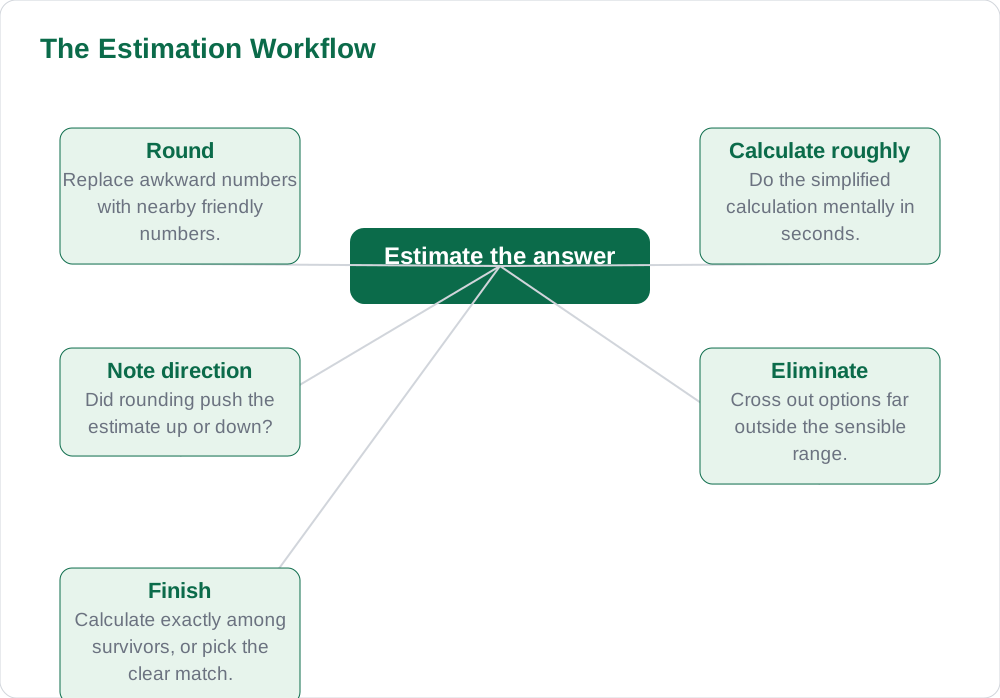
Estimation means replacing awkward numbers with nearby round numbers that are easy to work with mentally, so you can find an approximate answer in seconds. For example, a practice calculation involving 48 multiplied by 19 can be estimated as 50 multiplied by 20, giving roughly 1000, which tells you the exact answer must be somewhat below 1000. That single fact may be enough to eliminate options that are far above or below that range. Estimation is not guessing: it is a controlled approximation with a clear direction, because you know whether rounding up or down pushed your estimate higher or lower than the true value, and you can adjust for that.
The key skill is choosing round numbers that are close enough to be useful but simple enough to compute mentally. Rounding to one significant figure usually works well for a first estimate, and you can refine it if the options are close together. Do not round so aggressively that your estimate becomes meaningless, such as turning every number into the nearest hundred when the options differ by only tens. Practise estimation on ordinary homework problems, not just in exams, so that rounding choices become quick and automatic. Over time you will sense instantly whether an answer should be in the tens, hundreds, or thousands, which is often all an MCQ needs. Find more math strategies on the blog.
Rounding to Rule Out Impossible Options
Start every numerical MCQ with a quick estimate before you reach for full working. Round each number to a friendly value, do the simplified calculation mentally, and note the rough answer and its direction. Then look at the options and cross out any that fall far outside a sensible range around your estimate. Many mathematics MCQ options are deliberately spread out, with one or two absurd values included as distractors, and those fall immediately to a good estimate. Even when options are closer together, estimation usually removes at least one, which raises your odds and focuses your exact calculation on the survivors.
Be careful to keep track of whether your rounding pushed the estimate up or down. If you rounded both numbers up, your estimate is higher than the true answer, so the correct option should sit below it, and vice versa. When you round one number up and one down, the errors partly cancel, and the estimate may be quite close to the truth. Noting this direction prevents a common mistake, which is treating the estimate as exact and picking the option nearest to it when the true answer lies slightly to one side. Estimation narrows the field; exact working, when needed, makes the final choice. See The Elimination Technique for MCQs: Removing Wrong Options for the elimination steps.
Estimating With Fractions, Percentages, and Decimals
Estimation works for more than whole-number multiplication. For percentages, round the percentage and the base number to friendly values: a practice example like 19 percent of 248 can be estimated as 20 percent of 250, which is 50, so the true answer must be a little below 50. For fractions, replace awkward fractions with nearby simple ones, such as treating seven eighths as close to one, or three sevenths as close to one half. For decimal problems, count decimal places carefully, because a misplaced decimal is the most common estimation error, and a quick place-value check can catch an answer that is ten times too large or too small.
Division estimates work by rounding the divisor to a number that divides easily, then adjusting for the direction of rounding. If you round the divisor up, your estimated quotient is too small, so the true answer is larger, and the reverse holds when you round down. Square roots can be estimated by finding the two perfect squares the number sits between, which narrows the answer to a small range. These techniques feel slow when you first learn them, but after a week of daily practice they take only seconds, and they turn many multi-step MCQ calculations into short, confident decisions. The solved notes offer further practice material.
When Estimation Alone Is Enough
Sometimes estimation identifies the answer without any exact calculation, and recognising those moments saves valuable exam time. If your estimate is 480 and the options are 48, 480, 4800, and 9600, the correct answer is almost certainly 480, since the other values differ by whole place values. Similarly, if an estimate shows an answer must be negative while three options are positive, the negative option wins immediately. Trust estimation in these clear-cut cases, but verify with a quick sanity check: does the sign make sense, is the place value right, and does the unit match? Those three checks take seconds and confirm what estimation already told you.
When options are close together, estimation cannot finish the job alone, and that is fine: its role then is to remove the outliers and guide your exact working. Do the full calculation only for the remaining options, checking your working against the estimate as you go. If your exact answer lands far from your estimate, rework the calculation before trusting it, because the estimate is usually right about the rough size. This two-stage approach, estimate then verify, is faster than calculating blindly and far safer than guessing, and it is exactly how strong mathematics students handle MCQ papers under time pressure. Also read Pacing MCQs: How Much Time Per Question.
Practising Estimation Until It Is Fast
Build estimation into everyday practice by estimating the answer to every homework calculation before solving it exactly. Write the estimate beside your working, then compare it with the exact answer and note how close you came. This daily habit sharpens your rounding judgement and teaches you which roundings are reliable and which mislead. Time yourself occasionally: a good estimation for a typical MCQ should take under fifteen seconds, and if it takes longer, your rounding choices are probably too complicated. Simplify them, and accept a rougher estimate, since its job is only to narrow options, not to replace exact working entirely.
In the exam, use estimation as your first step on every numerical MCQ, even ones you find easy, because it catches slips in your exact working. If a question involves several steps, estimate the final result roughly from the start, and check intermediate steps against that expectation as you go. Keep rough working tidy so you can re-check a step without redoing the whole question. Students who estimate routinely report fewer careless errors and more time left at the end of the paper, which they can spend revisiting marked questions. That extra time, earned by seconds saved on each question, is often worth several marks by itself. Track your progress with Keeping an MCQ Error Log for Repeated Mistakes.
AI Help: Muse AI
Muse AI is Meta's personal AI assistant, and it can help you practise estimation for mathematics MCQs. For example, you can ask it to give you quick estimation drills, or to explain how rounding a number up or down changes an estimated answer.
Join Muse with invite code LTGSWD — in the Muse app, go to Settings > Redeem token and enter the code.
Disclosure: LTGSWD is the author's Muse invite code.
Muse AI does not give official STBB answers — always verify against your Sindh Textbook Board book and your teacher.
5 key points you must know
- Estimate every numerical MCQ first by rounding to friendly numbers you can handle mentally.
- Note whether rounding pushed your estimate up or down, so you know which side the true answer lies on.
- Eliminate options far outside the sensible range before doing exact calculation.
- Use estimation as a safety check on exact working, catching slips in sign and place value.
- Practise estimation daily on homework so it takes under fifteen seconds per question.
Frequently asked questions
What if my estimate falls exactly between two options?
Then estimation has done its job by removing the other options, and you should calculate exactly to choose between the final two. Use the estimate to check your exact working: if the exact answer lands far from the estimate, rework the calculation before trusting it.
Is estimation risky if I round badly?
Bad rounding gives a useless estimate, so keep roundings close to the original numbers, usually to one significant figure. Practise on homework problems and compare estimates with exact answers to learn which roundings stay reliable.
Should I estimate on easy questions too?
Yes, because estimation catches careless slips even on easy questions, and it costs only seconds. It also confirms your exact answer, giving you confidence to move on quickly instead of double-checking everything at the end.
How do I estimate percentages quickly?
Round the percentage and the base to friendly numbers, then find the simple percentage mentally. For example, estimate 19 percent of 248 as 20 percent of 250, which is 50, then remember the true answer is slightly lower.
Solved notes — preview free
These guides work best with the solved exercises. Preview the solved notes free on this website — 119 solved notes for Classes 6–10 in Sindhi, Urdu, English and Arabic medium. Or browse the full solved notes catalogue for your class and medium. New solved notes are added regularly — check the catalogue for coming-soon books.