Keeping an MCQ Error Log for Repeated Mistakes

Keeping an MCQ error log for repeated mistakes is the fastest way to turn practice papers into real improvement, because it shows you exactly where your marks are leaking instead of leaving you with a vague feeling that you need to study harder. Most students repeat the same mistakes across papers: the same misread words, the same confused concepts, the same careless calculation slips. Without a log, those patterns stay invisible, and revision stays generic. With a log, you can see at a glance that, for example, most of your errors come from two topics or one bad habit, and you can target exactly that. This guide shows you how to set up a simple error log, what to record for each mistake, and how to turn the log into a revision plan that actually raises your score.
Why an Error Log Beats More Practice Papers
Doing more practice papers without reviewing mistakes is like taking a test repeatedly without ever learning the answers: the score may wobble, but the underlying weaknesses stay put. An error log breaks that cycle by forcing you to confront each mistake once, understand it, and record it in a form you can revisit. The act of writing down why you got a question wrong is itself powerful learning, because it turns a passive error into an active lesson. Students who log errors often find their scores rising faster with fewer practice papers, since every paper now teaches them something specific instead of merely measuring them.
An error log also protects your confidence, because it replaces vague anxiety with concrete facts. Instead of thinking that you are bad at a subject, you can see that you lost five marks to misreading, three to one topic, and two to calculation slips, and each of those has a clear fix. That clarity makes revision feel manageable and progress feel visible, as logged error types shrink week by week. Keep the log simple enough to maintain daily, since a complicated system you abandon after three days helps nobody. A notebook or a simple document with a few columns is all you need. More study methods are on the blog.
What to Record for Every Mistake
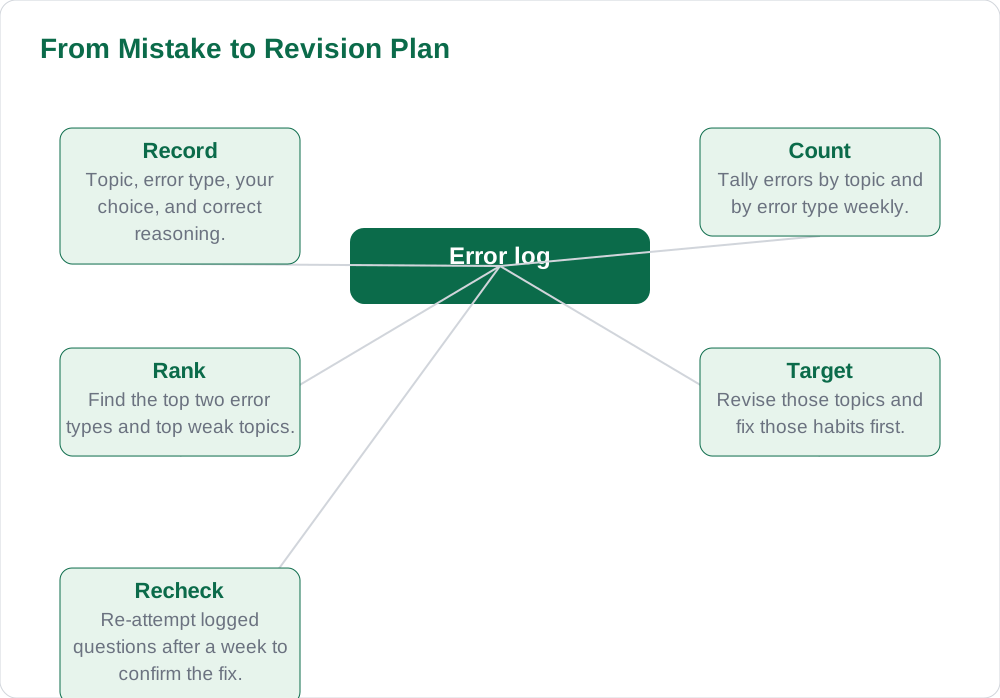
For each wrong MCQ, record five things: the topic, the question type, what you chose and why, the correct answer and why, and the error category. The error category is the most important column, so keep it to a short list: knowledge gap, misread stem, misread option, calculation slip, diagram misreading, rushing, or guessing. Forcing each mistake into one category feels strict, but it is exactly what reveals your patterns. If you cannot decide a category, write the reason in your own words first, then pick the closest category, since the pattern matters more than perfect labelling. Add the date and the paper or chapter, so you can track whether an error type is improving over time.
Also record the correct reasoning in your own words, not just the correct option letter. Writing the reason cements the correction and gives you something useful to reread during revision. If the mistake came from a misunderstood concept, write the correct concept briefly and note the textbook page or lesson where it appears. If it came from misreading, copy the exact word you missed, such as NOT or except, so the trap stays visible. This short entry takes about a minute per question, and that minute is the most valuable minute of your practice session, because it converts an error into a permanent lesson. See Reading MCQ Stems Carefully: Negatives and Traps for misreading patterns.
Finding Patterns by Topic and Error Type
Once you have logged twenty or thirty mistakes, step back and count them by topic and by error type. The counts usually surprise students: a subject they thought was weak overall may show errors concentrated in just one chapter, while a subject they felt confident about may leak marks through misreading alone. Rank your error types from most frequent to least, and rank your topics the same way. Your revision plan then writes itself: the top error type gets a habit fix, and the top topics get focused study sessions. This data-driven approach beats revising everything equally, because it spends your limited time where the marks actually are.
Look for repeated mistakes on the same concept, since a mistake that appears twice is a signal, not a coincidence. If you miss the same idea in different questions, your understanding of that idea is shaky, and it needs reteaching from the textbook, not just another practice question. Similarly, if the same trap word fools you repeatedly, make a personal warning list of your trap words and review it before each paper. Patterns also reveal strengths: topics with no logged errors need only light maintenance revision, freeing time for the weak spots. Review your log weekly, update the rankings, and let the new rankings steer the next week's revision. The solved notes help with targeted topic revision.
Turning the Log Into Weekly Revision
A log that is never reread is just a diary, so build a weekly review into your routine. Once a week, read through the week's new entries, update your rankings, and choose two targets for the coming week: one topic to restudy and one habit to fix. For a topic target, restudy the lesson from the textbook, work fresh questions on that topic, and re-attempt your logged questions on it after a few days to check the fix held. For a habit target, such as misreading stems, practise a focused drill, like underlining trap words on every practice question that week. Two targets per week is enough: more targets dilute your effort and the log's power.
Space your re-attempts deliberately, since re-answering a logged question immediately only tests short-term memory. Wait several days, then try the question again without looking at your log entry, and see whether you now answer correctly for the right reason. If you still miss it, the concept needs deeper work, perhaps a teacher's explanation or a different textbook section, and that itself is useful information. Celebrate shrinking error counts openly, even small ones, because visible progress sustains the logging habit through weeks when scores feel flat. The log is a long game: its payoff grows as patterns accumulate and fixes compound. For pacing your revision, see Pacing MCQs: How Much Time Per Question.
Keeping the Habit Alive Until the Exam
Error logging fails when it feels like extra homework, so keep it fast, rewarding, and part of your existing practice rather than a separate chore. Log mistakes immediately after marking a paper, while the reasoning is fresh, and cap the entry at a few lines so the whole log takes ten minutes at most. Use whatever format you will actually maintain: a notebook, a phone note, or a simple document, since the best format is the one you use. If you skip logging for a day, resume the next day without guilt, because a log with gaps still beats no log, and perfectionism about the log itself is a trap to avoid.
In the final week before exams, your log becomes your most valuable revision tool. Reread the top error patterns and the trickiest logged questions, rather than starting new topics, since the log contains exactly the mistakes you are most likely to repeat under pressure. Make a one-page summary of your personal traps and weak topics from the log, and glance at it the night before each paper. That summary is personalised in a way no generic revision guide can match, because it was built from your own errors. Students who arrive at exams with such a summary report feeling calmer and more prepared, because they know their weaknesses and have already worked on them. The books page lists the textbooks to revise from.
AI Help: Muse AI
Muse AI is Meta's personal AI assistant, and it can help you keep an MCQ error log. For example, you can ask it to explain the correct reasoning for a logged mistake in simple words, or to create fresh practice questions on your weakest logged topics.
Join Muse with invite code LTGSWD — in the Muse app, go to Settings > Redeem token and enter the code.
Disclosure: LTGSWD is the author's Muse invite code.
Muse AI does not give official STBB answers — always verify against your Sindh Textbook Board book and your teacher.
5 key points you must know
- Log every wrong MCQ with topic, error type, your reasoning, and the correct reasoning.
- Use a short error-category list so patterns by topic and habit become visible.
- Review the log weekly and pick two targets: one topic and one habit.
- Re-attempt logged questions after several days to confirm the fix really held.
- Use the log as your final-week revision guide, summarised on one page.
Frequently asked questions
How long should logging take per practice paper?
About a minute per wrong question, or roughly ten minutes for a typical paper. That time pays for itself, since it converts each error into a lesson and prevents the same mistake from recurring across many papers.
What if I do not know why I got a question wrong?
Then write down what you chose and what confused you, and check the textbook or ask your teacher for the correct reasoning. An honestly recorded unknown is still useful, because it flags a topic that needs reteaching rather than more guessing.
Should I log questions I guessed correctly?
Yes, log lucky guesses too, especially blind ones, since they hide knowledge gaps that the next paper may expose. Mark them as guesses in the log so they count separately from confident correct answers.
When should I stop logging and just revise?
Never fully stop, but shift the balance near exams: log briefly, and spend most time rereading the log's patterns and re-attempting logged questions. The log becomes the revision plan, not a distraction from it.
Solved notes — preview free
These guides work best with the solved exercises. Preview the solved notes free on this website — 119 solved notes for Classes 6–10 in Sindhi, Urdu, English and Arabic medium. Or browse the full solved notes catalogue for your class and medium. New solved notes are added regularly — check the catalogue for coming-soon books.