The Elimination Technique for MCQs: Removing Wrong Options
The elimination technique for MCQs is one of the most reliable ways to raise your score without learning any new facts. Instead of hunting for the right answer straight away, you start by removing the options that are clearly wrong. Most multiple-choice questions in Sindh board exams give you four options, and usually at least one or two of them are easy to rule out if you read carefully. Once you cross out the wrong options, your choice becomes much simpler, and even a guess becomes an educated one. This method works in every subject, from science and mathematics to Islamiat and English, because it turns a four-way gamble into a focused comparison. In this guide you will learn how to eliminate wrong options systematically, how to compare the last two options, and how to practise the technique so it becomes automatic in the exam hall.
Why Elimination Beats Guessing
Guessing from four options gives you only a one-in-four chance, but eliminating two wrong options doubles your odds to one in two before you even decide. That simple shift matters a lot across a whole paper, where dozens of questions add up. Elimination also forces you to think actively about each option instead of picking the first one that looks familiar. When you ask why an option is wrong, you use your real knowledge, even if that knowledge feels incomplete. A student who remembers only part of a lesson can often still spot an option that contradicts what they know, and that is enough to remove it from the race.
Elimination also protects you from the most common MCQ trap, which is the attractive distractor. Test setters design one option that sounds correct because it uses familiar words from the lesson, even though it states the wrong idea. If you simply choose what feels familiar, you fall for it. If you test each option against the question, the attractive distractor often fails on a small detail, such as a wrong unit, a reversed cause and effect, or a term used in the wrong context. Practising elimination trains your eye to catch those small details. Over time, you will notice that many questions practically solve themselves once the distractors are gone. For more solved practice material, visit the solved notes and the books page.
Step One: Read the Question Before the Options
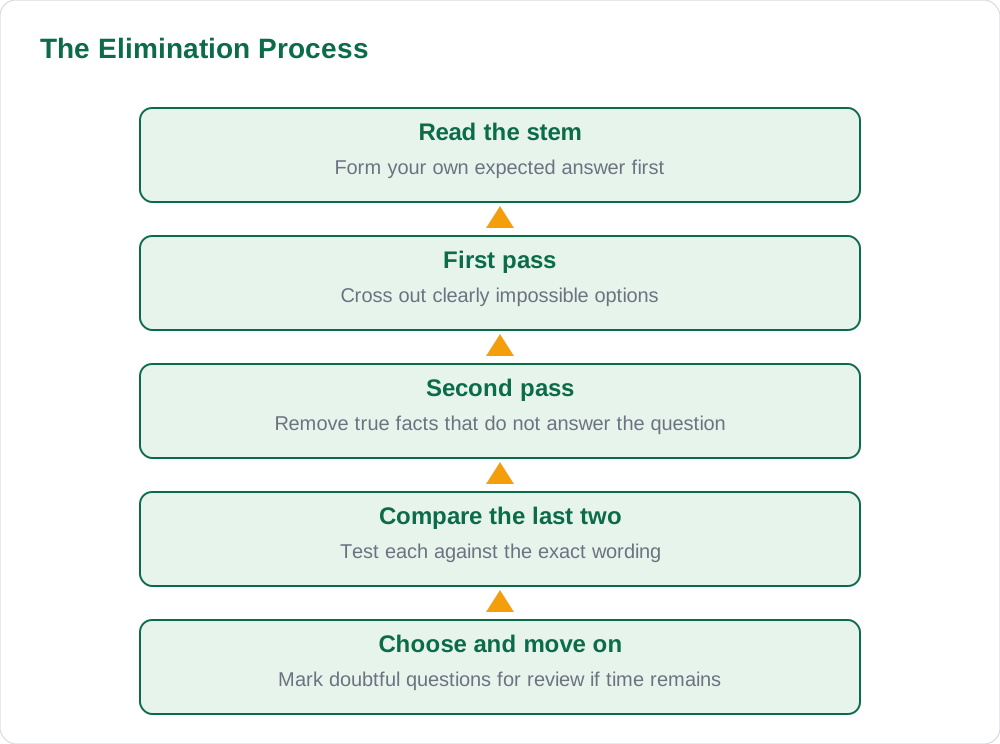
Always read the question stem fully before you look at the options, and try to form your own expected answer in your head first. This habit stops the options from steering your thinking. When you already have an idea of what the answer should be, wrong options stand out more clearly because they clash with your expectation. If you cannot form a full answer, even a rough idea helps, such as knowing the answer should be a process, a number in a certain range, or a name from a particular chapter. Cover the options with your hand while you read the stem if you find yourself jumping to the first familiar choice.
Pay close attention to the exact wording of the stem, because one word can change everything. Words like best, most, mainly, and first narrow what the question wants, and a careless reader may eliminate the correct option by mistake. Read the stem twice if it is long or complicated, and underline key words in your mind. This careful reading is itself part of elimination, since many students eliminate wrong options correctly but then pick an option that answers a different question from the one asked. Slow down for ten seconds here and you will save yourself from several avoidable mistakes. You can find related study methods in Reading MCQ Stems Carefully: Negatives and Traps.
Step Two: Remove the Clearly Wrong Options
Go through the options one by one and ask a single question about each: does this contradict something I know for sure? If it does, cross it out mentally and move on. Start with the easiest removals, such as options that are factually impossible, use the wrong unit, or belong to a different topic altogether. Do not worry about the options you are unsure of yet; elimination works in rounds, and the first round only needs to remove the obvious ones. Many students waste time agonising over every option at once, but a calm first pass usually removes one or two options quickly and makes the question feel far less intimidating.
Be careful with options that are true statements but do not answer the question. A classic distractor is a fact from the same chapter that has nothing to do with what was asked, and it fools students who only check whether the statement is true. Always test each option against the question, not against the chapter in general. Ask yourself: does this option answer exactly what was asked, in the way that was asked? If it answers a different question, eliminate it even if it is a true fact. This distinction separates average MCQ performers from strong ones, and it is a skill that improves quickly with practice. See also Pacing MCQs: How Much Time Per Question.
Step Three: Compare the Remaining Pair Carefully
Once two options remain, slow down and compare them word by word. In many questions, the last two options differ by only one detail, and that detail is the whole test. One option may say increase while the other says decrease, one may name the correct process while the other names a similar but different one, or one may be too extreme while the other is properly qualified. Read both options fully, then test each one by putting it back into the question as a complete sentence. The option that makes a correct, complete sentence is usually your answer, while the other will sound slightly off when read in full.
Watch out for absolute words in the remaining pair, such as always, never, all, and none. Such words make a statement very easy to disprove, because a single exception breaks it. Qualified options with words like usually, often, or mainly are more likely to be correct, though this is a tendency and not a rule. Also check for options that are partly correct but incomplete; a question asking for the best answer wants the most complete correct option, not merely a correct fragment. When the pair still feels equal after careful comparison, choose the option that matches your lesson most closely and move on rather than burning five minutes on one mark. The blog has more MCQ strategy guides to practise with.
Practising Elimination Until It Is Automatic
Elimination becomes fast only through practice, so build it into your daily revision. When you attempt practice questions, do not just circle the answer; write a short note beside each option explaining why it is wrong or right. This habit feels slow at first, but it teaches you the patterns that test setters use, and within a few weeks you will eliminate options in seconds. Review your mistakes too: when you eliminate the correct option by mistake, find out exactly which fact or word misled you, because that misunderstanding is worth fixing before the exam. A short daily set of twenty practice questions, done this way, beats a hundred questions answered carelessly.
In the exam itself, use elimination even on questions you think you know, because it acts as a safety check against misreading. If your first-choice answer survives elimination of the other three, your confidence is justified. If elimination removes your first choice, you have caught a mistake before it cost you a mark. Keep your pace sensible: spend no more than a minute or two on any single question in the first pass, mark the doubtful ones, and return to them after finishing the rest of the paper. That second look, with a calmer mind, often resolves the questions that felt impossible the first time. For pacing help, read Guessing vs Skipping in MCQs: A Calm Strategy.
AI Help: Muse AI
Muse AI is Meta's personal AI assistant, and it can help you practise the elimination technique for MCQs. For example, you can ask it to explain why a particular practice option is wrong and to give you fresh practice questions where you must eliminate two options before choosing.
Join Muse with invite code LTGSWD — in the Muse app, go to Settings > Redeem token and enter the code.
Disclosure: LTGSWD is the author's Muse invite code.
Muse AI does not give official STBB answers — always verify against your Sindh Textbook Board book and your teacher.
5 key points you must know
- Read the stem first and form your own expected answer before looking at the options.
- Eliminate clearly wrong options in a first pass, then remove true facts that do not answer the question.
- Compare the final two options word by word, since they usually differ by one key detail.
- Use elimination as a safety check even on questions you think you already know.
- Practise by writing why each option is wrong, not just by circling the answer.
Frequently asked questions
What if I cannot eliminate any option?
Then re-read the stem slowly, because you may have missed a key word. Recall one fact from the lesson, even a small one, and test each option against it. If nothing works, make your best educated guess, mark the question, and return to it later with a fresh mind.
Should I eliminate options on every question, even easy ones?
Yes, a quick elimination pass takes only seconds on easy questions and catches misreading. If your expected answer is among the options and the other three are clearly wrong, you can answer with confidence and move on quickly.
What is the biggest elimination mistake students make?
Eliminating the correct option because of a misunderstood word in the stem or option. Always re-read the exact wording before crossing out an option you are unsure about, and only eliminate options you have a real reason to reject.
How does elimination help when I have to guess?
It turns a blind guess into an educated one. Removing even one option raises your chance from one in four to one in three, and removing two raises it to one in two, which adds up to many extra marks across a full paper.
Solved notes — preview free
These guides work best with the solved exercises. Preview the solved notes free on this website — 119 solved notes for Classes 6–10 in Sindhi, Urdu, English and Arabic medium. Or browse the full solved notes catalogue for your class and medium. New solved notes are added regularly — check the catalogue for coming-soon books.