Food Chains and Ecosystems: What Happens When One Link Changes
Every living thing needs energy, and in nature that energy moves from one living thing to another through feeding. Plants capture energy from sunlight and use it to grow. Animals that eat plants gain that energy. Animals that eat those animals gain it next. That chain of feeding is called a food chain, and the place where all these chains connect, with soil, water, and air, is called an ecosystem. A garden, a field, a pond, and a riverbank are all ecosystems, each with its own food chains. This article uses local, observable examples to show how food chains work and what happens when one link changes. You will learn why removing one animal or plant can affect many others, and why protecting a whole ecosystem matters more than protecting one species alone. For more study help, see the [solved notes](/books.html) and the [books page](/books.html).
Producers, Consumers, and Decomposers
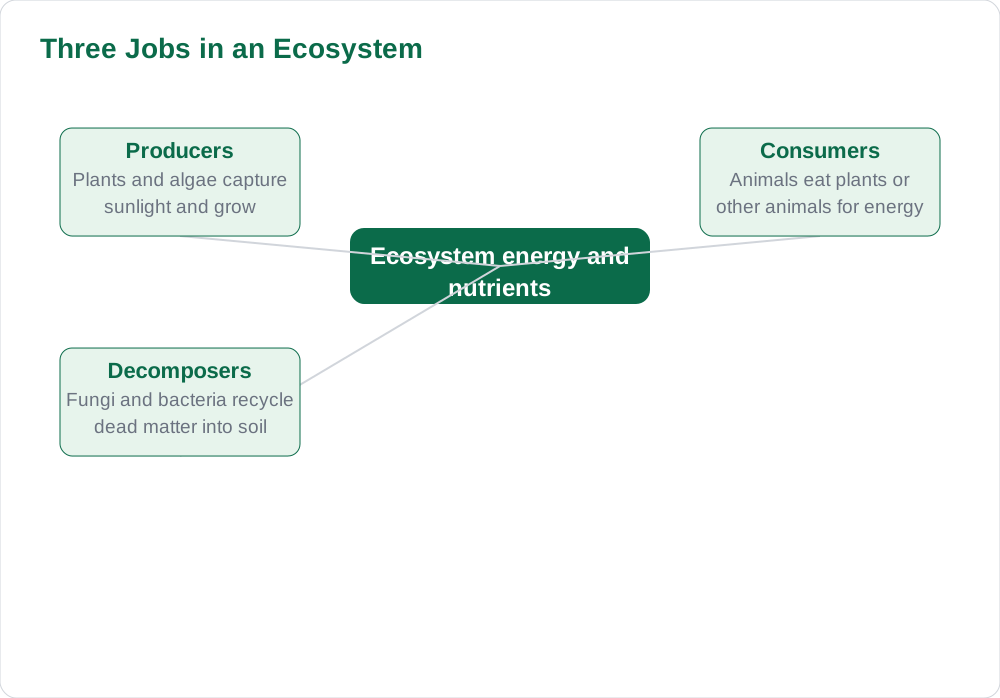
Producers are living things that make their own food, usually using sunlight. Green plants, algae in a pond, and crops in a field are producers. They use sunlight, water, and air to grow, and they store energy in their leaves, stems, seeds, and roots. Without producers, almost no other life could survive, because the energy that animals need starts with them. When you look at a field of wheat or a garden of vegetables, you are looking at the producers that support the whole local food web.
Consumers are living things that eat other living things. Herbivores eat plants, carnivores eat animals, and omnivores eat both. A goat eating grass is a herbivore, a cat hunting a mouse is a carnivore, and a person eating both vegetables and meat is an omnivore. Decomposers, such as fungi and many bacteria, break down dead plants and animals and return nutrients to the soil. Without decomposers, dead leaves would pile up and the soil would run out of nutrients. A complete ecosystem needs all three groups working together.
- Producers make their own food using sunlight, water, and air.
- Herbivores eat plants, carnivores eat animals, omnivores eat both.
- Decomposers break down dead matter and return nutrients to soil.
- All three groups are needed for a healthy ecosystem.
A Local Food Chain, Step by Step
A simple local food chain might be grass, goat, and human. Grass is the producer. A goat eats the grass and gains energy from it. A person who eats goat meat gains some of that energy next. Another chain might be wheat, mouse, and cat. Wheat grows in a field, a mouse eats the grain, and a cat hunts the mouse. In a pond, algae are eaten by small fish, which are eaten by larger fish, which may be eaten by a bird. Each step is called a link, and the arrow in a food chain diagram points from the food to the eater, showing where the energy goes.
A food chain is a simple model, not a complete picture. In real life, most animals eat more than one kind of food, so chains join into a food web. A goat may eat grass, leaves, and crop plants. A cat may hunt mice, birds, and lizards. A bird may eat insects, seeds, and fruit. When you draw a food web, you show many connected chains at once, which is closer to what really happens. For a school diagram, start with one clear chain, then add one or two extra links to show the web. Keep arrows pointing from food to eater, and label each living thing with its common name.
- Grass to goat to human is a simple local food chain.
- Wheat to mouse to cat is another clear example.
- Arrows point from the food to the eater, showing energy flow.
- A food web joins many chains because most animals eat more than one food.
What Happens When One Link Changes
When one link in a food chain changes, the effects spread to other links. If a field is sprayed and insects die, birds that eat insects lose food and may leave or lay fewer eggs. If goats eat too much grass in one area, the soil loses cover, the ground dries out, and fewer plants grow the next season. If predators are removed, herbivores may multiply quickly and eat far more plants than the area can regrow. Each of these changes shows that a food chain is not a list of separate animals, but a connected system where each link affects the others.
The size of the effect depends on how many other food sources the animals have. If a bird eats many kinds of insects, losing one insect type may matter less. If a predator eats only one kind of prey, losing that prey matters a great deal. That is why a food web is more stable than a single chain: more connections give more backup. In class discussions, pupils can test this by drawing a web, removing one link, and predicting which animals would struggle most. That prediction exercise builds the same thinking used in the article on observation and hypothesis, but applied to living things.
- Removing insects can leave insect-eating birds without food.
- Overgrazing can strip plant cover and damage the soil.
- Removing predators can let herbivores multiply and overeat plants.
- A food web with many links is more stable than a single chain.
Habitats, Balance, and Human Impact
A habitat is the place where a living thing lives, with the food, water, shelter, and conditions it needs. A pond habitat gives fish water, food, and hiding places among plants. A field habitat gives mice grain, shelter in crop rows, and open ground to run. When a habitat changes, the animals and plants that depend on it must move, adapt, or decline. Cutting down trees removes shade, nesting places, and food for birds and insects. Draining a pond removes water for fish, frogs, and the birds that visit it. Pollution can harm a habitat even when the place looks unchanged, because dirty water or soil affects the health of living things.
People affect ecosystems in many ways, both harmful and helpful. Farming, building, and waste can damage habitats, but careful habits can protect them. Leaving field edges with wild plants gives insects and birds food and shelter. Not dumping waste in water keeps ponds and rivers healthier. Planting trees, sorting waste, and reusing materials reduce pressure on habitats. These actions are connected to the article on recycling at school, because waste and resources are part of the same ecosystem story. Pupils can help by observing their local habitat, recording what lives there, and noticing changes over the seasons.
- A habitat provides food, water, shelter, and suitable conditions.
- Cutting trees or draining ponds removes habitat and food.
- Pollution can harm living things even when a place looks unchanged.
- Protecting field edges, water, and trees helps whole ecosystems.
Observing and Protecting Your Local Ecosystem
You can study an ecosystem without disturbing it. Choose a small area, such as a school garden, a field edge, or a pond bank, and visit it at the same time each week. Record what you see: which plants are growing, which insects visit, which birds appear, and whether the soil is wet or dry. Draw a simple food chain from your observations, then add extra links as you notice more feeding relationships. Photographs or neat sketches help you compare visits. Over a month, you may notice that some insects appear only when certain flowers open, or that birds visit more often after rain. Those patterns are real ecological observations.
Protection starts with respect and small actions. Do not pull up plants or chase animals during observations. Keep waste out of water and soil, and sort rubbish so it can be reused or recycled. If your school has a garden, help care for it by watering, weeding, and leaving some wild corners for insects. Share what you observe with classmates so the class builds a shared record of the local ecosystem. That record is more valuable than a copied diagram, because it comes from your own place and your own careful looking. For more on careful recording, see the science write-up guide.
- Visit the same small area weekly and record plants, insects, and birds.
- Build a food chain from your own observations, then add web links.
- Observe without disturbing plants or animals.
- Care for gardens, keep water clean, and sort waste to protect habitats.
AI Help: Muse AI
Muse AI is Meta's personal AI assistant, and it can help you build a food chain from your local observations and explain what might happen if one link changes.
Join Muse with invite code LTGSWD — in the Muse app, go to Settings > Redeem token and enter the code.
Disclosure: LTGSWD is the author's Muse invite code.
Muse AI does not give official STBB answers — always verify against your Sindh Textbook Board book and your teacher.
5 key points you must know
- Producers capture sunlight; consumers eat plants or animals; decomposers recycle dead matter.
- Food chain arrows point from food to eater, showing where energy flows.
- Changing one link affects other links in the chain and the wider web.
- A habitat must provide food, water, shelter, and suitable conditions.
- Careful local observation is the best way to learn ecology.
Frequently asked questions
What is the difference between a food chain and a food web?
A food chain is one line of feeding, such as grass to goat to human. A food web joins many chains because most animals eat more than one kind of food. The web is closer to real life and more stable because it has backup links.
Why do food chain arrows point from food to eater?
The arrow shows where energy goes. Grass holds energy from sunlight, and the goat gains some of that energy by eating the grass. The arrow points from the source of energy to the animal that receives it.
What happens if predators are removed from an area?
Herbivores may multiply quickly without predators to limit them, and they may eat more plants than the area can regrow. That can damage the plant cover, the soil, and the habitat for other animals.
What do decomposers do, and why do they matter?
Decomposers such as fungi and bacteria break down dead plants and animals and return nutrients to the soil. Without them, nutrients would stay locked in dead matter and new plants would struggle to grow.
How can pupils study an ecosystem without harming it?
Observe a small area weekly, record what you see, and draw food chains from your own notes. Do not pull plants, chase animals, or leave waste. Photographs and sketches let you compare visits without disturbing the habitat.
Solved notes — preview free
These guides work best with the solved exercises. Preview the solved notes free on this website — 119 solved notes for Classes 6–10 in Sindhi, Urdu, English and Arabic medium. Or browse the full solved notes catalogue for your class and medium. New solved notes are added regularly — check the catalogue for coming-soon books.