From Observation to Hypothesis: The Science Method for School Pupils
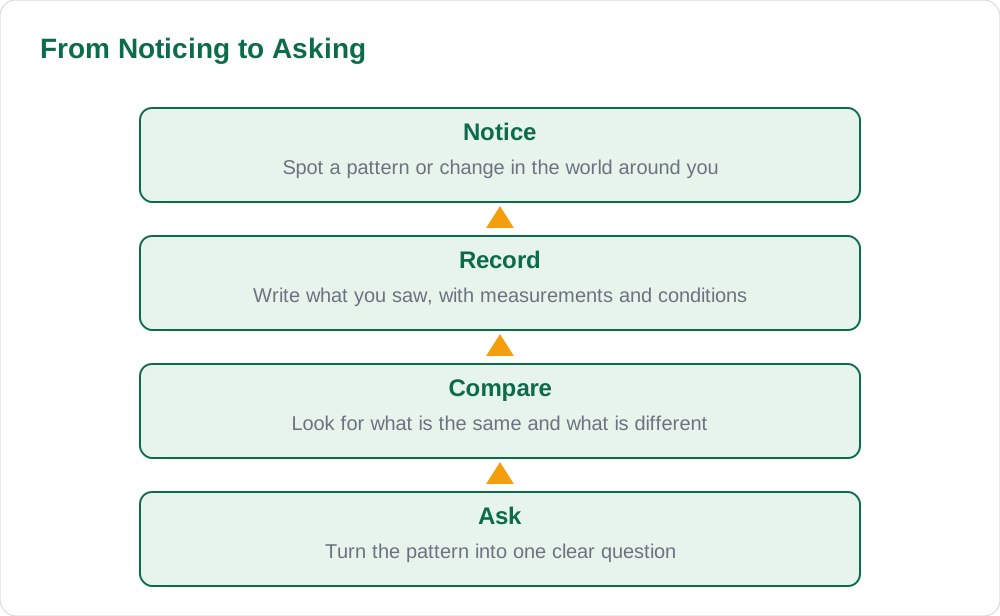
Science does not begin with a complicated experiment. It begins with looking carefully at the world and noticing something worth asking about. A pupil sees that plants near a window grow taller than plants in a dark corner, or that a wet towel dries faster in the sun than in shade. Those small observations are the starting point of real science. The next step is to turn what you noticed into a question, and then into a hypothesis, which is a clear, testable idea about why something happens. This article shows how to move from observation to hypothesis in a way that works for school science, homework, and class experiments. You will learn what makes a hypothesis strong, what makes one weak, and how to practise the skill with ordinary things around you. For more structured practice, see the [solved notes](/books.html) and the [books page](/books.html).
What Good Observation Really Means
Observation in science means watching with attention and recording what you actually see, hear, smell, or measure, without jumping to an explanation. A good observer notices details that other people miss: how far a shadow moves in one hour, which part of a leaf turns yellow first, or how many drops of water a paper towel can hold before it tears. The habit is to describe first and explain later. Instead of saying the plant looks sick, a careful observer writes that the lower leaves turned yellow after three days without water, while the upper leaves stayed green. That kind of record is useful because someone else can read it, repeat the observation, and check whether the same thing happens again.
In class, observation becomes stronger when you use all the tools available: your eyes, a ruler, a clock, a thermometer, and a notebook. Measure where you can, because numbers are easier to compare than vague words like big or fast. Write the date, the place, and the conditions, such as whether the day was sunny or cloudy. A short table in your notebook works well for repeated observations. If you are working through a chapter, the solved notes can help you see how textbook questions expect observations to be written.
- Describe what you see before you explain why it happens.
- Measure with a ruler, clock, or thermometer whenever possible.
- Record the date, place, and conditions for every observation.
- Use short tables so repeated observations are easy to compare.
Turning a Question into a Hypothesis
A question becomes useful in science when it can be tested. A question such as why do plants grow is too broad to test in one lesson. A better question is narrower: do plants grow taller in sunlight than in shade over two weeks. From that question, a hypothesis gives a predicted answer that you can check. For example, plants kept in sunlight will grow taller than plants kept in shade over two weeks because sunlight helps them make food. Notice the structure: the hypothesis names what changes, what is measured, and a reason that can be discussed. It does not have to be correct to be useful. A hypothesis that turns out to be wrong still teaches something, because the test shows what does not explain the pattern.
A strong hypothesis has three qualities. First, it is specific, naming the things being compared and the outcome being measured. Second, it is testable, meaning you can describe a fair way to check it with the materials in a school classroom. Third, it is honest about what you do not know, using words such as may or might when the evidence is still thin. Weak hypotheses fail on one of these points: they are too vague, they cannot be tested, or they simply restate the observation. If you find yourself writing that something happens because it just does, go back to the question and make it narrower until a real test becomes possible.
- Make the question narrow enough to test in one experiment.
- Name what changes and what you will measure.
- Give a reason that can be discussed and checked.
- A hypothesis can be wrong and still be good science.
Everyday Examples You Can Try at Home
You do not need a laboratory to practise the science method. Start with a wet cloth. Hang one cloth in sunlight and one in shade, and check both every thirty minutes. Your observation might be that the cloth in sunlight feels dry sooner. Your question could be whether sunlight or moving air dries cloth faster. A hypothesis might be that a cloth in sunlight dries faster than a cloth in shade because heat turns water into vapour more quickly. To test it fairly, use two cloths of the same size and wetness, hang them at the same time, and check them in the same way. That fairness matters more than fancy equipment, and it is the same principle behind the experiments in your books.
Another useful example comes from the kitchen. Drop a spoonful of salt into warm water and another into cold water, then stir both the same number of times. You may observe that the salt disappears faster in warm water. A hypothesis could be that salt dissolves faster in warm water than in cold water because warmer water moves its particles more quickly. A third example uses a ball: drop it from knee height and from shoulder height and listen to the sound it makes on the floor. Each example follows the same path: observe, ask, predict, and test. Keep a short notebook for these small tests so you build a record of how you think, not just what you found.
- Drying cloths: sunlight, shade, and time compared fairly.
- Dissolving salt: warm water versus cold water, same stirring.
- Dropping a ball: height changed, sound and bounce compared.
Fair Tests and Simple Variables
A fair test changes only one thing at a time. In science lessons this idea is often described with variables, but the meaning is simple: the thing you change on purpose, the thing you measure, and everything else that must stay the same. If you test whether sunlight helps plants grow, you change the light but keep the soil, water, pot size, and plant type the same. If you change two things at once, you cannot tell which one caused the difference. Pupils often forget this when they are excited about an experiment, so a short checklist before starting helps: what am I changing, what am I measuring, and what am I keeping the same. Writing those three lines at the top of the page prevents most confusion later.
Measurement also needs care. Use the same ruler, the same measuring cup, or the same way of counting each time. If you measure plant height, measure from the soil to the tallest tip every time, not sometimes from the pot rim. If you count how long something takes, start and stop the clock the same way. Repeat the test if you have time, because one result can be a mistake. Two or three repeats give you more confidence. When you write up the result, report what happened in each repeat, not only the one that matched your hypothesis. Honest reporting is what separates science from guessing, and teachers value it even when the result surprises you.
- Change one thing, measure one outcome, keep the rest the same.
- Write your three variables at the top of the page before starting.
- Use the same tool and method for every measurement.
- Repeat the test when time allows and report all results honestly.
Common Mistakes and How to Avoid Them
The most common mistake is writing a hypothesis that is only an opinion, such as sunlight is better for plants. That sentence is not testable because better is not measured. A stronger version names the measurement: plants in sunlight will grow taller than plants in shade over two weeks. Another common mistake is confusing the observation with the explanation. Saying the towel dried because the sun wanted it dry is not a scientific explanation. A scientific explanation connects to a process you can discuss, such as heat turning liquid water into invisible vapour. A third mistake is changing the plan halfway through the test because the first result looks dull. If you change the plan, you are starting a new test, so record it as a new test rather than mixing the results together.
A final mistake is hiding a result that disagrees with the hypothesis. In real science, a result that disagrees is valuable because it tells you the first idea was incomplete. Perhaps the plants in shade grew taller because the sunny spot was too hot and dried the soil. That new observation can lead to a better hypothesis about heat and water, not just light. When you write your conclusion, state plainly whether the evidence supported your hypothesis, partly supported it, or did not support it, and say what you would test next. That honest ending shows real scientific thinking and is exactly what good exam answers reward. For more on fair testing and exam writing, see how to check board results for careful step-by-step habits that transfer to science work.
- Replace vague words like better with a measurement you can record.
- Keep observation and explanation in separate sentences.
- Do not change the plan mid-test without starting a new record.
- Report results that disagree with your hypothesis honestly.
AI Help: Muse AI
Muse AI is Meta's personal AI assistant, and it can help you turn a rough observation into a clear, testable hypothesis by suggesting a specific measurement and a fair way to test it.
Join Muse with invite code LTGSWD — in the Muse app, go to Settings > Redeem token and enter the code.
Disclosure: LTGSWD is the author's Muse invite code.
Muse AI does not give official STBB answers — always verify against your Sindh Textbook Board book and your teacher.
5 key points you must know
- Observation means describing what you actually see and measure, before explaining it.
- A hypothesis is a specific, testable prediction with a reason you can check.
- A fair test changes one thing, measures one outcome, and keeps the rest the same.
- Results that disagree with a hypothesis are valuable and should be reported honestly.
- A short notebook with dates, measurements, and conditions builds strong science habits.
Frequently asked questions
What is the difference between an observation and a hypothesis?
An observation describes what you saw or measured, such as the plant in sunlight grew 4 cm in a week. A hypothesis predicts why something happens and can be tested, such as plants in sunlight grow taller because sunlight helps them make food. Observation comes first, then the hypothesis gives you something to check.
Can a hypothesis be wrong and still be good?
Yes. A good hypothesis is clear and testable, not necessarily correct. If the test shows it was wrong, you have learned something real and can form a better hypothesis. Hiding a disagreeing result is worse than being wrong.
How do I make a hypothesis more specific?
Name what you will change, what you will measure, and over what time. Instead of sunlight helps plants, write plants in sunlight will grow taller than plants in shade over two weeks. That version can be tested and measured.
What should I write in my notebook before an experiment?
Write the question, the hypothesis, what you will change, what you will measure, and what you will keep the same. Add the date, place, materials, and conditions. That short plan makes the test fair and the write-up much easier.
Do I need special equipment to practise the science method?
No. A ruler, a clock, two similar plants, cloths, water, and salt are enough for many fair tests. Careful recording and one-change-at-a-time testing matter more than expensive equipment.
Solved notes — preview free
These guides work best with the solved exercises. Preview the solved notes free on this website — 119 solved notes for Classes 6–10 in Sindhi, Urdu, English and Arabic medium. Or browse the full solved notes catalogue for your class and medium. New solved notes are added regularly — check the catalogue for coming-soon books.