Hazrat Ali (RA): Courage, Justice and Knowledge
Hazrat Ali (RA) is one of the most loved and respected figures in Islamic history. He was the cousin and son-in-law of the Holy Prophet Muhammad (peace be upon him), the husband of Hazrat Fatima (RA), and the fourth Caliph of Islam. From his childhood, he was known for courage, honesty, and a deep love of knowledge. He stood beside the Holy Prophet (peace be upon him) in the hardest moments, he spoke the truth without fear, and he judged with fairness. For Class 6 pupils, the life of Hazrat Ali (RA) teaches three great qualities: courage, justice, and knowledge. This guide shares episodes from his life and shows how pupils can practise these qualities.
A Childhood Close to the Prophet
Hazrat Ali (RA) grew up close to the Holy Prophet Muhammad (peace be upon him). From a young age, he learned faith, honesty, and courage by watching the Prophet example. He was among the first to accept Islam, and he did so as a young boy, with a clear and brave heart. His early acceptance of Islam shows pupils that age is no barrier to truth. A young person can understand what is right, can choose it bravely, and can stand by it firmly.
This part of his life teaches pupils that good company shapes character. Hazrat Ali (RA) grew in the company of the best of people, and his character grew with it. Pupils can learn to choose good friends, to spend time with people who encourage honesty and learning, and to listen to teachers and elders who guide them well. A useful discussion question is: how do the people we spend time with shape the people we become, and how can we choose our company wisely?
- Hazrat Ali (RA) grew up close to the Holy Prophet (peace be upon him).
- He accepted Islam at a young age, with courage and clarity.
- Age is no barrier to choosing truth bravely.
- Good company shapes character; choose friends who encourage goodness.
Courage: Bravery for Truth, Not for Show
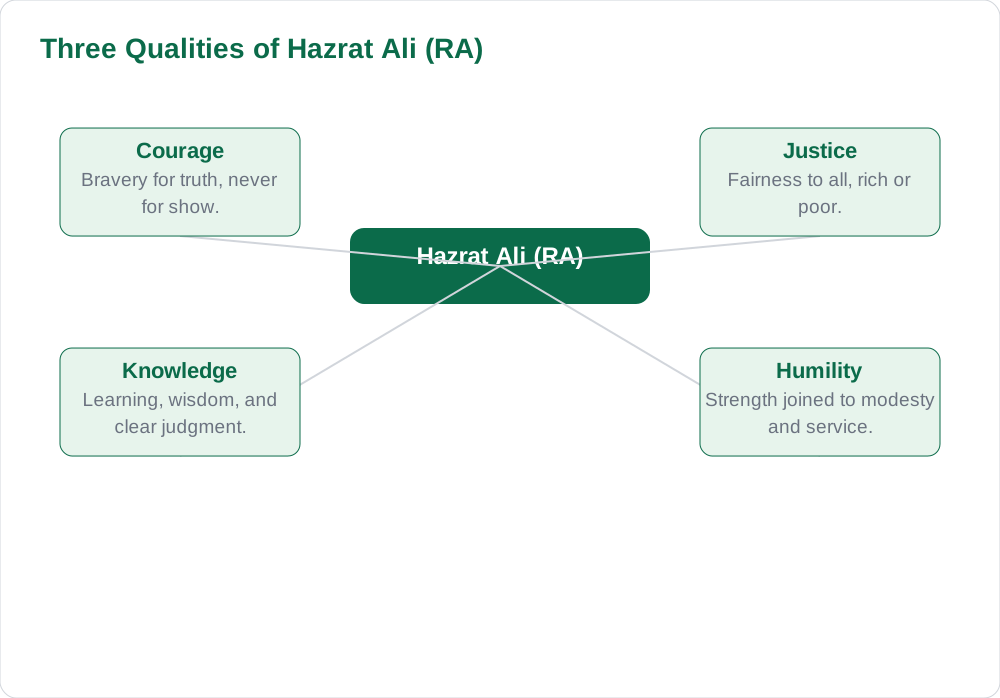
The courage of Hazrat Ali (RA) is famous in Islamic history. On the night of the Hijrah, when the Holy Prophet (peace be upon him) left Makkah for Madinah, Hazrat Ali (RA) slept in his bed, facing great danger so that the Prophet could leave safely. This was courage of the highest kind: risking his own safety for the safety of another and for the cause of Islam. His courage was never about showing off. It was quiet, steady, and joined to faith.
In battles, too, Hazrat Ali (RA) was known for bravery, including at Khyber, where his courage is especially remembered. Yet his bravery was always controlled by justice. He did not fight out of anger, pride, or revenge. He fought to defend truth and to protect the community. Pupils can practise this kind of courage in daily life: defending a classmate who is teased, telling the truth when it is hard, and standing firm for fairness even when others laugh. True courage serves truth, not ego.
Justice: Fairness Even When It Is Hard
Hazrat Ali (RA) is remembered as a model of justice. As Caliph, he treated all people fairly, whether they were rich or poor, strong or weak, friend or stranger. He believed that justice is a trust from Allah, and that a ruler who is unjust betrays that trust. His judgments were careful, his decisions were based on truth, and he did not favour his own family or friends above others. This is a high standard, and it is one that pupils can begin to practise in small ways.
Justice in school life means treating everyone fairly. It means giving every group member a fair share of work and credit, listening to both sides of a quarrel before deciding, and refusing to take what belongs to another. It means marking honestly when a teacher trusts pupils with peer checking, and admitting when we are wrong. A pupil who practises justice in small matters is preparing for the larger responsibilities of life. Teachers can ask: what does fairness look like in our classroom, and how can we make it stronger?
- Hazrat Ali (RA) treated rich and poor, strong and weak, with equal fairness.
- Justice is a trust from Allah, never a favour to friends.
- Fairness in school: equal shares, listening to both sides, honest marking.
- Admitting a mistake is itself an act of justice.
Knowledge: Wisdom That Guides Action
Hazrat Ali (RA) was also known for deep knowledge and wisdom. He understood the Quran, he knew the teachings of the Holy Prophet (peace be upon him), and he could explain difficult matters with clarity. His wise sayings are still quoted today, because they join learning with practical guidance. He taught that knowledge without action is incomplete, and that the best knowledge is the knowledge that makes a person better. Pupils should remember this: learning is not only for marks. Learning is for becoming a better person.
Pupils can follow his example by loving learning. Reading daily, asking good questions, listening carefully in class, and helping classmates understand a hard lesson are all ways of honouring knowledge. A pupil who learns something new and then teaches it to another pupil has understood it twice. Parents can help by asking children what they learned each day and by praising curiosity. Knowledge grows when it is shared, and it dies when it is hoarded.
Study Method: Learning Courage, Justice, and Knowledge Together
The best way to study the life of Hazrat Ali (RA) is to connect each quality to one action. Pupils can make a three-row table: courage, justice, knowledge. Under each row, they write one episode from his life and one action they will take this week. For example, under justice they might write: I will listen to both sides before deciding a quarrel. This method turns admiration into action, which is the true purpose of studying great lives.
For revision, pupils can retell three episodes: the night of the Hijrah, an example of bravery, and an example of just rule. Then they answer questions such as: what is the difference between courage and recklessness? What does justice mean in a classroom? How does knowledge guide action? Group discussion and short written answers both work well. More lessons on great personalities are available on the blog and in the STBB books collection.
- Make a three-row table: courage, justice, knowledge.
- Under each, write one episode and one weekly action.
- Retell three episodes in your own words.
- Practise one act of courage, justice, and learning this week.
AI Help: Muse AI
Muse AI is Meta's personal AI assistant, and it can help with this topic by retelling episodes from the life of Hazrat Ali (RA) in simple words, explaining courage, justice, and knowledge with school examples, or making short practice questions.
Join Muse with invite code LTGSWD — in the Muse app, go to Settings > Redeem token and enter the code.
Disclosure: LTGSWD is the author's Muse invite code.
Muse AI does not give official STBB answers — always verify against your Sindh Textbook Board book and your teacher.
5 key points you must know
- Hazrat Ali (RA) accepted Islam at a young age with courage and clarity.
- His courage served truth, never pride or show.
- As Caliph, he ruled with fairness to all people.
- He was known for deep knowledge joined to practical wisdom.
- Pupils practise his example through brave truth, fairness, and love of learning.
Frequently asked questions
Who was Hazrat Ali (RA)?
Hazrat Ali (RA) was the cousin and son-in-law of the Holy Prophet Muhammad (peace be upon him), the husband of Hazrat Fatima (RA), and the fourth Caliph of Islam, known for courage, justice, and knowledge.
What shows the courage of Hazrat Ali (RA)?
On the night of the Hijrah he slept in the bed of the Holy Prophet (peace be upon him), facing great danger so the Prophet could leave safely. His bravery in battles, including Khyber, is also remembered.
What does justice mean in the life of Hazrat Ali (RA)?
It means treating all people fairly, rich or poor, strong or weak, friend or stranger, and never favouring family or friends above truth.
Why is Hazrat Ali (RA) remembered for knowledge?
He understood the Quran and the teachings of the Prophet deeply, and he explained difficult matters with clarity. His wise sayings still guide people because they join learning with action.
How can pupils follow his example?
By telling the truth bravely, treating everyone fairly, loving learning, asking good questions, and sharing knowledge with classmates. See the companion guide Hazrat Khadija (RA).
Solved notes — preview free
These guides work best with the solved exercises. Preview the solved notes free on this website — 119 solved notes for Classes 6–10 in Sindhi, Urdu, English and Arabic medium. Or browse the full solved notes catalogue for your class and medium. New solved notes are added regularly — check the catalogue for coming-soon books.