Hazrat Khadija (RA): Support, Generosity and Steadfast Faith
Hazrat Khadija (RA) holds a special place in Islamic history. She was the first wife of the Holy Prophet Muhammad (peace be upon him), the first person to accept Islam, and a constant source of support in the hardest years of the early message. She was known for her wisdom, her generosity, and her steadfast faith. For Class 6 pupils, her life is a shining example of how one person can strengthen others through belief, kindness, and courage. This guide tells her story in simple words and draws out lessons that pupils can practise in their own lives.
A Life of Wisdom and Honour Before Islam
Before Islam, Hazrat Khadija (RA) was already known in Makkah as a woman of wisdom, honour, and good judgment. She was a successful businesswoman, trusted by traders for her honesty and fairness. People called her by a title of honour that reflected her pure character and noble conduct. Her story teaches pupils that good character is built long before fame arrives. The habits of honesty, care, and fairness that she practised in business were the same qualities that later made her a pillar of support for Islam.
Pupils can learn from this part of her life that reputation is earned slowly, through daily conduct. A pupil who is honest in small matters, who keeps promises, who treats workers and classmates with respect, is building a reputation that will serve them for life. Hazrat Khadija (RA) shows that a person does not need to wait for a great moment to be great. Greatness begins with ordinary honesty, practised every day. Teachers can ask pupils: what is one honest habit you can practise this week?
- Hazrat Khadija (RA) was known for wisdom, honour, and good judgment.
- She was a trusted and successful businesswoman in Makkah.
- Her honest character was built through daily conduct.
- Reputation is earned slowly, through small honest acts.
The First to Believe: Steadfast Faith
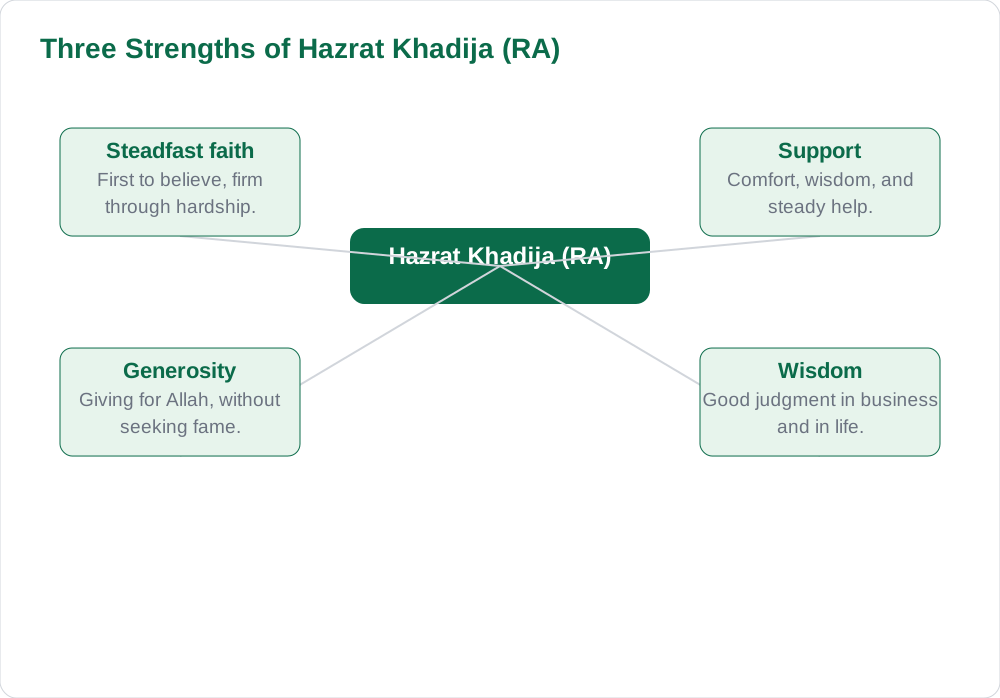
When the Holy Prophet Muhammad (peace be upon him) received the first revelation, Hazrat Khadija (RA) was the first person to accept Islam. This was a moment of great courage. The message was new, and many people would oppose it, yet she believed without hesitation. She listened, she understood, and she stood firm. Her faith was not a passing feeling. It was a steady commitment that never wavered, even when the early Muslims faced mockery, boycott, and hardship.
Steadfast faith means holding to truth when it is difficult. Pupils can practise steadfastness in smaller ways: holding to honesty when others cheat, holding to kindness when others are unkind, and holding to prayer when the day is busy. Hazrat Khadija (RA) shows that faith is proved in hard times, not only in easy times. A useful classroom discussion is: what does it mean to stand firm for what is right, and how can we support a friend who stands alone for truth?
Support in Hard Times: Strength Beside the Prophet
One of the greatest lessons of Hazrat Khadija (RA) life is support. In the early years of Islam, the Holy Prophet (peace be upon him) and the Muslims faced great hardship. They were mocked, boycotted, and cut off from trade and social life. Through all of this, Hazrat Khadija (RA) stood beside him with encouragement, comfort, and strength. She used her wisdom to advise, her words to comfort, and her resources to help the young community survive. Her support was quiet, steady, and constant.
Pupils can learn that supporting others is one of the highest forms of goodness. A pupil supports a friend by listening when the friend is sad, by helping with a difficult lesson, by sharing notes, or by standing beside someone who is being treated unfairly. Support does not always need money or power. Often it needs time, patience, and kind words. Hazrat Khadija (RA) shows that the strongest support is the support that stays through hard times, not only through easy times.
- Hazrat Khadija (RA) supported the early message with courage and constancy.
- Her support joined wisdom, comfort, and practical help.
- Supporting others is one of the highest forms of goodness.
- Steady support in hard times matters more than easy praise.
Generosity: Giving for the Sake of Allah
Hazrat Khadija (RA) was generous with her wealth, her time, and her care. She gave for the sake of Allah, without seeking fame or reward from people. Her generosity was not wasteful spending. It was purposeful giving that strengthened the community and helped the message of Islam survive its hardest years. Generosity of this kind teaches pupils that wealth is a trust from Allah. It is not only for personal comfort. It is a means to help others, to relieve hardship, and to build good.
Pupils can practise generosity in ways suited to their age. Sharing lunch with a classmate who forgot theirs, giving a pencil to someone who needs it, donating a small amount to a class charity drive, or giving time to help a younger pupil are all forms of generosity. The lesson of Hazrat Khadija (RA) is that generosity is measured by sincerity, not by size. A small gift given with a sincere heart is worth more than a large gift given for show. Families can encourage this by giving together and by praising quiet generosity.
Study Method: Learning From a Life, Not Only a Lesson
The best way to study the life of Hazrat Khadija (RA) is to learn from her example, not only to memorise facts. Pupils can make a three-column chart: faith, support, generosity. Under each column, they write one thing she did and one thing they will do this week. For example, under support they might write: I will listen to a friend who is sad. This method turns history into action, and action into character.
For revision, pupils can retell her story in three sentences: who she was, what she believed, and how she helped. Then they can answer questions such as: why was she the first to believe? How did she support the early Muslims? What does her generosity teach us about wealth? Group discussion helps pupils hear different answers and learn from one another. More lessons on great personalities are available on the blog and in the STBB books collection.
- Make a three-column chart: faith, support, generosity.
- Under each, write one act of hers and one act of yours.
- Retell her story in three sentences in your own words.
- Practise one act of support or generosity this week.
AI Help: Muse AI
Muse AI is Meta's personal AI assistant, and it can help with this topic by retelling the life of Hazrat Khadija (RA) in simple words, explaining faith, support, and generosity with daily examples, or making short practice questions for revision.
Join Muse with invite code LTGSWD — in the Muse app, go to Settings > Redeem token and enter the code.
Disclosure: LTGSWD is the author's Muse invite code.
Muse AI does not give official STBB answers — always verify against your Sindh Textbook Board book and your teacher.
5 key points you must know
- Hazrat Khadija (RA) was the first person to accept Islam.
- She was known for wisdom, honour, and honest conduct.
- She supported the Holy Prophet (peace be upon him) through hardship.
- She gave generously for the sake of Allah, without seeking fame.
- Her life teaches steadfast faith, support, and generosity.
Frequently asked questions
Who was Hazrat Khadija (RA)?
Hazrat Khadija (RA) was the first wife of the Holy Prophet Muhammad (peace be upon him) and the first person to accept Islam. She is remembered for her wisdom, generosity, and steadfast faith.
Why is Hazrat Khadija (RA) called the first to believe?
When the Holy Prophet (peace be upon him) received the first revelation, she was the first person to accept the message of Islam, believing without hesitation and standing firm through hardship.
How did Hazrat Khadija (RA) support the early Muslims?
She supported them with encouragement, wise advice, comfort, and practical help, standing beside the Holy Prophet (peace be upon him) through mockery, boycott, and hardship.
What does her generosity teach pupils?
It teaches that wealth is a trust from Allah, to be used for helping others. Generosity is measured by sincerity, not by size, and small sincere gifts matter greatly.
How can pupils follow her example?
By practising honesty daily, supporting friends in hard times, giving sincerely to others, and holding firmly to truth when it is difficult. More lessons on great personalities are on the blog.
Solved notes — preview free
These guides work best with the solved exercises. Preview the solved notes free on this website — 119 solved notes for Classes 6–10 in Sindhi, Urdu, English and Arabic medium. Or browse the full solved notes catalogue for your class and medium. New solved notes are added regularly — check the catalogue for coming-soon books.