Verification and Attestation of Board Documents Explained
Sooner or later, most pupils are asked to produce a verified or attested copy of a board document — a certificate, a marksheet or a migration certificate — for a college admission, a job application, a scholarship or study abroad. The words verification and attestation sound similar and are often used interchangeably, but they mean different things, and knowing the difference saves wasted trips and rejected applications. This guide explains both processes in plain language, when pupils typically need each one, how to get documents verified or attested, and the precautions that protect original documents. Procedures and fees differ between boards and institutions, so always confirm the exact requirement with the institution asking for the document and with your board's official notice.
Verification vs Attestation: The Difference
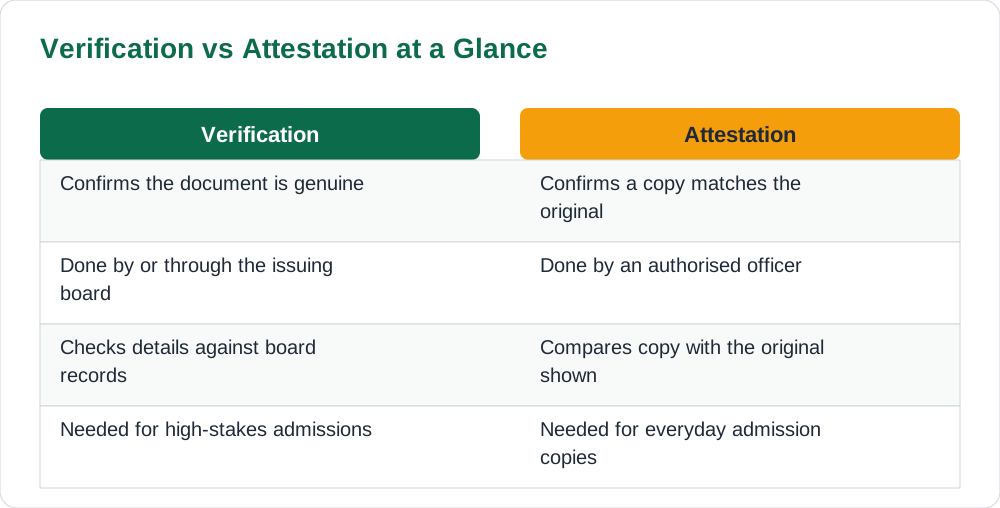
Verification means confirming that a document is genuine. The institution or employer asks the issuing board, or checks through the board's own system, whether the certificate or marksheet is real and whether the details on it match the board's record. Verification is usually done behind the scenes, by the institution, and the pupil's role is often limited to giving consent and providing the document details. Some boards offer an online verification service where a record can be checked against a roll number or certificate number.
Attestation means certifying that a copy is a true copy of the original. An authorised officer, such as a gazetted officer or another authority the receiving institution recognises, examines the original, compares the copy, and signs and stamps the copy to confirm it matches. Attestation does not confirm that the original itself is genuine in the board's record; it only confirms that the copy is faithful to the original shown. That distinction matters: an attested copy of a forged original is still a copy of a forgery, which is why institutions that need certainty ask for verification as well as, or instead of, attestation.
When Pupils Typically Need Each One
Attested photocopies are the everyday requirement. College admissions, scholarship forms and job applications commonly ask for attested copies of certificates and marksheets, because the institution wants a copy it can keep on file while the pupil keeps the original. The instruction usually specifies who may attest, for example a gazetted officer, and sometimes how many copies are needed, so read the institution's instructions carefully rather than assuming any signature will do.
Verification is typically needed when the stakes are higher: admission to a foreign institution, a government job, or any case where the receiving body must be certain the document is genuine. In these cases the institution usually writes to the board or uses the board's verification service itself, and the pupil may need to pay a verification fee or provide an authorisation letter. Some pupils also seek verification themselves before applying abroad, so that any problem with the record is discovered early rather than after an application has been submitted. If you are unsure which one is required, ask the receiving institution in writing, because submitting the wrong one wastes time.
How to Get a Document Verified
Start by finding out exactly what the receiving institution wants: verification by the board, a verification letter, or an online check. Then find your board's published procedure, which usually involves an application form, a copy of the document, the fee, and sometimes an authorisation letter from the pupil. Applications usually go through the school or directly to the board's verification section, depending on the board's rules, and the board replies either to the institution or to the pupil, as its procedure states. Allow generous time, because verification involves checking records and is rarely instant.
Keep a complete record of the application: the form, the fee receipt, the date submitted, and any reference number given. If the institution is waiting on the verification, give it the reference number so it can follow up directly. If the board reports a mismatch, for example a name spelled differently from the record, deal with it through the school and the board's correction procedure at once, because a mismatch discovered during verification can hold up an admission. Never use an agent who promises faster verification for an extra payment, and never submit a document you know to be incorrect, because verification is precisely the process that will expose it.
How to Get Copies Attested Safely
For attestation, take the original document and the photocopies to an officer the receiving institution recognises, and ask the officer to sign and stamp each copy, usually across the copy itself or on the back, as the institution requires. Check before you leave that every copy is signed and stamped, that the stamp is legible, and that the officer's name and designation are clear, because an illegible attestation is often rejected. Make more copies than you think you need, since fresh attestation trips are a common waste of time during admission season.
Protect your originals throughout. Never hand an original to an unofficial person, never leave originals with an agent, and never send originals by ordinary post without tracking and insurance if the institution insists on seeing them. Keep originals in a waterproof folder at home, and keep attested copies separately, so a lost bag does not take both. If an original is lost, the duplicate certificate guide explains the general route to a replacement, and the books catalogue and solved notes library remain useful for study while the paperwork is sorted.
Common Problems and Precautions
The most common problems are a name mismatch between the board record and an identity document, a lost original, and an attestation by someone the institution does not recognise. A name mismatch is best fixed through the board's correction procedure before any verification is requested, because verification will simply report the record as it stands. A lost original needs a duplicate from the board, which takes time and usually requires a police report or affidavit, so guard originals from the day you receive them. An unrecognised attestation needs to be redone by a recognised officer, which is why reading the institution's instructions first matters.
Two precautions cover most cases. First, never alter a board document, even to correct an obvious error, because an altered document can be treated as forged and can destroy trust in every other document you hold. Second, never pay an unofficial middleman for verification or attestation, because the genuine process runs through the board and recognised officers, and a middleman's stamp or letter is worthless and potentially incriminating. If you are ever unsure whether a requirement is genuine, check with the institution and the board directly, in writing, before spending money or handing over documents. For related processes, the migration certificate guide and the name correction guide may help.
AI Help: Muse AI
Muse AI is Meta's personal AI assistant, and it can help you prepare verification paperwork, for example by turning an institution's document checklist into a step-by-step list of originals, copies and attestations to gather.
Join Muse with invite code LTGSWD — in the Muse app, go to Settings > Redeem token and enter the code.
Disclosure: LTGSWD is the author's Muse invite code.
Muse AI does not give official STBB answers — always verify against your Sindh Textbook Board book and your teacher.
5 key points you must know
- Verification confirms a document is genuine; attestation confirms a copy matches the original.
- Everyday admissions usually need attested copies; high-stakes cases usually need verification.
- Read the receiving institution's instructions first — they state who may attest.
- Never alter a board document, even to fix an obvious error — use the correction procedure.
- Guard originals in a waterproof folder and keep attested copies separately.
Frequently asked questions
What is the difference between verification and attestation?
Verification confirms the document itself is genuine by checking it against the board's record. Attestation certifies that a photocopy is a true copy of the original shown to the attesting officer. They answer different questions.
Who can attest my board documents?
Whoever the receiving institution recognises, commonly a gazetted officer. Read the institution's instructions first, because an attestation by an unrecognised person is often rejected.
How long does board verification take?
It varies by board and workload, and it involves checking records, so it is rarely instant. Apply early, keep the fee receipt and reference number, and give the institution the reference so it can follow up.
What if my name on the certificate differs from my identity document?
Fix it through the board's correction procedure before requesting verification, because verification reports the record as it stands and a mismatch can hold up an admission.
Can I get a document attested without the original?
No — attestation requires the officer to compare the copy with the original. If the original is lost, apply for a duplicate from the board first.
Solved notes — preview free
These guides work best with the solved exercises. Preview the solved notes free on this website — 119 solved notes for Classes 6–10 in Sindhi, Urdu, English and Arabic medium. Or browse the full solved notes catalogue for your class and medium. New solved notes are added regularly — check the catalogue for coming-soon books.