Correcting a Name or Date on Board Documents
Your name, your father's name, and your date of birth appear on almost every academic document you will ever hold — your marksheet, your certificate, your college admission forms, and later your job applications. When one of them is wrong on a board document, even by a single letter, the mismatch can cause delays, questions, and sometimes rejection at a counter. The sooner you catch and correct it, the easier life becomes. This article explains the general correction process for names and dates on board documents, and why early checking matters so much. Procedures, fees, and timelines vary by board, so always confirm the current requirements with your school or the board's official notification. This is a general guide, not the board's own rulebook.
Why Small Errors Cause Big Problems
A board document is a formal identity record, not just a school paper. Colleges, employers, and passport offices compare names and dates across documents, and a mismatch — even an innocent one — can trigger questions. A pupil named with one spelling on the marksheet and another on the identity card may be asked to prove that both documents belong to the same person, which costs time and sometimes money.
Dates matter just as much. A wrong date of birth on a board certificate can conflict with other records and create problems at admission or employment. Because these documents are used for years, a small error left uncorrected can keep causing trouble long after the examination is forgotten.
The Most Common Errors
The most common errors are spelling mistakes in names, swapped or missing parts of a name, a wrong father's name, and an incorrect date of birth. They usually creep in at the admission or registration stage, when details are copied from a form into the board's records. A hurried form, unclear handwriting, or a missing document can all introduce an error that then repeats on every later document.
The lesson is to check your details at every stage, not only when the final certificate arrives. Read the registration slip, the roll number slip, and the marksheet as each one reaches you. Catching an error early is almost always simpler than correcting a certificate years later.
- Spelling mistakes in the pupil's name.
- Wrong or missing part of a name, such as a surname.
- Error in the father's name.
- Incorrect date of birth, day, month, or year.
- Mismatch between board records and identity documents.
The General Correction Process
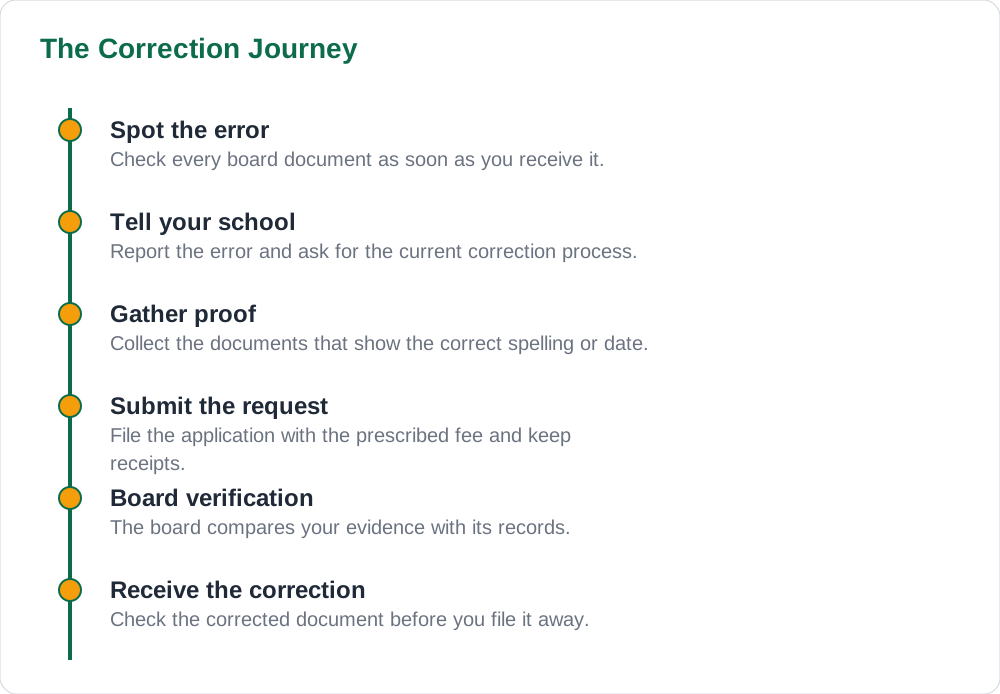
In general, a correction begins with a written request through your school, supported by documents that prove the correct spelling or date. The board checks the request against its records and the supporting evidence, and if satisfied, issues a corrected document. Some corrections are simple spelling fixes; others, such as a change of date of birth, may require stronger evidence and stricter verification.
Confirm the current procedure, documents, fee, and timeline with your school or the board's official notification before you apply. Keep copies of everything you submit, and ask for a receipt or reference number. Do not rely on rumours about what the board accepts — the official notification is the only reliable source.
Evidence Pupils Usually Prepare
The evidence required depends on the type of correction. For a name spelling, boards commonly ask for identity documents and the school's admission record showing the correct spelling. For a date-of-birth correction, boards usually require stronger proof, such as a birth record or other official document showing the correct date. In all cases, the key principle is the same: the correction must be supported by documents that already exist, not by a fresh claim alone.
Before you submit, check that the correct spelling or date is identical across every supporting document. If your own papers disagree with each other, sort that out first, because the board will notice the inconsistency. Your school can advise you on which documents the board currently accepts. Related board processes, such as result verification, are covered in our guide on board result scrutiny and rechecking.
Why Early Checking Saves Trouble
Corrections are usually easier soon after the error appears. Records are fresh, the school still holds the admission file, and the board's correction window may still be open. Years later, the same correction can require more evidence, more steps, and more time. A few minutes of checking today can save months of effort later.
Make a habit of it: every time a board document reaches you, read the personal details first, before you look at the marks. Compare them with your identity documents and your school record. If anything differs, report it the same week. For general guidance on examination records, browse the blog listing and confirm the current procedure with your school.
What to Do While the Correction Is Pending
While a correction is being processed, keep your studies and admission plans moving. If an institution needs the document urgently, explain the situation honestly and ask whether it will accept a letter from your school confirming that a correction is in progress, along with your other identity documents. Many counters accept interim proof when the situation is explained clearly.
Keep a file with copies of your application, your evidence, and any receipts. Note the date you applied and any reference number. Follow up politely if the stated processing time has passed, and keep the school informed so it can support you if the institution asks for confirmation. Meanwhile, keep your studies moving with the books and notes library.
AI Help: Muse AI
Muse AI is Meta's personal AI assistant. If you spot an error on a board document, you can ask Muse AI to help you draft a checklist of documents to prepare or a list of questions to ask your school about the correction process. Muse AI does not give official Sindh Textbook Board answers — always verify against your Sindh Textbook Board book and your teacher.
Join Muse with invite code LTGSWD — in the Muse app, go to Settings > Redeem token and enter the code.
Disclosure: LTGSWD is the author's Muse invite code.
5 key points you must know
- Names and dates on board documents are formal identity records — errors cause real delays.
- Check personal details on every board document as soon as you receive it.
- Corrections generally go through your school with supporting evidence.
- Confirm the current procedure, documents, and fee with your school or board notification.
- Early corrections are usually simpler than corrections made years later.
Frequently asked questions
How do I correct a spelling mistake in my name on a board document?
Report the error to your school and ask for the board's current correction process. You will generally submit a written request through the school with documents proving the correct spelling, and the board will verify and issue a corrected document.
Is correcting a date of birth harder than correcting a name spelling?
In general, yes. Date-of-birth corrections usually require stronger official evidence, such as a birth record, because the date is used across many identity systems. Confirm the current evidence requirements with your school or the board's official notification.
How long does a correction take?
The timeline varies by board and by how complete your application is. Confirm the current processing time with your school or the board's official notification, and follow up politely if that time has passed.
What if I need the document urgently while the correction is pending?
Explain the situation to the institution and ask whether it will accept a letter from your school confirming the correction is in progress, along with your other identity documents. Many counters accept interim proof when the situation is explained honestly.
Should I check my details on every document or only on the certificate?
Check every document — the registration slip, the roll number slip, the marksheet, and the certificate. Catching an error early is almost always simpler than correcting a certificate years later.
Solved notes — preview free
These guides work best with the solved exercises. Preview the solved notes free on this website — 119 solved notes for Classes 6–10 in Sindhi, Urdu, English and Arabic medium. Or browse the full solved notes catalogue for your class and medium. New solved notes are added regularly — check the catalogue for coming-soon books.