Presenting Answers Neatly in Urdu-Medium Board Exams
In a board exam, the examiner meets your answer on paper before meeting your ideas. A well-presented Urdu-medium answer is easy to follow, easy to mark, and easy to reward. This guide shows how headings, spacing, and underlining in Urdu script keep long answers readable and complete. The techniques are simple, they cost no extra study time, and they help good knowledge earn the marks it deserves.
What the Examiner Sees First
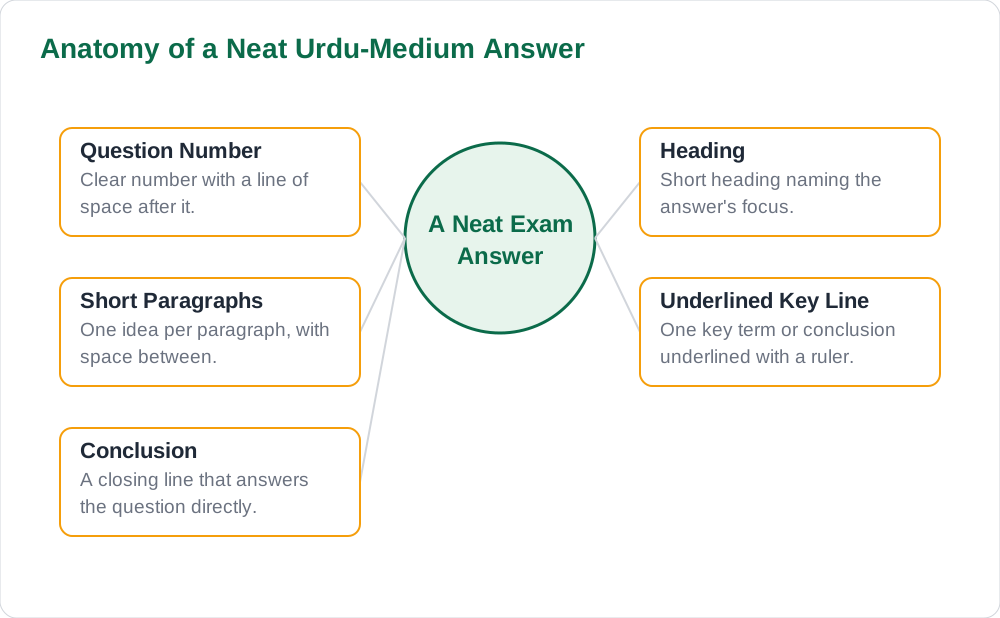
An examiner marking dozens of papers looks first for structure: a clear question number, a heading, and paragraphs that signal where one point ends and the next begins. A page of unbroken Urdu script, however correct, forces the examiner to hunt for points, and hunting leads to missed marks. A page with headings, short paragraphs, and one underlined key line per answer lets the examiner follow the argument at a glance and credit every point you made.
Presentation is not decoration; it is communication. Think of your answer as a guided tour: the heading tells the examiner where you are going, the first line states the main point, and each paragraph adds one supporting idea. Pupils who practise this structure find that they also think more clearly, because planning the layout forces them to plan the ideas. For general exam-writing habits, see how to write a perfect answer.
- Write the question number clearly and leave a line before starting.
- Use a heading for each long answer so the examiner can follow you.
- One paragraph, one idea: never bury three points in one block.
- Underline one key line per answer, not every line.
Headings and Structure in Urdu Script
Headings in Urdu script work best when they are short, centred or right-aligned as your school prefers, and written slightly larger than the body text. A heading such as Asbab or Nateeja tells the examiner that a new section is starting, and it helps the pupil stay on track. Under the heading, write a one-line introduction that states the answer's main claim, then develop it in short paragraphs. For a five-mark question, three or four paragraphs with a brief conclusion are usually enough.
Use subheadings sparingly inside very long answers. Two or three subheadings can organise a ten-mark essay, but a subheading for every sentence fragments the answer. Numbered points work well when the question asks for causes, effects, or steps, because they show the examiner that every part of the question has been addressed. Pupils can study model structures in solved notes to see how textbook answers organise their points.
- Keep headings short: one to three words that name the section.
- Open with one line stating the main claim of the answer.
- Use numbered points when the question asks for causes, effects, or steps.
- Reserve subheadings for long answers; short answers need at most one.
Spacing, Underlining, and Neatness That Help Marks
Spacing is the cheapest way to make an answer readable. Leave a full line between paragraphs, a finger-width margin on the right, and a clear gap after the question number. Write at a steady size: very large writing wastes pages and time, while tiny cramped writing strains the examiner's eyes. If you make a mistake, cross it out with a single clean line and continue; scribbled corrections and overwriting make the page look careless even when the content is good.
Underlining should highlight, not decorate. Underline the key term, the definition, or the conclusion line of each answer, using a ruler for a straight line. Avoid underlining whole paragraphs, coloured ink, or decorative borders, which distract rather than help. For handwriting habits that support neat presentation, see how to improve handwriting. Neatness is a habit built in daily homework, not a trick switched on in the exam hall.
- Leave a full line between paragraphs and a clear margin.
- Write at a steady, medium size; avoid very large or cramped writing.
- Correct mistakes with one clean line, never scribbles.
- Underline key terms and conclusions only, with a ruler.
Long Answers: Plan Before You Write
Long answers fail most often because pupils start writing before they know what they want to say. Spend the first minute planning: jot three or four points in the margin or on the last page, order them logically, and then write. A plan for a question about causes might list two economic causes, one social cause, and one conclusion. Writing from a plan keeps the answer complete, because the pupil can tick off each point as it is covered, and it prevents the common fault of repeating the first point three times.
Planning also protects time. A pupil who plans for one minute and writes for eight usually finishes with a complete answer, while a pupil who writes for nine minutes without a plan often runs out of space and time halfway through the third point. For time habits that leave room for planning, see how to manage time during exams. Keep plans tiny: three or four words per point is enough.
- Plan first: jot three or four points before writing a long answer.
- Order the points logically: causes before effects, problem before solution.
- Tick off each point as you cover it so nothing is missed.
- Keep plans tiny: three or four words per point is plenty.
A Final Five-Minute Check
Reserve the last five minutes of the paper for a presentation check, not for new writing. Read each answer quickly and ask four questions: is the question number correct, is there a heading where one was needed, is any paragraph overlong and in need of a split, and is the conclusion actually answering the question? Fix only what is quick to fix: a missing heading, a split paragraph, or an underlined key line. Rewriting whole answers in the last minutes usually creates more errors than it fixes.
Also check that every question has been attempted and that no page was left blank by accident. A short attempted answer earns more than a blank page, and a clearly presented short answer often earns partial marks. Pupils who practise this five-minute check in every mock exam find it becomes automatic, and their board papers look calm, complete, and professional.
- Reserve five minutes at the end for a presentation check only.
- Check question numbers, headings, paragraph length, and conclusions.
- Fix quick wins; do not rewrite whole answers in the last minutes.
- Confirm every question has been attempted and no page is accidentally blank.
AI Help: Muse AI
Muse AI is Meta's personal AI assistant. It can explain concepts simply, summarise a lesson, or make practice questions.
Ask Muse AI to turn one of your long answers into a three-point plan with a heading and a conclusion line you can practise presenting neatly.
Join Muse with invite code LTGSWD — in the Muse app, go to Settings > Redeem token and enter the code.
Disclosure: LTGSWD is the author's Muse invite code.
Muse AI does not give official Sindh Textbook Board answers — always verify against your Sindh Textbook Board book and your teacher.
5 key points you must know
- Presentation is communication: headings and short paragraphs help the examiner credit every point.
- Use short headings, a one-line opening claim, and one idea per paragraph.
- Spacing, steady writing, and one underlined key line per answer keep pages readable.
- Plan long answers with three or four points before writing.
- Reserve five minutes at the end for a quick presentation check.
Frequently asked questions
How much underlining is too much?
Underline one key line per answer, such as a definition or conclusion. Underlining whole paragraphs defeats the purpose, because nothing stands out. One ruled line under the key term is enough.
Should I use headings in short answers too?
Short answers of two or three marks usually need no heading; a clear first line is enough. Reserve headings for longer answers where they help the examiner follow your structure and help you stay on track.
What if my handwriting is slow?
Practise steady, medium-size writing in daily homework rather than trying to write fast in the exam. Short paragraphs, planned points, and clean corrections save more time than rushing, and they keep the paper readable.
Is it better to attempt all questions briefly or a few questions in full?
Attempt every question. A short, well-presented attempt can earn partial marks, while a blank page earns none. Plan your time so every question gets at least a structured attempt.
Solved notes — preview free
These guides work best with the solved exercises. Preview the solved notes free on this website — 119 solved notes for Classes 6–10 in Sindhi, Urdu, English and Arabic medium. Or browse the full solved notes catalogue for your class and medium. New solved notes are added regularly — check the catalogue for coming-soon books.