Preparing a Takreer: Speech Skills in Urdu
To master preparing takreer speech skills Urdu pupils need, you must treat a speech as a planned talk, not as an essay read aloud. A takreer is a speech, a short talk given to an audience on one topic with a clear purpose: to inform, to persuade, or to inspire. Many pupils prepare a takreer by writing a long essay and then memorising it word by word. That method fails on stage, because memorised words sound flat and a single forgotten line can stop the whole speech. A better way is to build the speech from an outline, practise it in spoken words, and deliver it from key points. This guide shows that method from outline to delivery.
What a Good Takreer Does
A good takreer does three things: it holds attention, it makes one clear point, and it ends with something to remember. Holding attention means speaking to the audience, not to the floor or the paper. Making one clear point means the audience can say after the speech what it was about in one sentence. Ending with something to remember means the closing line stays in the mind after the speech ends. These three goals matter more than long vocabulary or fancy phrases. A short, clear speech that the audience understands beats a long, ornate speech that the audience forgets.
Before you write anything, decide your purpose in one sentence. Are you informing the audience about a topic, persuading them to adopt a view, or inspiring them to act? Your purpose shapes your examples and your closing. For example, an informative takreer needs clear facts and order, a persuasive takreer needs reasons and an answer to an objection, and an inspiring takreer needs a story and a call to action. Writing the purpose sentence first keeps every later choice focused.
Building the Outline
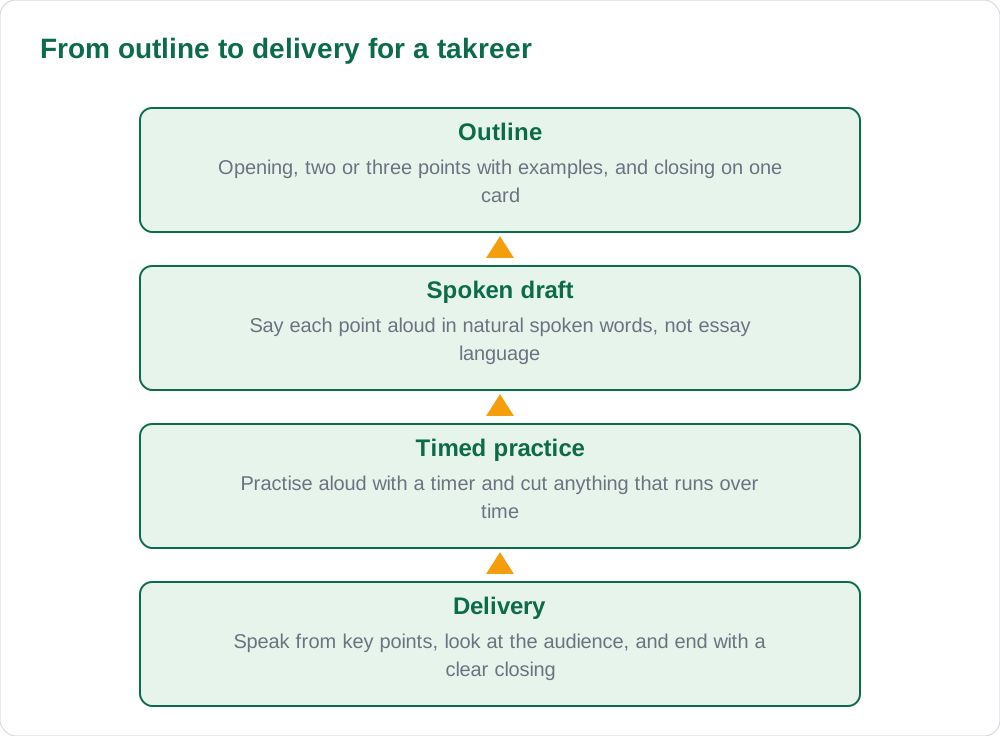
Build the speech from a short outline, not from a full essay. Write the topic at the top, then three parts: opening, body, and closing. The opening is one or two lines that greet the audience and state the topic. The body is two or three points, each with one example or story. The closing is one or two lines that gather the speech and end with a memorable thought. Keep the outline on one card or one page. If your outline fills two pages, it is too long. A short outline forces you to choose only the strongest points.
Choose points that fit the time. For a three-minute takreer, two points with one example each is enough. For a five-minute takreer, three points is enough. Each point should have a clear first line, so the audience can follow the structure. Write the outline in spoken language, not in written essay language. Short sentences, direct words, and natural pauses sound better on stage than long, complex sentences. Practise saying each point aloud as you write it, so the outline already sounds like speech.
Opening: Greet, State, Promise
The opening has three jobs in under thirty seconds: greet the audience, state the topic, and promise what the speech will show. A respectful greeting fits the occasion: greet the chair, teachers, judges, and audience as your school custom asks. Then state the topic in one clear line. Then give a promise line that tells the audience what to listen for, such as 'today I will share two reasons why reading shapes character'. This promise gives the audience a map, so they listen with purpose.
Avoid two opening mistakes. First, do not begin with an apology, such as saying you are not a good speaker. An apology lowers attention before the speech begins. Second, do not begin with a long quotation or story that the audience cannot connect to the topic. If you use a quotation or story, keep it short and link it to the topic at once. A clean, confident opening sets the tone for the whole speech.
Body: Points, Examples, and Links
The body carries the speech. Give each point in its own block: a clear first line, one example or story, and one linking line to the next point. Examples make points real. A story about a pupil who reads daily shows the value of reading better than a general claim. Keep examples short and true to life. One well-told example beats three rushed ones. After each example, add one line that states what the example shows, so the audience does not have to guess the connection.
Use linking words to show the audience where you are: first, next, and finally. These small words act as signposts. Without them, the audience cannot tell when one point ends and the next begins. Also use one Urdu idiom only if it fits naturally and you understand it fully. A forced idiom distracts the audience, while a natural one adds colour. Keep the body balanced: no point should be much longer than the others, and the whole body should fit the time you were given.
Closing: Gather and End Strong
The closing gathers the speech in two or three lines. Restate the main point in fresh words, thank the audience, and end with a memorable thought: a short line to remember, a question to think about, or a call to action. Do not introduce a new point in the closing. Do not end with a trailing line such as 'that is all I have to say' without a final thought. The last line is what the audience carries away, so choose it with care and practise it until it sounds natural.
Write the closing first if you struggle with endings. A strong closing gives the whole speech a destination, which makes the body easier to build. Practise the closing separately, saying it aloud five times, so it sounds confident on stage. When you deliver, slow down slightly for the closing, pause before the final line, and say the final line clearly. That pause signals to the audience that the speech is ending and that the last line matters.
Delivery: Voice, Eyes, and Calm
Delivery is how the speech reaches the audience. Speak slowly enough to be understood, loudly enough to reach the back row, and with natural pauses between points. Look at the audience, not only at your notes. A good habit is to look at one friendly face for a sentence, then another, moving your gaze calmly across the room. Stand still, with hands relaxed, and avoid swaying or tapping. Calm body language helps the audience trust the speaker. If you feel nervous, breathe slowly before you begin and speak the first line a little more slowly than usual. Nervousness fades once the first point is delivered.
Practise delivery with a timer and a listener. Record yourself once on a phone if your school allows it, and listen for speed, clarity, and pauses. Ask your listener one question: what was my main point? If the listener can answer in one sentence, the speech is clear. If not, simplify the outline. Practise the speech three times aloud, not silently, because silent reading does not train the voice. For more Urdu speaking and writing practice, see types of mazmoon and the solved notes, and check the books catalogue.
AI Help: Muse AI
Muse AI is Meta's personal AI assistant, and it can help you practise turning your takreer outline into spoken sentences. Muse AI does not give official STBB answers — always verify against your STBB book and your teacher.
Join Muse with invite code LTGSWD — in the Muse app, go to Settings > Redeem token and enter the code.
Disclosure: LTGSWD is the author's Muse invite code.
Muse AI does not give official Sindh Textbook Board answers — always verify against your Sindh Textbook Board book and your teacher.
5 key points you must know
- A takreer needs one clear purpose: inform, persuade, or inspire.
- Build from a short outline: opening, two or three points, closing.
- Opening: greet, state the topic, and promise what the speech will show.
- Body: one point at a time, each with one example and a linking line.
- Closing: restate the point, thank the audience, end with a memorable line.
Frequently asked questions
Should I memorise my takreer word by word?
No. Memorise the outline and the closing line, and speak the body from key points. Word-by-word memorising sounds flat and fails if one line is forgotten.
How long should a school takreer be?
Follow the time your teacher or competition gives, usually three to five minutes. Two points fit three minutes; three points fit five minutes. Time your practice.
What if I forget a point on stage?
Pause, breathe, and move to the next point on your outline. The audience rarely notices a skipped point if you continue calmly. Do not apologise or restart.
How can I reduce nervousness before a takreer?
Practise aloud three times, breathe slowly before you begin, and speak the first line a little more slowly than usual. Nervousness usually fades once the first point is delivered.
Solved notes — preview free
These guides work best with the solved exercises. Preview the solved notes free on this website — 119 solved notes for Classes 6–10 in Sindhi, Urdu, English and Arabic medium. Or browse the full solved notes catalogue for your class and medium. New solved notes are added regularly — check the catalogue for coming-soon books.