Low-Cost Teaching Aids from Everyday Materials
Good teaching does not depend on expensive equipment, and some of the best classroom aids are made from cardboard, bottle caps, and old charts. In schools where budgets are small, low-cost teaching aids from everyday materials can turn an abstract lesson into something pupils can touch, move, and remember. This article shows how to make durable aids for science, mathematics, and language using materials that cost almost nothing, and how to use them so they genuinely improve learning rather than becoming classroom decoration. Pupils learn more when they handle objects, count real things, and see ideas in front of them, and teachers who build their own aids often teach with more energy because the aid carries a story. With a little planning, your classroom can be full of useful tools made by you and your pupils.
Why Hands-On Aids Work Better Than Talking Alone
Pupils remember what they do far better than what they only hear, so a teaching aid that lets them touch and move ideas makes learning stick. A child who groups bottle caps into tens understands place value more deeply than one who only copies numbers from the board, and a pupil who builds a cardboard model of a plant remembers its parts because they made each one. Aids also help pupils who struggle with language or reading, because they can show understanding by arranging, pointing, or building instead of writing long answers. In mixed-ability classes, a simple aid gives every pupil an entry point into the same lesson.
Low-cost aids have another advantage: they can be made in quantity, so every group gets one instead of watching the teacher demonstrate a single expensive model. When each group has its own set of counters, cards, or charts, all pupils practise at once and the teacher can check learning group by group. Aids made from everyday materials are also easy to replace when they break, which means teachers are not afraid to let pupils actually handle them. The goal is learning through doing, not protecting a precious object, and cheap materials make that possible. The solved notes offer lesson topics you can match with a handmade aid.
Cardboard, Caps, and Charts: Your Basic Toolkit
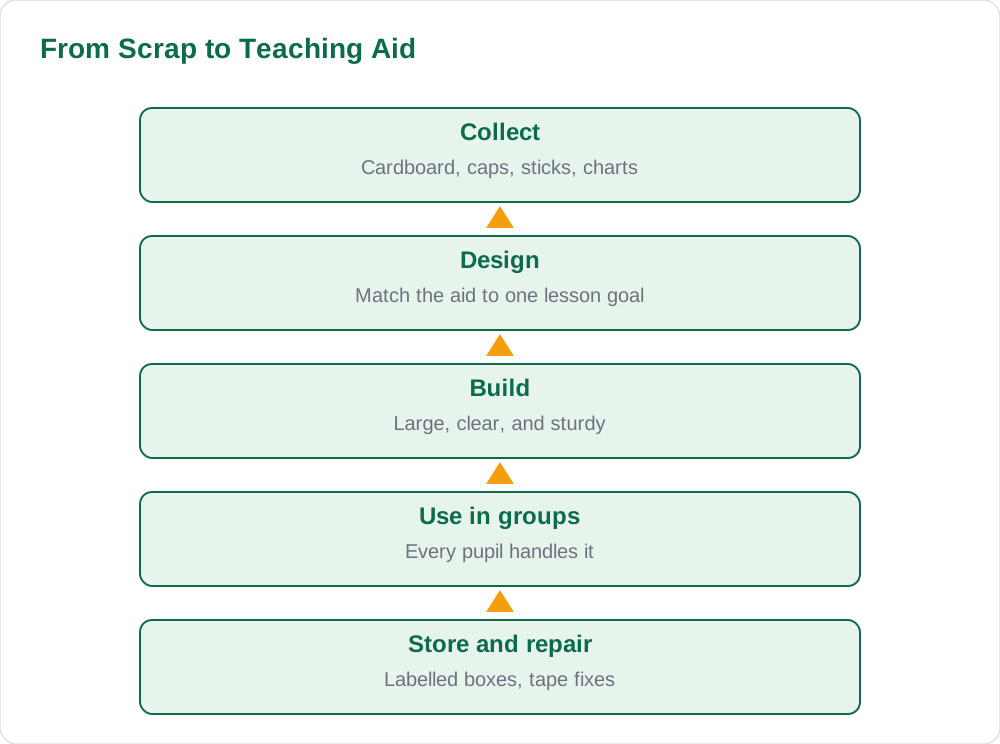
Start with a small collection of free materials that you gather over time: cardboard boxes, bottle caps, sticks, stones, string, old newspapers, and chart paper. Cardboard can be cut into number cards, word cards, fraction strips, and simple models, and covering it with clear tape or old plastic makes it last much longer. Bottle caps in different colours become counters for counting, grouping, and simple probability, while sticks and stones work for measuring, sorting, and building shapes. Keep the materials in labelled boxes or bags so you can find them quickly, and involve pupils in collecting and sorting them, which itself teaches classification.
Charts are the most versatile low-cost aid of all, because one well-made chart can serve a class for years. Make charts with large, clear writing that pupils at the back can read, use colour to separate ideas, and leave space to add pupil contributions over time. A word wall for new vocabulary, a number line along the wall, and a chart of classroom routines all teach silently every day. Avoid overcrowding a chart with small text, since a chart nobody can read teaches nothing, and replace faded charts rather than leaving them as decoration. The book collection lists subjects where a simple chart can support each topic.
Science Aids: Models Pupils Can Build and Test
Science comes alive when pupils build and test models instead of only reading about processes. A cardboard model of the water cycle, with arrows showing evaporation, condensation, and rainfall, helps pupils explain the cycle in their own words. Simple experiments using bottles, cups, and water can show floating and sinking, shadows, or plant growth, and pupils can record what they observe in a shared table. Even a labelled diagram drawn large on chart paper, with parts pupils can point to and name, beats a small textbook picture that only the front row can see.
Let pupils build the aids themselves whenever possible, because making a model teaches as much as using one. A group that constructs a simple lever from a ruler and a stone understands balance better than a group that only hears the definition, and explaining their model to another group deepens the learning further. Keep experiments safe and simple, using water, sand, and paper rather than anything harmful, and always link the activity back to the lesson question: what did we observe, and what does it tell us. Science aids need not be perfect to be powerful; they need to be handled, discussed, and explained. More classroom ideas appear on the blog.
Maths and Language Aids: Counters, Cards, and Word Walls
Mathematics benefits enormously from things pupils can move, because numbers become real when they are grouped, shared, and rearranged. Bottle caps teach counting, addition, and multiplication when pupils make groups of ten, while fraction strips cut from cardboard show halves and quarters more clearly than any definition. A large number line on the wall, a set of digit cards for making numbers, and a place-value chart with pockets for ones, tens, and hundreds turn abstract ideas into daily practice. Use these aids in short daily routines, such as a five-minute counting game, so they become familiar tools rather than one-off novelties.
For language, word cards, sentence strips, and picture cards build reading and vocabulary through play. Pupils can match words to pictures, arrange sentence strips into the correct order, or build new words by changing one letter card at a time. A word wall that grows through the term gives pupils a reference they actually use, especially when new words are added with pupil-drawn pictures. Keep language aids durable by laminating with tape and storing sets in envelopes labelled by topic, so a group can start work in seconds. The [home page](/) links to resources that support these subjects across classes.
Make Aids Last: Storage, Repair, and Pupil Ownership
A teaching aid only saves time if you can find it and reuse it, so storage matters as much as making. Label every box or envelope with the topic and class, store aids where pupils can reach them for group work, and keep a simple list of what you own so you do not remake the same aid twice. Teach pupils how to use and return aids carefully, with a group leader responsible for counting pieces at the end of the lesson, and repair broken aids promptly with tape or glue before small damage becomes ruin. Aids that are respected last years, and pupils respect what they helped to make.
Involve pupils in making and improving aids, and display the best ones proudly, because ownership builds care. A pupil who painted a chart or built a model will protect it, explain it to others, and remember the lesson behind it. Start small: make one aid per week, use it well, and store it properly, and within a term you will have a classroom toolkit that rivals far more expensive collections. Share ideas with colleagues too, since one teacher's bottle-cap counters can become another's fraction kit, and a school that shares aids multiplies its resources. For questions, visit the contact page.
AI Help: Muse AI
Muse AI is Meta's personal AI assistant, and it can help teachers brainstorm low-cost aid ideas, plan a step-by-step build from cardboard or bottle caps, or write clear instructions for a group activity. Ask it for three aid ideas for one lesson topic, then choose the one that fits your materials and class.
Join Muse with invite code LTGSWD — in the Muse app, go to Settings > Redeem token and enter the code.
Disclosure: LTGSWD is the author's Muse invite code.
Muse AI does not give official STBB answers — always verify against your Sindh Textbook Board book and your teacher.
5 key points you must know
- Hands-on aids help pupils remember by touching, moving, and building ideas.
- Cardboard, bottle caps, sticks, and charts form a free, durable basic toolkit.
- Science models built by pupils teach processes better than reading alone.
- Counters, fraction strips, and word cards make maths and language concrete.
- Labelled storage, quick repairs, and pupil ownership make aids last for years.
Frequently asked questions
What materials should I collect first?
Start with cardboard, bottle caps, sticks, string, and chart paper. These cover counting, sorting, models, and charts across science, maths, and language, and they cost nothing.
How do I make cardboard aids last longer?
Cover surfaces with clear tape or old plastic, use thick cardboard, and store aids in labelled boxes. Quick repairs with tape after each use prevent small damage from spreading.
Should pupils make the aids or should the teacher?
Both. Teacher-made aids ensure accuracy for key lessons, while pupil-made aids deepen learning and build ownership, so pupils care for and remember them.
How often should I use teaching aids?
Use them in short routines several times a week rather than as rare special events. Familiar aids become tools pupils reach for naturally, which is when they help most.
Solved notes — preview free
These guides work best with the solved exercises. Preview the solved notes free on this website — 119 solved notes for Classes 6–10 in Sindhi, Urdu, English and Arabic medium. Or browse the full solved notes catalogue for your class and medium. New solved notes are added regularly — check the catalogue for coming-soon books.