Managing a Large Class of 50 Plus Pupils

Teaching fifty or more pupils in one room can feel like crowd control rather than teaching, yet many teachers manage large classes with calm and success every day. The secret is not a louder voice or stricter punishment, but systems that let fifty pupils work without all needing the teacher at once. This article explains how grouping, routines, and signal systems help you manage a large class of 50 plus pupils while still giving individuals attention. You will learn how to organise seating and groups, use signals to gain attention in seconds, and set up peer support so learning continues even when you are helping one group. Large classes have real advantages too: more ideas, lively discussion, and strong peer learning, and the systems in this article help you enjoy those strengths instead of fighting the numbers.
Accept the Numbers and Plan for Them
The first step in managing a large class is to stop planning as if you had twenty pupils and start planning for the class you actually have. With fifty plus pupils, you cannot mark every answer in class, hear every pupil read aloud, or give long individual explanations, and trying to do so leaves everyone waiting. Instead, design lessons where pupils check each other's work, practise in pairs, and show understanding through quick signals such as hands, cards, or mini-boards. Plan your time in blocks, with short teacher input followed by longer pupil activity, so the lesson moves even when you cannot reach every desk.
Seating also matters more at this scale, so arrange rows or groups that let you walk the room quickly and see every face from the front. Keep aisles clear, put pupils who need extra support near the front, and separate pairs who distract each other before problems start. A simple seating plan, drawn once and kept on your desk, saves minutes every lesson and lets you learn names faster. When the room is organised for fifty, the class feels smaller, and you spend your energy teaching rather than searching for space. Browse the solved notes for ready practice material that works well in large groups.
Groups and Monitors: Let Pupils Help Run the Class
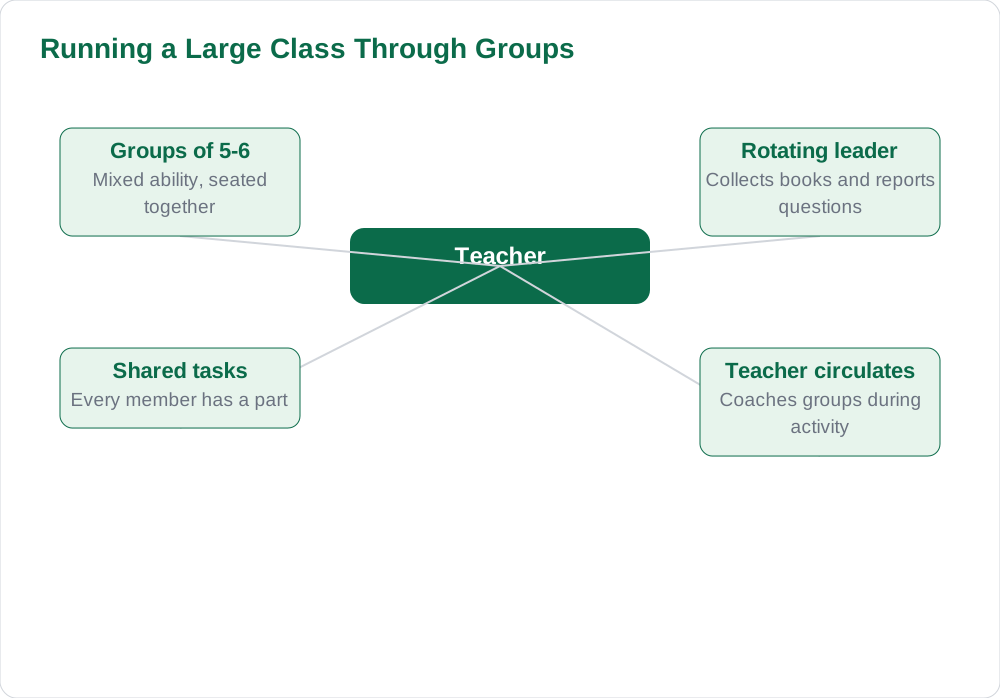
In a large class, pupil helpers are not a luxury but a necessity, so build a system of groups and monitors that shares the workload fairly. Divide the class into groups of five or six, each with a rotating group leader who collects books, distributes materials, and reports the group's questions. Rotate leaders weekly so the role stays fair and every pupil gets a turn at responsibility, and train leaders in exactly what to do, because an untrained monitor creates more confusion than help. Groups also give pupils a smaller community inside the big class, where they can ask questions they would never ask in front of fifty people.
Use groups for learning as well as organisation, with tasks that require every member to contribute, such as each pupil answering one part of a worksheet or explaining one step to the group. Walk between groups during activity time, listening and coaching, rather than standing at the front waiting for hands. Praise groups that work well together by name, and keep a simple record of group effort so you can recognise improvement over the term. When pupils help run the class, they take ownership of it, and behaviour improves because the class belongs to them too. The book collection offers material you can split across groups for shared tasks.
Signal Systems That Gain Attention in Seconds
A teacher who shouts over fifty pupils loses voice, patience, and authority, so replace shouting with signals the whole class can see and hear. Teach one attention signal on the first day, such as raising your hand while counting down from five, and practise it until every pupil responds without prompting. Other useful signals include a hand clap pattern pupils repeat back, a bell or whistle for outdoor work, and a simple call-and-response phrase the class answers together. The key is consistency: use the same signal every time, wait calmly until everyone responds, and never start talking over noise, because pupils learn that noise delays the lesson.
Signals also organise transitions, which are the moments when large classes most often fall apart. Use a clear signal for moving into groups, another for packing up, and a visible timer or countdown so pupils know how long an activity lasts. Practise transitions as a routine, time them, and praise the class when they beat their previous record, turning organisation into a small game. When signals replace shouting, the classroom feels calmer, your voice lasts the day, and pupils learn self-control because they respond to a cue rather than to fear. More ideas for classroom systems appear on the blog.
Keep Everyone Learning During Whole-Class Teaching
Whole-class teaching in a large room risks leaving half the class passive, so build in quick checks that involve everyone at once. Ask pupils to answer together, show fingers for a multiple-choice answer, hold up a mini-board or slate, or turn to a partner and explain the idea in one sentence. These low-cost checks give you instant feedback from fifty pupils without marking fifty books, and they keep attention high because every pupil must respond. Vary the method across the lesson so pupils stay alert, and use the results honestly: if many answers are wrong, reteach the point rather than moving on.
Keep teacher talk short and focused, because long lectures lose a large class faster than a small one. Explain one idea at a time, show an example on the board, and then let pupils practise immediately while the idea is fresh. During practice, circulate with a purpose, checking the groups most likely to struggle first, and use pupil answers on the board to teach the whole class from real examples. A lesson shaped as short input, quick check, and guided practice keeps fifty pupils busy and learning, instead of watching the teacher talk. The [home page](/) links to resources that support this style of lesson.
Behaviour and Care When You Cannot See Everyone
In a class of fifty plus, you cannot watch every pupil every minute, so prevention and fairness matter more than punishment. Seat pupils thoughtfully, keep lessons active so boredom does not breed mischief, and build relationships by learning names and greeting pupils at the door. When disruption happens, deal with it quietly and close by: walk to the pupil, use their name, and state the expected behaviour without stopping the whole lesson. Public scolding in front of fifty classmates humiliates a pupil and usually makes behaviour worse, while a private word preserves dignity and keeps the class calm.
Keep consequences simple, consistent, and known in advance, such as a warning, a move of seat, and a short talk after class, applied the same way to every pupil. Record repeated issues briefly so you can spot patterns and talk to parents with facts rather than impressions. Also care for yourself: a large class is tiring, so protect your voice, plan rest between demanding lessons, and ask colleagues for ideas when a particular group is hard to manage. Managing fifty pupils well is a professional skill to be proud of, and steady systems make it sustainable all year. For questions, see the contact page.
AI Help: Muse AI
Muse AI is Meta's personal AI assistant, and it can help teachers plan a large-class lesson, design group tasks, or suggest attention signals and seating layouts for fifty plus pupils. Ask it for a group activity that gives every member a role, then adapt it to your room and class.
Join Muse with invite code LTGSWD — in the Muse app, go to Settings > Redeem token and enter the code.
Disclosure: LTGSWD is the author's Muse invite code.
Muse AI does not give official STBB answers — always verify against your Sindh Textbook Board book and your teacher.
5 key points you must know
- Plan for fifty pupils, not twenty: short input, long pupil activity.
- Use groups of five or six with rotating leaders to share classroom jobs.
- Replace shouting with one consistent attention signal, practised until automatic.
- Check understanding from everyone at once with signals, cards, or pair talk.
- Handle disruption quietly and fairly, and keep consequences consistent.
Frequently asked questions
How can I mark work in a class of 50 plus?
Use peer checking, self-checking against board answers, and quick whole-class signals for most practice, reserving your own marking for short weekly checks or one group at a time.
What group size works best in a large class?
Five or six pupils per group works well: large enough to share ideas, small enough that everyone must contribute, and easy to organise in a crowded room.
How do I stop shouting to gain attention?
Teach one signal, such as a raised hand with a countdown, practise it until it is automatic, and wait calmly for full response before speaking. Never talk over noise.
What if one group always disturbs the class?
Reseat the group, give its members clear roles, and visit it early during activities. A private talk with the pupils involved usually works better than punishing the whole class.
Solved notes — preview free
These guides work best with the solved exercises. Preview the solved notes free on this website — 119 solved notes for Classes 6–10 in Sindhi, Urdu, English and Arabic medium. Or browse the full solved notes catalogue for your class and medium. New solved notes are added regularly — check the catalogue for coming-soon books.