Feedback That Actually Improves Pupils' Work
Most pupils receive plenty of marks and comments on their work, yet much of it never changes what they do next. A tick, a grade, or a vague well done tells a pupil nothing about how to improve, so the same mistakes appear again in the next exercise. Feedback that actually improves pupils' work is specific, actionable, and focused on the next step: it names what was done well, points to one clear thing to fix, and shows how to fix it. This article explains how teachers can give feedback that pupils can use, whether on written work, classwork, or homework, without spending hours marking every book. When feedback becomes a short conversation about improvement rather than a final judgement, pupils begin to revise, retry, and take pride in getting better.
What Makes Feedback Useful Instead of Just a Mark
Useful feedback answers three questions for the pupil: where am I going, how am I doing, and what should I do next. A grade alone answers none of them, because it judges the past without guiding the future. Compare well done with your introduction states the idea clearly, but your second paragraph needs one example to prove it, and the second comment immediately tells the pupil what to keep and what to change. Pupils improve when feedback is tied to the learning goal, given while the work is still fresh, and limited to a few points they can actually act on, rather than a page covered in corrections.
Timing matters as much as content, because feedback given weeks later arrives after the pupil has forgotten the task and moved on. Aim to return short tasks quickly, even if the feedback is brief, and build in class time for pupils to read and act on comments before the next task. Feedback also works best when it focuses on the work, not the pupil: comment on the paragraph, the method, or the answer, not on whether the pupil is clever or lazy. When pupils see feedback as help rather than criticism, they read it, and reading it is the first step to using it. The solved notes show model answers pupils can compare with their own work.
Be Specific: Name the Strength and the Next Step
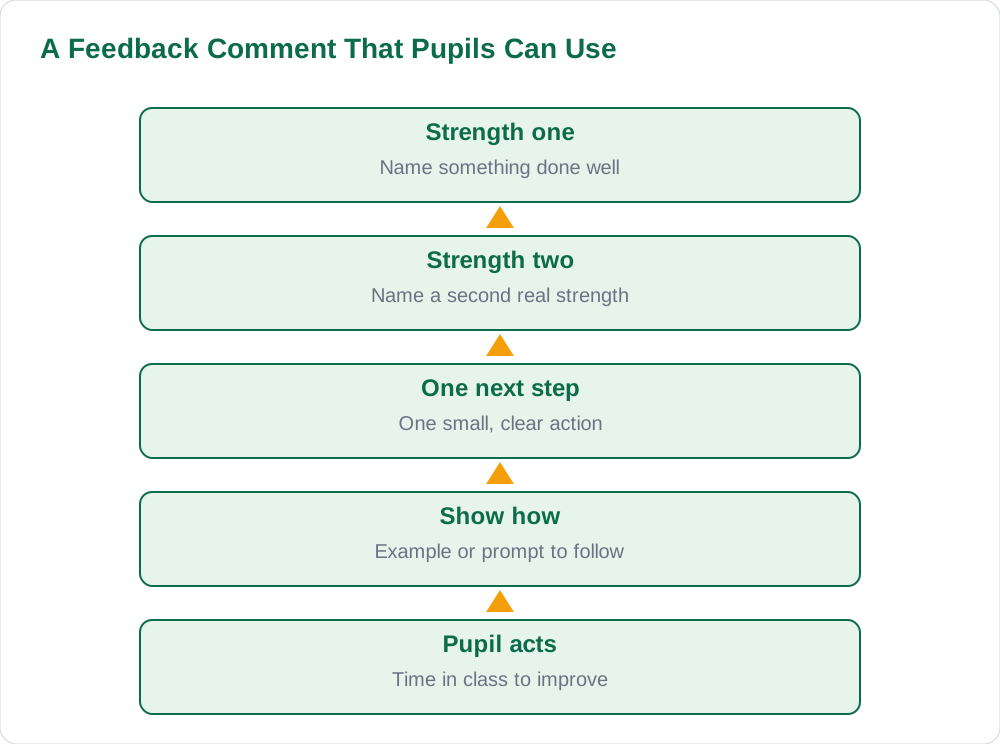
Specific feedback names exactly what the pupil did and exactly what to do next, so there is no guessing. Instead of good work, write your spellings are accurate and your handwriting is clear, which praises real strengths, and instead of careless, write check the tens column in question three, where you added instead of subtracting. A useful pattern is two strengths and one next step: praise two genuine strengths first, then give one clear action, such as add a concluding sentence that answers the question directly. This balance keeps pupils encouraged while still giving them a concrete job to do.
Make the next step small enough to complete in a few minutes, because a long list of fixes overwhelms pupils and nothing gets done. If a piece of work has many errors, choose the most important one, such as organising ideas in order, and leave the rest for later tasks. Use the same language across the class for common next steps, such as check, explain, example, and conclude, so pupils learn what each instruction means. Over time pupils begin to give themselves the same specific feedback, checking their own work before handing it in, which is the real goal of good marking. Find practice material in the book collection to apply these feedback habits.
Show, Don't Just Tell: Models and Examples
Pupils often cannot act on feedback because they have never seen what good looks like, so show them a model. Display an anonymous example of strong work, or write a short improved version on the board, and ask the class to spot what makes it better. When you write add an example here, show one example sentence yourself, so the pupil can copy the pattern rather than guessing. Models are especially powerful for writing, where pupils need to see paragraph structure, and for mathematics, where a worked step shows the method clearly.
Use pupil work as models too, with permission, because a classmate's improved paragraph feels more achievable than a perfect textbook answer. Keep a small collection of before-and-after examples, showing a first draft beside the improved version with the changes highlighted, and refer to it when giving similar feedback. This approach also saves marking time: instead of writing the same long comment thirty times, teach the pattern once to the class and then give short personal comments that point to it. Pupils who understand the target can reach it, and models make the target visible. More teaching strategies appear on the blog.
Build in Time to Act: Feedback Without Action Is Wasted
The most common reason feedback fails is that pupils never get time to use it, because the teacher moves straight to the next topic. Protect ten minutes in the lesson after returning work, during which pupils read their comments, ask questions, and make the improvement in a different colour pen. This response time turns feedback from a dead end into a loop: the pupil improves the work, the teacher sees the improvement, and the next task starts from a higher level. Pupils quickly learn that feedback matters, because their teacher checks whether they acted on it.
Make acting on feedback a normal habit, not a punishment, by praising pupils who revise well and by showing improved work to the class. Use simple routines such as a feedback page at the back of the book where pupils copy their next step and tick it off when done, or a short starter task that revisits the previous feedback point. In large classes, focus response time on one group or a few common errors at a time, rather than trying to re-mark every book. When pupils expect to act on feedback every time, the quality of first drafts rises too, because they start checking their own work. The [home page](/) gives an overview of resources for teachers and pupils.
Spoken Feedback and Peer Feedback That Help
Not all feedback needs to be written, and spoken feedback during a lesson is often faster and more powerful than a comment days later. While pupils work, walk around and give short, specific comments: this paragraph is clear, now add your reason, or check this step again, and let the pupil fix it immediately. Spoken feedback lets you ask questions, hear the pupil's thinking, and adjust your guidance on the spot, and it builds a relationship in which pupils welcome advice. Keep spoken comments brief and focused, so you can reach many pupils in one activity session.
Peer feedback can also improve work when pupils are trained to do it well, using the same pattern of strengths and one next step. Teach pupils to comment on the work, use kind and specific language, and suggest one improvement, and start with short, structured tasks such as checking a partner's answers against a checklist. Monitor early peer feedback closely, correcting unkind or vague comments, and always let the teacher have the final word on accuracy. When pupils learn to give and receive feedback kindly, they become better learners and better classmates. For questions about this site, visit the contact page.
AI Help: Muse AI
Muse AI is Meta's personal AI assistant, and it can help teachers draft feedback comments, rephrase a vague comment into a specific next step, or create model paragraphs that show pupils what good work looks like. Try asking it to suggest one clear improvement for a sample paragraph, then adapt the wording for your own pupil.
Join Muse with invite code LTGSWD — in the Muse app, go to Settings > Redeem token and enter the code.
Disclosure: LTGSWD is the author's Muse invite code.
Muse AI does not give official STBB answers — always verify against your Sindh Textbook Board book and your teacher.
5 key points you must know
- Useful feedback answers where am I going, how am I doing, and what next.
- Name two genuine strengths and one small, clear next step.
- Show models and examples so pupils can see what good work looks like.
- Build in class time for pupils to act on feedback before the next task.
- Use spoken and trained peer feedback to speed up the feedback loop.
Frequently asked questions
How much feedback should I write on each piece of work?
Less than you think. Two strengths and one next step are usually enough; a page covered in corrections overwhelms pupils, while one clear action gets done.
Should I give a grade as well as a comment?
If you must grade, give the comment first and let pupils act on it before revealing the grade, so they read the feedback instead of only looking at the mark.
How can I give feedback quickly in a large class?
Use whole-class feedback on common errors, spoken comments during activities, and short personal notes. Reserve detailed written feedback for key tasks, not every exercise.
What if pupils ignore my comments?
Build in response time in class and check the improvements. When pupils see that feedback is always followed by action time, they start reading it seriously.
Solved notes — preview free
These guides work best with the solved exercises. Preview the solved notes free on this website — 119 solved notes for Classes 6–10 in Sindhi, Urdu, English and Arabic medium. Or browse the full solved notes catalogue for your class and medium. New solved notes are added regularly — check the catalogue for coming-soon books.