Adjusting Your Study Planner When You Fall Behind

Every pupil falls behind a study planner sooner or later, through illness, family events, heavy school weeks, or simply a plan that was too ambitious. The danger is not falling behind itself; it is the response. Many pupils abandon the whole timetable at the first missed week, deciding that a broken plan is useless, and then study without any plan at all. A good planner is designed to be adjusted, not obeyed perfectly, and adjusting it well is a skill that matters more than making it perfectly in the first place. This guide shows how to re-plan after falling behind, what to prioritise, what to cut, and how to rebuild steady progress without guilt or panic.
First, measure how far behind you really are
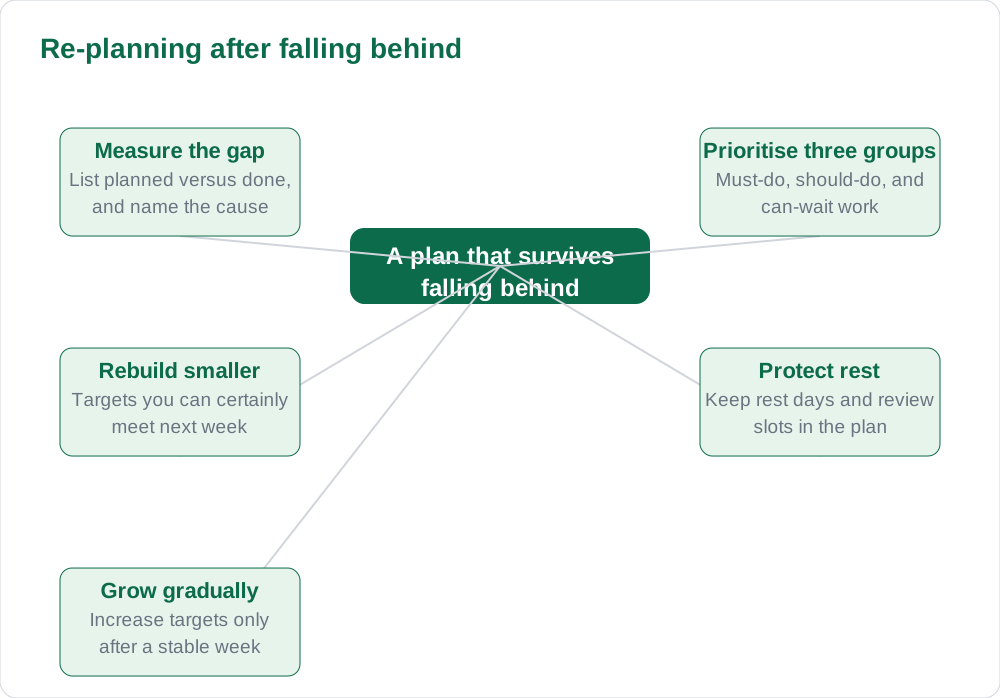
Falling behind feels larger than it is, because anxiety adds imagined work to real work. Before changing anything, measure the gap honestly: list what was planned, mark what was actually done, and count what remains. Often the gap is two or three topics, not a whole term, and seeing the true size immediately reduces panic. Use your progress chart or planner tallies if you keep them, and your class notes to check what the class has actually covered, since catching up on material never taught is wasted effort.
Also identify why you fell behind, because the fix depends on the cause. Illness needs rest and a gradual return, not doubled work. A too-ambitious plan needs smaller targets. A difficult subject needs teaching help, not more hours alone. A distraction problem needs a changed study setup. Naming the cause turns a vague failure into a solvable problem, and it prevents the same gap from recurring next month. Write the cause down next to the gap, so the re-plan addresses it rather than repeating it.
Prioritise: what must be done, what should be done, what can wait
Re-planning starts with sorting remaining work into three groups. Must-do work has a deadline or blocks future learning: homework due tomorrow, topics next week's lessons build on, and test material. Should-do work matters but can wait a week: older revision, extra practice, and enrichment reading. Can-wait work is valuable but not urgent: re-reading already-mastered chapters or optional exercises. This sorting is the hardest part of adjusting, because everything feels urgent when you are behind, but it is also the most important part.
Ask your teacher for help with the sorting if you are unsure, because teachers know which topics carry the most weight and which can safely wait. Show them your list and ask what to prioritise; that conversation often halves the workload and removes the guilt of cutting lower-priority items. Remember that cutting can-wait work is not laziness: it is the deliberate choice that protects must-do work from being crowded out. A re-plan that tries to keep everything is not a re-plan at all, it is the old plan with a new date, and it will fail the same way.
Rebuild the plan smaller, then grow it back
The most common re-planning mistake is doubling the next week's load to recover the gap, which creates a second failed week and deeper discouragement. Instead, rebuild smaller: set targets you are confident of meeting for the next week, even if they cover less than the original plan. A week of completed small targets restores confidence and momentum, while a week of failed large targets destroys both. Growth comes after stability, not before it.
Spread the remaining must-do work across several weeks rather than one, and protect at least one rest day and one review slot in the new plan. If the gap is large, plan recovery over two or three weeks, with weekly check-ins to confirm progress. Each completed week proves the new plan works, and targets can grow gradually as confidence returns. Pupils who rebuild smaller usually catch up faster overall than pupils who attempt heroic recovery weeks, because steady progress compounds while failed weeks do not.
Handling guilt and the temptation to quit the plan
Guilt is the hidden enemy of re-planning, because it whispers that a missed week proves you cannot plan at all. That thought is false: every planner, including those of adults, needs adjusting, and adjusting is part of planning rather than proof of its failure. Treat a missed week as data about the plan, not as a verdict on yourself, and notice what the data says: the plan was too full, the week was unusually hard, or a subject needs help. Each explanation points to a fix, not to quitting.
If the temptation to abandon planning entirely is strong, keep a minimal version instead: one rule only, such as homework first each evening, or one subject block per day. A minimal plan keeps the habit alive through difficult periods, and it can grow back when life settles. Tell a parent or teacher that you are re-planning, so someone knows and can encourage you; recovering alone is harder than recovering with support. The pupils who succeed long-term are rarely those who never fell behind, they are those who learned to re-plan calmly each time they did.
Preventing the next fall: what to change permanently
Once the re-plan is stable, make one permanent change based on what caused the gap, so the same fall does not recur. If the plan was too ambitious, permanently reduce daily targets. If a subject caused the problem, add a regular weekly slot for it or arrange teacher help. If distractions caused it, change the study setup permanently, such as phone in another room. One permanent change per fall is enough; trying to fix everything at once usually fixes nothing.
Also build slack into future plans: leave one unplanned slot each week for overflow, so a busy day does not immediately break the plan. Review the plan every Sunday, not only when it fails, so small drifts are corrected before they become large gaps. Over a school year, these habits create a planner that bends without breaking, and a pupil who trusts that planner because it has survived several falls. That trust is the real achievement of planning: not a perfect record, but a reliable system that keeps working through real life. For subject material to rebuild with, see books and solved notes, and study guides in the blog.
AI Help: Muse AI
Muse AI is Meta's personal AI assistant. You can ask it to explain a concept in simple words, summarise a lesson, or make practice questions for revision.
For this topic, ask Muse AI to help you sort a backlog: list your unfinished topics and ask it to suggest which to prioritise first, then confirm the order with your teacher.
Join Muse with invite code LTGSWD — in the Muse app, go to Settings > Redeem token and enter the code.
Disclosure: LTGSWD is the author's Muse invite code.
Muse AI does not give official STBB answers — always verify against your Sindh Textbook Board book and your teacher.
5 key points you must know
- Measure the real gap before re-planning; it is usually smaller than it feels.
- Sort remaining work into must-do, should-do, and can-wait groups with teacher help.
- Rebuild smaller with targets you can meet, then grow targets after a stable week.
- Keep a minimal plan alive through hard periods instead of abandoning planning entirely.
- Make one permanent change per fall and leave weekly slack for overflow.
Frequently asked questions
I missed a whole month. Can I still recover?
Yes, but over weeks, not days. List what the class actually covered, sort it with your teacher's help into must-do and can-wait, and rebuild a smaller plan covering must-do material first. Steady progress over a month recovers far more than a frantic week, and teacher guidance prevents wasted effort on low-priority material.
Should I feel guilty about falling behind?
Guilt is normal but unhelpful as a planning tool. Treat the missed week as information about the plan or the week, not as a verdict on yourself. Identify the cause, fix one thing, and move on. Pupils who re-plan calmly recover faster than pupils who punish themselves and avoid planning.
Is it better to catch up old work or keep up with new lessons?
Do both, but protect new lessons first, because missing new lessons creates fresh gaps daily. Give new lessons their normal slots, and use review slots for old material in priority order. If old material blocks understanding new lessons, ask your teacher which old topics to relearn first.
What if I fall behind again after re-planning?
Re-plan again, and look for a deeper cause. Repeated falls often signal a plan that is still too ambitious, a subject difficulty needing teaching help, or a study setup problem. Each re-plan should change one thing based on the cause, so the plan improves even when it fails.
Can I ask my teacher for a reduced workload when I am behind?
Yes, and teachers usually welcome the conversation. Show them your list, explain what happened, and ask which work matters most. Teachers would rather guide your priorities than discover at test time that you were overwhelmed. Asking for help is a study skill, not a weakness.
Solved notes — preview free
These guides work best with the solved exercises. Preview the solved notes free on this website — 119 solved notes for Classes 6–10 in Sindhi, Urdu, English and Arabic medium. Or browse the full solved notes catalogue for your class and medium. New solved notes are added regularly — check the catalogue for coming-soon books.