Sindhi Muhavare: Idioms and Their Meanings

When a Sindhi elder says that someone has eaten the salt of a house, no one thinks about a meal. The sentence means that the person owes loyalty and gratitude. This is the world of Sindhi muhavare idioms meanings, where a short phrase carries a whole story. A muhavara is an idiom: a fixed group of words whose meaning is larger than the single words. Pupils often fear muhavare because they try to translate them word by word. That method fails. The right method is to learn each muhavara as one picture, one situation, and one sentence of your own. This guide explains what muhavare are, how they grow from village and home life, how to learn them, and how to use them correctly in sentences and exams.
What a Muhavara Really Is
A muhavara is a short, fixed expression that native speakers understand as one unit. Its meaning cannot be found by adding the meanings of its words. For example, a phrase about the heart breaking does not describe a medical event. It describes deep sadness. A phrase about eyes opening does not describe waking up. It describes understanding something new. Muhavare survive because they paint pictures. They turn an abstract feeling such as shame, courage, or regret into a scene you can imagine. That is why elders use them in advice, and why poets use them in poetry. A single muhavara can do the work of a long explanation.
Muhavare differ from proverbs. A proverb is a complete sentence that teaches a lesson, such as a saying about hard work and reward. A muhavara is a phrase that fits inside a sentence, such as a phrase meaning to work very hard. In exams, you may be asked to explain the meaning of a muhavara, to use it in a sentence, or to identify it in a passage. All three tasks become easy if you learn the situation behind the phrase. Ask yourself when a person would say this muhavara. The answer tells you its meaning more clearly than any dictionary definition.
Where Muhavare Come From
Most Sindhi muhavare come from daily life in the village and the home. Farming gives phrases about fields, rain, seeds, and harvest. Family life gives phrases about mothers, children, guests, and neighbours. River and desert life gives phrases about journeys, thirst, and far roads. When you learn a muhavara, picture the original scene. A phrase about sowing and reaping comes from the field, but it is used for any action and its result. A phrase about a guest and the door comes from hospitality, but it is used for respect in general. The picture helps you remember the meaning because you connect the phrase to something you have seen.
Some muhavare come from crafts, markets, and animals. A phrase about a potter wheel describes a person who keeps repeating the same mistake. A phrase about a weighing scale describes fairness. You do not need to know the exact history of every phrase. You only need a simple picture that fits. When you meet a new muhavara, ask your teacher or an elder for the situation in which it is used. Elders are living dictionaries of muhavare. Their examples from real life are often clearer than textbook definitions. Write the elder example in your notebook beside the textbook meaning.
How to Learn Muhavare Without Cramming
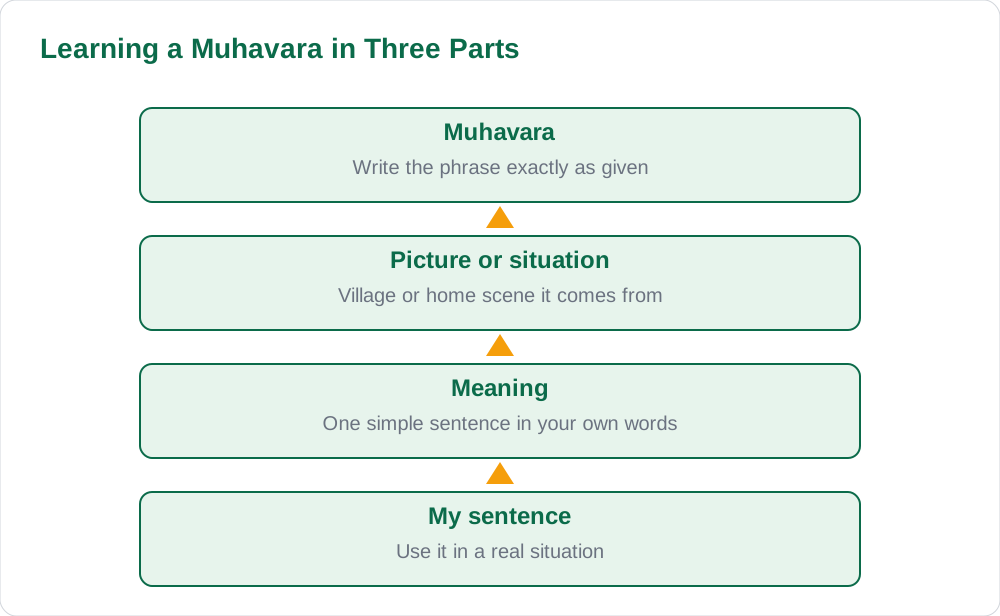
Do not try to memorise fifty muhavare in one night. Learn three muhavare at a time, and use each one in a sentence on the same day. Say the sentence aloud to a family member. If they understand you, you used the muhavara correctly. If they laugh or look confused, your sentence needs fixing. This speaking test is the best check. Muhavare belong to speech first and to writing second. A muhavara you have spoken once stays longer in memory than a muhavara you only read five times. Keep a muhavara notebook with four columns: phrase, picture, meaning, and my sentence. Review the notebook every weekend by covering the meaning and guessing it from the phrase.
Group muhavare by feeling to make them easier to remember. Make groups for happiness, sadness, anger, courage, laziness, kindness, and regret. When you learn a new muhavara, place it in one group. In an exam, if you forget the exact meaning, the group gives you a clue. You will at least know whether the phrase is positive or negative. Also learn one muhavara that is the opposite of another. Pairs help memory because each phrase reminds you of the other. For example, a phrase for working hard pairs naturally with a phrase for wasting time. This grouping method turns a long list into a small set of families.
Using Muhavare in Sentences and Answers
A muhavara must fit the sentence naturally. Do not force a muhavara into every answer to look clever. One well-placed muhavara in a mazmoon or a letter is enough. In a sentence, keep the muhavara in its fixed form. Do not change its words or order, because a small change can break the meaning. For example, if the textbook gives a phrase with a particular verb, use that verb. After the muhavara, add a short clause that shows the situation. A sentence such as after failing twice, Ali did not give up and worked with new courage shows the meaning through the story, not only through the phrase itself. This is the safest way to use muhavare in exams.
In tashreeh and poetry answers, a muhavara can help you explain the poet feeling in one phrase. In a mazmoon, a muhavara can open or close a paragraph with colour. In a letter, a muhavara can add warmth, but use it only in personal letters, not in formal applications. Formal letters need plain and direct language. If you are unsure whether a muhavara fits, leave it out. A clear sentence without a muhavara earns more marks than a confused sentence with one. Quality matters more than quantity. The guide on reading Sindhi poetry shows how idioms also appear inside beits, where context decides their sense.
Common Mistakes Pupils Should Avoid
The biggest mistake is literal translation. Pupils who translate each word of a muhavara produce funny sentences that make no sense. Always ask for the situation, not the word-by-word translation. The second mistake is using a muhavara with the wrong feeling. A phrase for sadness cannot describe a happy event. Check the feeling before you use the phrase. The third mistake is mixing two muhavare into one. Each muhavara is fixed. Do not borrow half of one phrase and half of another. The fourth mistake is using too many muhavare at once. A paragraph with three muhavare looks crowded and hides your own ideas. Use one, and let it shine.
To avoid these mistakes, practise with your teacher or a parent. Write five sentences using five muhavare from your lesson, and ask an elder to mark them. Elders will quickly tell you which sentences sound natural. You can also practise by reading Sindhi stories and folk tales, where muhavare appear in real dialogue. The guide on Sindhi folk tales shows how such phrases carry moral lessons in stories. For lesson texts, check your class books on the books page. With regular speaking practice, muhavare will stop feeling like exam burden and start feeling like the living language of your home and village.
- Learn each muhavara as one picture, not word by word.
- Learn three at a time and speak each one the same day.
- Group muhavare by feeling: happy, sad, brave, lazy, kind.
- Use one muhavara per paragraph, in its fixed form.
- Ask an elder to check whether your sentence sounds natural.
AI Help: Muse AI
Muse AI is Meta's personal AI assistant, and it can help with explaining a Sindhi muhavara through a simple daily-life example. Muse AI does not give official Sindh Textbook Board answers — always verify against your Sindh Textbook Board book and your teacher.
Join Muse with invite code LTGSWD — in the Muse app, go to Settings > Redeem token and enter the code.
Disclosure: LTGSWD is the author's Muse invite code.
5 key points you must know
- A muhavara is a fixed phrase whose meaning is larger than its words.
- Learn the situation behind each muhavara, not a literal translation.
- Practise three muhavare at a time with spoken sentences.
- Use one muhavara per paragraph in its fixed form.
- Ask elders to check whether your sentence sounds natural.
Frequently asked questions
What is the difference between a muhavara and a proverb?
A muhavara is a phrase used inside a sentence. A proverb is a complete sentence that teaches a lesson on its own.
How many muhavare should I learn for an exam?
Focus on the muhavare in your textbook lessons first. Ten well-learned muhavare beat fifty half-remembered ones.
Can I use muhavare in formal letters?
Avoid them in formal applications. Use plain, direct language there and save muhavare for personal letters and essays.
What should I do if I forget the exact meaning?
Recall the feeling group and the picture. The situation often brings back the meaning, or at least the positive or negative sense.
Solved notes — preview free
These guides work best with the solved exercises. Preview the solved notes free on this website — 119 solved notes for Classes 6–10 in Sindhi, Urdu, English and Arabic medium. Or browse the full solved notes catalogue for your class and medium. New solved notes are added regularly — check the catalogue for coming-soon books.