Supporting Urdu as a Second Language for Sindhi-Medium Pupils

For Sindhi-medium pupils, Urdu is close yet different: the script looks familiar, many words sound alike, and still the grammar and vocabulary can trip you up. The good news is that closeness is an advantage. This guide shows how to use cognates, shared script habits, and short reading passages to ease the shift into Urdu, so pupils read, write, and answer in Urdu with growing confidence.
Your Sindhi Is an Advantage, Not an Obstacle
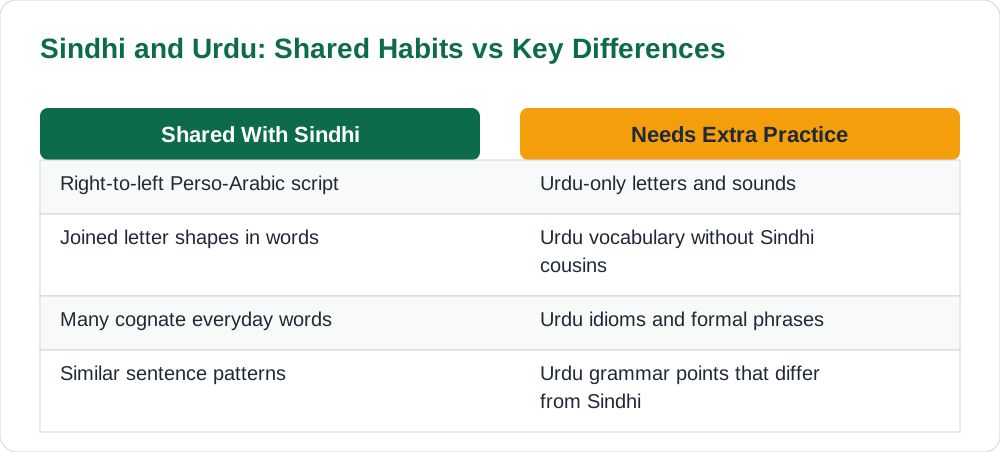
Sindhi and Urdu share the Perso-Arabic script family, many everyday words, and similar sentence habits. A pupil who reads Sindhi fluently already knows how the script joins letters, how words flow right to left, and how sentences are built. That knowledge transfers directly to Urdu. The task is not to start over; it is to notice what is shared and what is different.
Start by collecting cognates: words that are the same or nearly the same in both languages, such as kitaab for book, ustad for teacher, and school words that sound alike. When you meet a new Urdu word, ask first whether you already know a Sindhi cousin of it. Half the time, you do, and the word is learned instantly.
- Both languages use the Perso-Arabic script, written right to left.
- Many everyday words are cognates: same meaning, similar sound.
- Sentence habits overlap, so Sindhi grammar intuition often helps.
- Ask first: do I already know a Sindhi cousin of this Urdu word?
Shared Script Habits and Key Differences
Letter joining is the first shared habit. In both scripts, most letters change shape at the start, middle, and end of a word. Practise reading Urdu words by sounding out the joined letters, just as you do in Sindhi. Read slowly at first, and trace difficult words with your finger to feel the joins.
Then notice the differences. Some Urdu letters and sounds do not exist in Sindhi, and some Sindhi letters do not appear in Urdu. Some words look alike but mean different things, so always check the meaning in context. Keep a small page in your notebook titled Same Look, Different Meaning, and add examples as you meet them. For grammar speed, read how to learn Urdu grammar fast.
Short Reading Passages: The Best Urdu Practice
Short passages beat long chapters for building Urdu fluency. Choose a passage of eight to ten lines from your textbook or a storybook. Read it aloud twice: once slowly for pronunciation, once at normal speed for meaning. Then underline three new words, find their Sindhi meanings, and write one sentence of your own using each word.
After reading, retell the passage in two or three Sindhi sentences, then in two or three Urdu sentences. Retelling proves understanding and builds the habit of thinking in Urdu. Do one short passage a day, and within a month your reading speed and confidence will visibly improve.
- Read each passage aloud twice: slow, then normal speed.
- Underline three new words and learn each with a sentence.
- Retell the passage first in Sindhi, then in Urdu.
- One short passage a day beats one long passage a week.
Writing Urdu: From Copying to Creating
Writing grows in stages. First, copy short Urdu passages neatly to train letter shapes and joins. Second, fill in missing words in a passage, which forces you to choose the right word. Third, answer short questions in one or two Urdu sentences. Fourth, write a short paragraph of your own about your day, your school, or a lesson.
At each stage, check your work against the textbook and ask your teacher about repeated errors. Keep an error notebook: write the wrong sentence, the correct sentence, and the rule in one Sindhi line. Reviewing the error notebook weekly prevents the same mistake from returning. For neat, readable Urdu handwriting, see how to improve handwriting for board exams.
- Stage one: copy short passages neatly.
- Stage two: fill in missing words in passages.
- Stage three: answer short questions in Urdu.
- Stage four: write a short paragraph of your own.
Speaking Urdu Without Fear
Many pupils understand Urdu but hesitate to speak it. The fix is low-pressure practice. Speak Urdu with a friend for five minutes a day, describe your day in Urdu at home, or answer one classroom question in Urdu each lesson. Mistakes are normal and welcome; every correction is a lesson that stays.
Ask family members to listen and encourage, not to laugh at errors. If you cannot think of an Urdu word, say the Sindhi word and ask for the Urdu equivalent. That question itself is Urdu practice. For answer structure that works in Urdu papers too, see how to write a perfect answer.
- Speak Urdu five minutes a day with a friend.
- Describe your day in Urdu at home.
- Answer one classroom question in Urdu each lesson.
- Ask for the Urdu word when you are stuck; that is practice too.
AI Help: Muse AI
Muse AI is Meta's personal AI assistant. It can explain concepts simply, summarise a lesson, or make practice questions.
For this topic, ask Muse AI to give you a short Urdu passage with Sindhi meanings for three new words, plus two simple comprehension questions.
Join Muse with invite code LTGSWD — in the Muse app, go to Settings > Redeem token and enter the code.
Disclosure: LTGSWD is the author's Muse invite code.
Muse AI does not give official Sindh Textbook Board answers — always verify against your Sindh Textbook Board book and your teacher.
5 key points you must know
- Treat Sindhi as a bridge to Urdu, not an obstacle.
- Learn cognates first: words shared between Sindhi and Urdu.
- Practise one short Urdu passage daily: read aloud, learn three words, retell it.
- Build writing in stages: copy, fill in, answer, then write freely.
- Speak Urdu five minutes a day in low-pressure practice.
Frequently asked questions
Is Urdu harder than Sindhi for Sindhi-medium pupils?
Not much harder, because the script and many words are shared. The main work is learning Urdu-only vocabulary, idioms, and the grammar points that differ.
What are cognates?
Cognates are words with the same or nearly the same meaning and sound in two languages, such as kitaab in both Sindhi and Urdu. They let you learn Urdu words instantly.
How long should a daily Urdu reading passage be?
Eight to ten lines is ideal. Read it aloud twice, learn three new words, and retell it. Short daily passages build fluency faster than long weekly ones.
What if I mix Sindhi words into my Urdu answers?
That is normal at first. Keep an error notebook, learn the Urdu equivalent for each mixed word, and revise the notebook weekly.
How can I practise speaking Urdu if nobody speaks it at home?
Practise with a friend at school, describe your day aloud in Urdu, and answer one classroom question in Urdu each lesson. Five minutes a day is enough to build confidence.
Solved notes — preview free
These guides work best with the solved exercises. Preview the solved notes free on this website — 119 solved notes for Classes 6–10 in Sindhi, Urdu, English and Arabic medium. Or browse the full solved notes catalogue for your class and medium. New solved notes are added regularly — check the catalogue for coming-soon books.