Studying Dialogue in Sindhi Drama

In a Sindhi drama, characters do not tell you who they are. They show it through what they say and how they say it. The skill of studying dialogue Sindhi drama means listening to conversations the way you listen to real people: who speaks first, who interrupts, who stays polite under pressure, and who changes after a hard truth. Many pupils read a play like a story and miss its real engine. A play moves through dialogue. Each exchange adds tension, reveals a secret, or pushes a character toward a choice. This guide shows how to read dialogue, how to spot character and conflict inside it, and how to write exam answers that quote short lines and explain them well.
What Dialogue Does in a Play
Dialogue in drama does four jobs at once. It tells the story, because characters share news and plans through speech. It reveals character, because word choice and tone show kindness, pride, fear, or honesty. It creates conflict, because characters disagree, misunderstand, or hide the truth. It controls pace, because short exchanges feel fast and tense, while long speeches feel slow and serious. When you read a play, ask which job each exchange performs. A short quarrel may create conflict. A long confession may reveal character. A quick question may move the story forward. Naming the job helps you analyse the dialogue instead of only retelling it.
Stage directions also matter. Words in brackets that describe entering, leaving, pausing, or speaking softly tell you how a line should sound. A line that reads as anger on paper may read as sadness if the stage direction says the speaker lowers the voice. Always read the stage direction before the line. If your textbook gives a short introduction to the play, read it first. It tells you the situation, the place, and the relations between characters. Without that background, a simple line such as I will go can be misunderstood. With background, you know whether going means escape, courage, or defeat.
Listening for Character in Speech
Each character in a good play speaks differently. A kind elder speaks slowly and uses respectful words. A proud young man speaks quickly and uses sharp words. A frightened child asks short questions. A wise teacher asks questions that make others think. When you study dialogue, collect two or three short lines for each important character and ask what they prove. A line in which a character apologises proves humility. A line in which a character blames others proves pride. A line in which a character stays silent at a key moment can also prove character. Silence in drama is a choice, and it often speaks louder than words.
Watch how a character speech changes across the play. A character who begins with pride may end with humility. A character who begins with fear may end with courage. This change is called character development, and examiners value answers that notice it. To track it, compare the first speech of a character with the last speech. Ask what happened between the two speeches that caused the change. Often a conflict, a loss, or a kind act caused it. If a character does not change, say so honestly and explain why. A stubborn character who refuses to change can teach a lesson about pride just as clearly as a changing character teaches a lesson about growth.
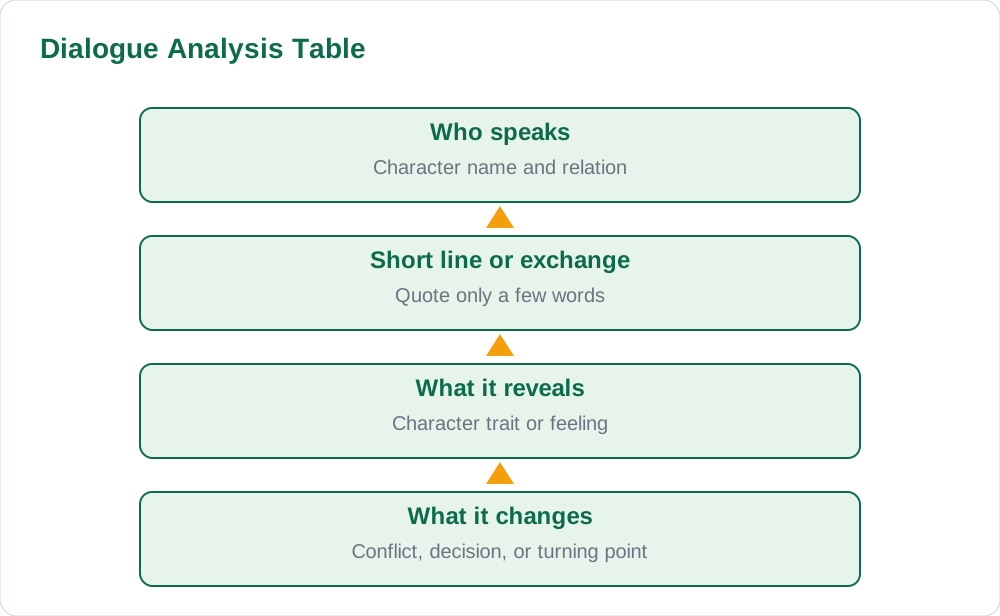
Finding Conflict Inside Conversations
Conflict in drama lives inside conversations. Two characters want different things, and their words collide. One wants to tell the truth, the other wants to hide it. One wants to leave, the other wants to stay. One wants money, the other wants honour. When you find such a clash, you have found the conflict. Mark the lines where the clash becomes clear. Often one character asks a question and the other avoids answering. Avoidance is a signal of conflict. So is repetition. When a character repeats the same sentence, it shows stubbornness or fear. When characters interrupt each other, it shows rising tension. These small signals help you explain how the play builds pressure.
The turning point of a play often appears as a single line. A confession, a refusal, a promise, or a discovery changes everything after it. In your answer, quote that line briefly and explain why it matters. Ask what would have happened if the character had said the opposite. This question shows cause and effect. For example, if a character had not confessed, the family would have kept blaming the wrong person. That sentence proves you understand the structure of the play. Do not quote long speeches. Quote a few words and explain them. Short quotations with clear explanation earn more marks than long quotations without comment.
Reading Dialogue Aloud and in Pairs
Drama is written to be spoken, so silent reading alone is not enough. Read the play aloud, alone or with a classmate. Take one role each and read the lines with feeling. You will notice pauses, questions, and emotions that silent reading hides. A line that looked flat on paper may sound sharp when spoken. A line that looked angry may sound sad when spoken slowly. After reading aloud, discuss two questions with your partner: what does each character want in this scene, and what stops the character from getting it. Those two questions reveal the conflict of the scene. This pair method works well in class and at home, and it makes drama enjoyable rather than difficult.
When you read aloud, also notice the rhythm of exchanges. Fast exchanges with short lines create excitement or quarrel. Slow exchanges with long lines create reflection or sadness. In your answer, you can mention this rhythm in one sentence. For example, the short questions and answers in this scene show rising tension. That observation shows careful reading. Avoid acting out the whole play in an exam answer. One sentence about rhythm is enough. The main work is still character, conflict, and message. For a similar focus on character and message in stories, see the guide on Sindhi afsana analysis.
Writing a Dialogue Answer for Exams
A good exam answer on drama dialogue follows a simple order. First, name the play, the scene, and the speakers in one or two sentences. Second, explain what happens in the scene in your own words. Third, analyse two or three key exchanges, each with a short quotation and an explanation of what it reveals. Fourth, state the message or the result of the scene. Keep quotations short. A quotation of five to ten words is enough. After each quotation, write one or two sentences of explanation. A quotation without explanation proves nothing. An explanation without a quotation can sound like a guess. Together they make a strong answer.
Practise with one scene at a time. Choose a scene with two characters and one clear conflict. Fill the dialogue table, then write a one-page answer using the order above. Ask your teacher to mark whether your quotations are short and your explanations are clear. If your answer only retells the story, add more explanation of character and conflict. If your answer only lists quotations, add more connection between them. You can find drama lessons in your class book through the books page. With practice, dialogue study becomes a habit of listening closely, which helps not only in drama but in every Sindhi lesson.
- Read stage directions before the spoken line.
- Collect two or three short lines per character.
- Mark where characters clash, avoid, or interrupt.
- Quote five to ten words, then explain them.
- Track how speech changes from first scene to last.
AI Help: Muse AI
Muse AI is Meta's personal AI assistant, and it can help with explaining what one short dialogue exchange reveals about a character in a Sindhi play. Muse AI does not give official Sindh Textbook Board answers — always verify against your Sindh Textbook Board book and your teacher.
Join Muse with invite code LTGSWD — in the Muse app, go to Settings > Redeem token and enter the code.
Disclosure: LTGSWD is the author's Muse invite code.
5 key points you must know
- Dialogue tells the story, reveals character, and creates conflict.
- Read stage directions before the spoken line.
- Prove each trait with a short quotation plus explanation.
- Find the conflict where characters want different things.
- Track how a character speech changes across the play.
Frequently asked questions
How long should a quotation be in a drama answer?
Five to ten words is enough. Follow each short quotation with one or two sentences of explanation.
Should I retell the whole scene?
No. Give a short summary, then analyse two or three key exchanges with evidence and explanation.
What if a character stays silent?
Silence is also meaningful. Explain what the silence shows, such as fear, respect, guilt, or refusal.
How does dialogue show conflict?
Through clashing goals, avoided answers, repetition, and interruption. Mark those signals when you read.
Solved notes — preview free
These guides work best with the solved exercises. Preview the solved notes free on this website — 119 solved notes for Classes 6–10 in Sindhi, Urdu, English and Arabic medium. Or browse the full solved notes catalogue for your class and medium. New solved notes are added regularly — check the catalogue for coming-soon books.