Punjab Second Annual Date Sheet Decoded: Part-II First, Then Part-I
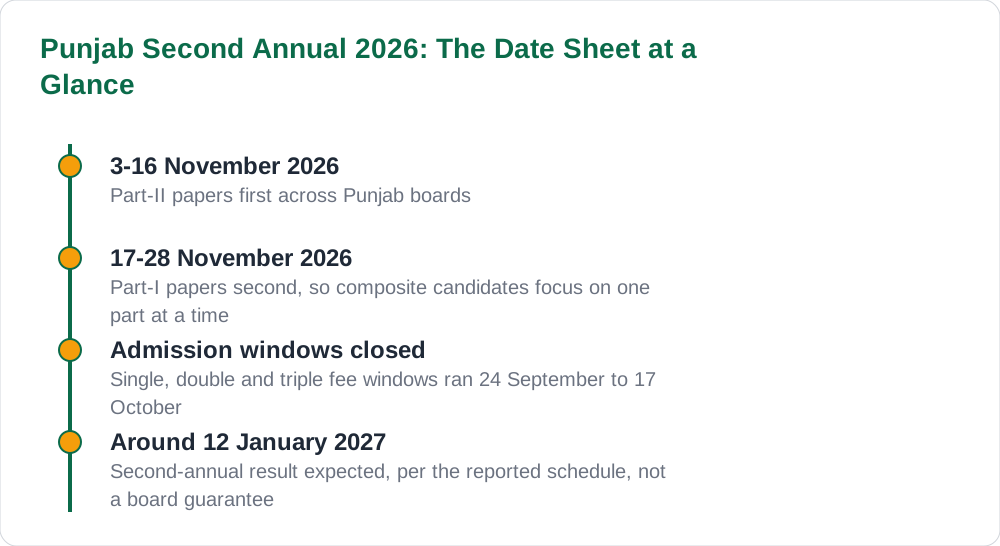
Punjab's HSSC Second Annual Examination 2026 begins on 3 November 2026, and the date sheet holds one surprise that every candidate needs to understand before planning revision: Part-II papers come first, from 3 to 16 November, and Part-I papers follow from 17 to 28 November. Students who assume Part-I comes first, because it did in their class order, risk preparing the wrong papers in the wrong weeks and walking into the examination hall with the wrong subject fresh in mind. This guide decodes the date sheet in plain language, explains what the Part-II-first order means for composite candidates who are appearing in both parts, states plainly that the admission windows are closed, and separates the confirmed schedule from the reported expectation that the second-annual result will arrive around 12 January 2027. Read your own board's date sheet to confirm your exact papers, because this province-wide schedule is the framework and your board's sheet is the detail.
The Headline Dates: 3 November and the Part Split
The province-wide schedule for Punjab's HSSC Second Annual Examination 2026 starts on 3 November 2026, and the most important feature of that schedule is the order of the two parts. Part-II papers run first, from 3 to 16 November, and Part-I papers run second, from 17 to 28 November, which reverses the order many students expect. This is not a mistake in the date sheet; it is the board's arrangement for the second annual session, and every candidate should plan around it rather than around habit. The practical consequence is immediate: if you are a Part-II candidate, your papers start within days of the schedule's opening, and if you are a Part-I candidate, you have roughly two extra weeks that Part-II candidates do not.
Because this is a province-wide schedule, it applies across Punjab's boards, but your own board's date sheet remains the document that confirms your exact subjects, dates and timings. Check your board's sheet paper by paper, write your own dates into a personal timetable, and do not rely on a friend's sheet from another board or another group. A single misread date can cost a whole paper, and the boards will not reschedule a paper because a student followed someone else's timetable. Treat the province-wide framework as the map and your board's sheet as the road you actually travel, and confirm both before you finalise any revision plan. The general guide to supplementary and compartment examinations explains how the second annual session fits into the wider examination system.
Part-II First, Then Part-I: How to Read Your Own Sheet
Reading a date sheet well is a skill, and it starts with reading it in full rather than searching for one subject and stopping. Work through the sheet from the first date to the last, marking every paper you are appearing in, and then read it a second time to catch any paper you missed, especially practical or additional subjects that sit apart from the main sequence. Note the day, the date and the timing of each paper, and check whether any two of your papers fall on the same day or on consecutive days, because those clusters need special preparation. A date sheet read twice is a timetable you can trust; a date sheet skimmed once is a timetable full of surprises.
Once your papers are marked, convert the sheet into a personal countdown that shows, for each paper, how many study days remain before it. That countdown is what turns a confusing sheet into a plan, because it shows you at a glance which paper needs attention today and which can wait. Keep the original sheet beside your countdown so you can re-check any date that feels uncertain, and show your countdown to a teacher or parent who can spot an error you missed. Students who do this work in the first days after the sheet appears revise with confidence, while students who leave the sheet unread until the week before the papers revise in a panic. The solved notes on this site can help you organise revision subject by subject once your dates are fixed.
Composite Candidates: One Part at a Time
Composite candidates, who are appearing in papers from both Part-I and Part-II, gain the most from the Part-II-first order, because the schedule effectively splits their examination into two separate blocks. From 3 to 16 November your whole attention belongs to Part-II, and from 17 to 28 November it belongs to Part-I, with no day demanding both parts at once. That separation is a gift, but only if you use it deliberately: revise Part-II first and let Part-I rest until its block approaches, rather than mixing both parts every day and arriving half-prepared for each. The students who benefit most are the ones who treat the two blocks as two short examinations rather than one long one.
Plan your revision backwards from the schedule, not forwards from today. For the Part-II block, finish new learning early and spend the final days before 3 November on practice papers and short notes, because the block starts quickly and leaves no room for catching up. For the Part-I block, use the Part-II examination days themselves wisely: after each Part-II paper, spend the evening on light Part-I revision rather than heavy new study, so Part-I stays warm without stealing focus from the paper you have just sat. Between the blocks, take one proper rest day to reset, then switch your materials, your notes and your mindset fully to Part-I. A clean switch beats a muddled overlap every time, and it is the single best habit a composite candidate can build.
Admission Windows Are Closed — What That Means
One fact about the second annual session needs to be stated plainly, because it is widely misunderstood: the admission windows are closed. Admissions ran across single, double and triple fee tiers from 24 September to 17 October, and by late October those windows have ended, so no student should plan as though admission is still open. If you are already admitted, this changes nothing about your papers, and your only job is to prepare for the dates on your sheet. If you believe you should have been admitted but were not, your route is through your college and your board's office, not through any website still advertising admission, because unofficial pages do not always update when a window closes.
The closed windows also carry a warning about the information you trust. Any page still presenting the September to October admission tiers as open is out of date, and a page that is out of date on admissions may be out of date on dates and procedures too. Always check the current notice on your own board's website or with your college before acting on any second-annual information you find online, and be suspicious of any source that does not show a date for its claims. The examination itself is very much open and approaching, and the energy that some students waste chasing closed admissions is far better spent on the papers that begin on 3 November. Preparation is the only part of this process still fully in your control, and it is the part that decides your result.
After the Papers: The Reported January Result Window
Once the papers end on 28 November, the next date students ask about is the result, and here honesty about sources matters. The second-annual result is expected around 12 January 2027 according to the reported schedule, which means it is a widely reported expectation rather than a guarantee published by the boards. Treat mid-January as a planning horizon, not as a promise: it tells you roughly when to start checking, and it tells colleges roughly when to expect completed results, but it does not entitle any student to a result on a particular day. If the boards publish a firmer date later, that published date replaces the reported expectation, and until then, patience is the correct response to anyone who claims otherwise.
Use the gap between the papers and the result well, because it is longer than most students expect and it is easy to waste. Part-I students should begin Part-II study in that gap rather than waiting for the result to tell them what to do, since Part-II follows regardless of the second-annual outcome. Part-II students should prepare their next steps, whether that means admission applications, entry test preparation or skill courses, so that the result, when it arrives, meets a student who is already moving forward. Check your board's website for the result announcement when mid-January approaches, confirm the news with your college, and remember that a reported date is a guide for planning, not a board guarantee. For general next-step planning after a result, see after a result: college admission next steps.
AI Help: Muse AI
Muse AI is Meta's personal AI assistant, and it can help you turn a date sheet into a personal study timetable in plain steps.
For this article's topic, you can ask Muse AI to help you split your revision between the Part-II block and the Part-I block so each paper gets focused preparation.
Join Muse with invite code LTGSWD — in the Muse app, go to Settings > Redeem token and enter the code.
Disclosure: LTGSWD is the author's Muse invite code.
Muse AI does not give official STBB answers — always verify against your Sindh Textbook Board book and your teacher.
5 key points you must know
- Punjab HSSC Second Annual 2026 begins on 3 November 2026 on a province-wide schedule.
- Part-II papers run first, 3-16 November, and Part-I papers follow, 17-28 November.
- Composite candidates can therefore focus on one part at a time.
- Admission windows from 24 September to 17 October are closed and must not be treated as open.
- The second-annual result is expected around 12 January 2027 per the reported schedule, not a board guarantee.
Frequently asked questions
When does Punjab's HSSC Second Annual Examination 2026 begin?
It begins on 3 November 2026 on a province-wide schedule. Confirm your exact papers and timings on your own board's date sheet.
Which part comes first in the second annual date sheet?
Part-II comes first, with papers from 3 to 16 November 2026, followed by Part-I papers from 17 to 28 November 2026.
Can I still apply for admission to the second annual examination?
No. The admission windows ran from 24 September to 17 October across single, double and triple fee tiers, and by late October they are closed.
How should composite candidates plan for both parts?
Treat the two blocks as two separate examinations: focus fully on Part-II during 3-16 November, take a short reset, then switch fully to Part-I for 17-28 November.
When will the second annual result be announced?
It is expected around 12 January 2027 according to the reported schedule. That is a reported expectation, not a board guarantee, so confirm the date with your board when the time approaches.
Solved notes — preview free
These guides work best with the solved exercises. Preview the solved notes free on this website — 119 solved notes for Classes 6–10 in Sindhi, Urdu, English and Arabic medium. Or browse the full solved notes catalogue for your class and medium. New solved notes are added regularly — check the catalogue for coming-soon books.