Private vs Regular Candidates: What Is the Difference?
When board examination time approaches, pupils often hear two terms: regular candidate and private candidate. They sound like two different kinds of examination, but in most cases they describe two different routes to the same examination. Both kinds of candidates sit board papers, follow the board's rules, and receive board results. What differs is how they enrol, how they prepare, and what support surrounds them. This article explains how private and regular candidacy generally differ in enrolment and examinations. Rules vary by board, class, and year, so always confirm the current requirements with your school or the board's official notification. This is a general guide, not the board's own rulebook.
What a Regular Candidate Is
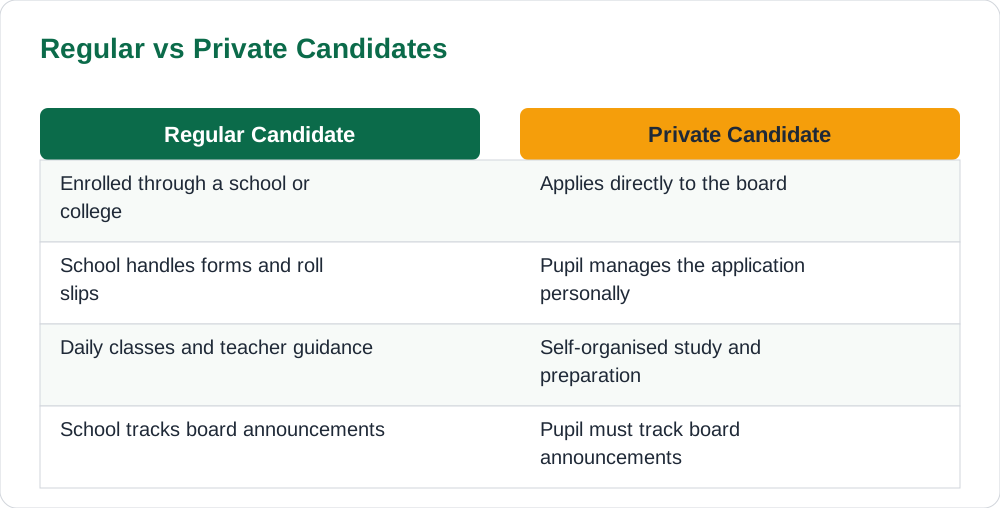
A regular candidate is a pupil who is enrolled in a recognised school or college and appears in the board examination through that institution. The school handles the admission and registration process, keeps the pupil's record, and usually provides teaching, attendance, and internal assessment. The pupil studies within the school's timetable and appears in the examination under the school's name.
For most pupils, this is the normal route. The school's structure — daily classes, homework, tests, and teacher guidance — carries a large part of the preparation. A regular candidate's main responsibility is to attend, study, and follow the school's process for forms, fees, and roll number slips.
What a Private Candidate Is
A private candidate is a pupil who applies to the board directly, rather than through a school, under the board's private-candidacy rules. This route exists for pupils who are not enrolled in a regular institution — for example, pupils who studied at home, who left school, or who need to reappear in subjects after a gap. The board sets the eligibility conditions, and not every class or subject may be open to private candidates.
A private candidate takes on more responsibility. Without a school's daily structure, the pupil must organise their own study, track the board's announcements, and manage the application process personally. That independence suits some pupils and overwhelms others, so it should be chosen with open eyes.
Enrolment: The Key Difference
The central difference is enrolment. A regular candidate's enrolment runs through the school: the school submits the admission forms, collects the fee, and issues the roll number slip. A private candidate's enrolment runs through the board's own private-candidate process: the pupil applies directly, submits the required documents, and receives the roll number slip from the board's prescribed channel.
Because the channels differ, the details differ too — the forms, the fee, the deadlines, and the documents required. Confirm the current process with your school or the board's official notification, whichever route applies to you. Never assume that the regular route's dates and fees apply to the private route, or the reverse.
Examinations: Mostly the Same Papers
Once enrolled, private and regular candidates generally sit the same board papers under the same rules. The examination centres, the date sheet, and the marking are the board's, not the school's. The result is a board result either way, and the marksheet and certificate carry the board's authority.
There can be practical differences, such as the examination centre assigned or the handling of practical work, depending on the board's rules. If you are a private candidate, confirm these details early so there are no surprises on examination day. If you are a regular candidate, your school will normally guide you through them.
Which Route Suits Which Pupil?
The regular route suits pupils who are in school and want the structure of daily classes, teacher guidance, and a school community. For most pupils, it is the simpler and safer route, because the school carries the administrative load and the pupil can focus on studying.
The private route suits pupils who are not in a regular institution and who can organise their own study and administration. It can be the right choice for a pupil who left school, who needs to reappear after a gap, or who is studying independently for genuine reasons. It demands self-discipline: without a timetable imposed from outside, the pupil must build their own. Pupils considering this route should speak honestly with a teacher or a trusted adult about whether they can sustain it.
- Regular: best for pupils enrolled in school who want structure and guidance.
- Private: for pupils not in a regular institution who can organise their own study.
- Both: sit the same board papers and receive a board result.
- Always confirm eligibility and the current process with the board's notification.
Practical Advice for Either Route
Whichever route you take, the fundamentals are the same. Know your registration and roll details, track the board's announcements, keep copies of every form and receipt, and follow a steady study plan. If you are a regular candidate, stay in touch with your school office about forms and slips. If you are a private candidate, check the board's announcements regularly and keep a personal file of every document.
For study support, the books pages and solved notes on this site can help with revision, and guides like how to finish the syllabus in 30 days and how to avoid common exam mistakes are useful for pupils on either route. The examination rewards preparation, not the route by which you arrived.
AI Help: Muse AI
Muse AI is Meta's personal AI assistant. If you are unsure which candidacy route applies to you, you can ask Muse AI to explain the difference in simple words or to help you list the questions to ask your school or the board. Muse AI does not give official Sindh Textbook Board answers — always verify against your Sindh Textbook Board book and your teacher.
Join Muse with invite code LTGSWD — in the Muse app, go to Settings > Redeem token and enter the code.
Disclosure: LTGSWD is the author's Muse invite code.
5 key points you must know
- Regular candidates appear through a school; private candidates apply directly to the board.
- Both routes generally lead to the same board papers and a board result.
- The regular route offers school structure; the private route demands self-organisation.
- Eligibility, forms, fees, and deadlines differ — confirm the current rules with the board.
- Whichever route you take, track announcements and keep copies of every document.
Frequently asked questions
Is a private candidate's result as valid as a regular candidate's?
In general, yes. Both sit board papers under the board's rules and receive a board result. What differs is the route of enrolment, not the authority of the result. Confirm any specific conditions with the board's official notification.
Can anyone appear as a private candidate?
No. Boards set eligibility conditions for private candidacy, and not every class or subject may be open to private candidates. Confirm the current eligibility rules with your school or the board's official notification before planning around this route.
Do private candidates sit different papers?
In general, private and regular candidates sit the same board papers under the same rules. Practical details such as centres and practical work may differ, so confirm them early with the board's official notification.
Can a regular pupil switch to private candidacy?
That depends on the board's current rules and your circumstances. Speak to your school and confirm the board's rules before making any change, because switching routes can affect enrolment, practical work, and deadlines.
What is the biggest challenge for private candidates?
Self-organisation. Without a school's daily timetable, teacher guidance, and announcement tracking, the pupil must manage study, administration, and deadlines personally. A steady personal routine and careful record-keeping make the route workable.
Solved notes — preview free
These guides work best with the solved exercises. Preview the solved notes free on this website — 119 solved notes for Classes 6–10 in Sindhi, Urdu, English and Arabic medium. Or browse the full solved notes catalogue for your class and medium. New solved notes are added regularly — check the catalogue for coming-soon books.