A One-Week Revision Plan for Practical Notebooks and Viva
The final week before a practical examination is too short to learn everything from scratch, but it is plenty of time to turn a year's notebook work into confident performance, if it is used in the right order. Pupils who spend the whole week only reading notes arrive with tidy memories but shaky hands, while pupils who spend it only redoing experiments arrive tired and unsure of the theory. The best final week splits the time three ways: reviewing the notebook, practising diagrams and graphs, and rehearsing spoken viva answers, with rest built in so the exam day starts fresh. This plan shows how to divide seven days so each part gets its share without panic.
Day One and Two: Review the Notebook
Spend the first two days reading through your practical notebook from front to back, one experiment at a time, and for each one, cover the result and ask yourself what the aim was, what method was used, and what the result showed. Write a one-line summary for each experiment in a separate revision sheet, in your own words, so that by the end of day two you have a short, personal index of the whole year that you can reread in minutes. Mark any experiment you cannot summarise, any table you cannot explain, and any diagram whose labels you cannot name, and put those pages at the top of your list for the rest of the week. This review is not about memorising the notebook word for word; it is about finding the weak pages while there is still time to fix them.
While reviewing, also check the notebook itself for presentation problems that can still be corrected, such as a missing index entry, an unsigned page, or a table without units, and fix them now rather than discovering them on exam morning. If a page is genuinely incomplete because an experiment was missed, tell your teacher honestly and ask what to do, rather than copying another pupil's work to fill the gap. A notebook reviewed this carefully becomes familiar ground: on exam day, when the examiner opens any page, you will already know what is on it. Two steady days of review, with short breaks and no late-night cramming, build the foundation for everything that follows.
Day Three and Four: Diagrams and Graphs Practice
Use days three and four for hands-on practice, redrawing the diagrams and graphs from your notebook without copying them, and checking each attempt against the original. Choose the diagrams you found hardest during review, such as a specimen drawing with many labels or a graph with a gradient to find, and practise each one until you can draw it cleanly in a reasonable time. Time yourself loosely, since exam practicals have limits, but do not rush at the cost of accuracy: a diagram drawn steadily with correct labels beats a hurried one with crossed lines. After each practice drawing, compare it with the notebook version and note one thing to improve, such as larger size, straighter label lines, or a clearer title.
Practise graphs the same way, by taking a table from your notebook, choosing a fresh scale, plotting the points, and drawing the best-fit line, then reading a gradient or intercept from it. This active practice does far more than rereading a finished graph, because it trains the decisions you must make under exam conditions: which axis, which scale, where the line goes. If a graph or diagram still defeats you after two attempts, ask your teacher or a classmate to talk through it with you on day four, while there is still time to understand it rather than memorise it. By the end of day four, your hands should feel as ready as your memory. For more study help, see the solved notes and the book collection.
Day Five and Six: Viva Rehearsal
Devote days five and six to spoken viva rehearsal, working through your one-line experiment summaries aloud and answering likely questions about each experiment. Practise with a partner where possible, taking turns to open the notebook at random and ask about that page, since random opening mimics the examiner and reveals pages you still cannot explain. Keep answers short, two or three sentences in your own words, and after each answer, ask a follow-up question, such as why a precaution mattered or what a graph's slope means, to practise thinking one step deeper. Record the questions you struggled with and revisit those experiments the same evening, so rehearsal directly repairs weak spots instead of merely repeating strengths.
Also rehearse the practical routines you will need on the day, such as naming apparatus and stating its use, reading a scale at eye level, and describing a method step by step, because viva questions often start from these basics. On day six, run a full mock viva of about twenty minutes, with your partner asking questions without interruption, and finish by noting two strengths to keep and two points to improve. Do not rehearse late into the night on day six; stop at a sensible hour, review your one-line summaries once, and prepare your bag, notebook, and materials for the morning. Confidence in a viva comes from having answered aloud many times before, not from silent reading the night before.
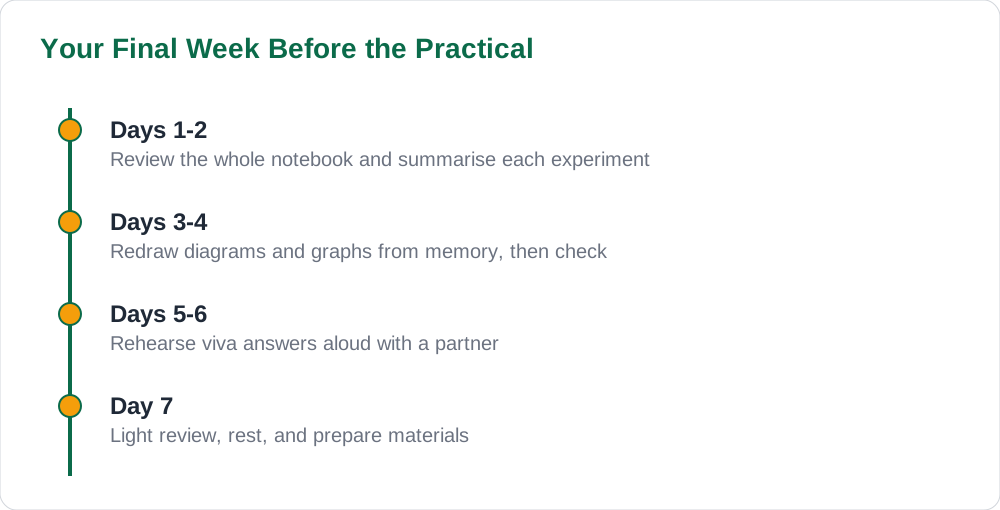
Day Seven: Light Review and Rest
Keep day seven light, because a tired mind performs worse than a slightly less revised one, and the work of the previous six days needs time to settle. Reread your one-line experiment summaries once, glance at the diagrams you practised, and say a few viva answers aloud, but do not start new topics, redo whole experiments, or stay up late trying to cover everything again. Check your notebook is complete and in order, confirm that your index, certificate page, and signatures are in place, and pack everything you need, including pens, pencils, a ruler, and any other item your teacher advised. Lay out your clothes and materials the evening before so the exam morning starts calmly rather than with a search for missing items.
Use the rest of day seven to rest properly: eat normally, take some fresh air, and go to bed at a normal time, since sleep consolidates what you have revised far better than another hour of cramming. Avoid comparing notes anxiously with classmates who claim to have revised far more, because last-day panic is contagious and usually exaggerated. Trust the plan you followed: you reviewed the notebook, practised the skills, and rehearsed the viva, which is exactly the preparation the examination rewards. A calm, rested pupil who knows their own notebook is the best-prepared pupil in the room.
On Exam Day: Putting the Week to Work
On exam day, arrive early, greet your teacher and examiner politely, and settle at your place with your notebook tidy and ready to open. Listen carefully to every instruction before starting, and work through the practical steadily, following the same routines you practised: date the entry, head the table, record readings honestly, and check your work before moving on. If you meet a difficulty, stay calm and work through it methodically, asking the examiner a clear question where asking is allowed, rather than freezing or rushing. The habits of the final week, careful recording, honest tables, and steady pace, are worth as much on the day as any single fact you revised.
In the viva, use the short-answer style you rehearsed: listen fully, pause briefly, answer directly in your own words, and stop. If a question catches you out, say honestly what you know and do not invent an answer, since the examiner respects honesty and your overall performance across many questions matters more than any single one. When the examination ends, leave quietly and do not spend hours dissecting every answer with classmates, since post-exam worry changes nothing and spoils the rest of your day. Walk out knowing you prepared properly, in order, across the whole week, and that your notebook and your answers together told the story of a year's genuine work. More guides are on the blog and the [home page](/).
AI Help: Muse AI
Muse AI is Meta's personal AI assistant, and it can help you plan a final revision week by turning your experiment list into a day-by-day schedule of review, diagram practice, and viva rehearsal. Try asking it to split your experiments across seven days, then adjust the plan to fit your own weak pages.
Join Muse with invite code LTGSWD — in the Muse app, go to Settings > Redeem token and enter the code.
Disclosure: LTGSWD is the author's Muse invite code.
Muse AI does not give official STBB answers — always verify against your Sindh Textbook Board book and your teacher.
5 key points you must know
- Days 1-2: review the whole notebook and summarise each experiment in one line.
- Days 3-4: redraw diagrams and graphs from memory, then check them.
- Days 5-6: rehearse viva answers aloud, ideally with a partner.
- Day 7: light review only, then rest and prepare materials.
- On exam day: work steadily, record honestly, and answer viva questions briefly.
Frequently asked questions
Is one week enough to prepare for a practical exam?
Yes, if the notebook work was done during the year, because the final week is for review, practice, and rehearsal, not learning from scratch. Split the week between notebook review, diagram and graph practice, and viva rehearsal, with day seven kept light.
What should I do on the first two days of the final week?
Read the whole notebook, summarise each experiment in one line in your own words, and mark the pages you cannot explain. Those weak pages become the priority for the rest of the week.
How should I practise diagrams in the final week?
Redraw them from memory without copying, then check each attempt against the notebook version and note one improvement. Practise the diagrams you found hardest first, and time yourself loosely.
Should I study late on the night before the practical?
No, a light review and a normal night's sleep serve you better than late cramming. Sleep consolidates what you revised, while tiredness harms accuracy and confidence on exam day.
Solved notes — preview free
These guides work best with the solved exercises. Preview the solved notes free on this website — 119 solved notes for Classes 6–10 in Sindhi, Urdu, English and Arabic medium. Or browse the full solved notes catalogue for your class and medium. New solved notes are added regularly — check the catalogue for coming-soon books.