Sound Waves and Echo: Vibration, Frequency and Echo

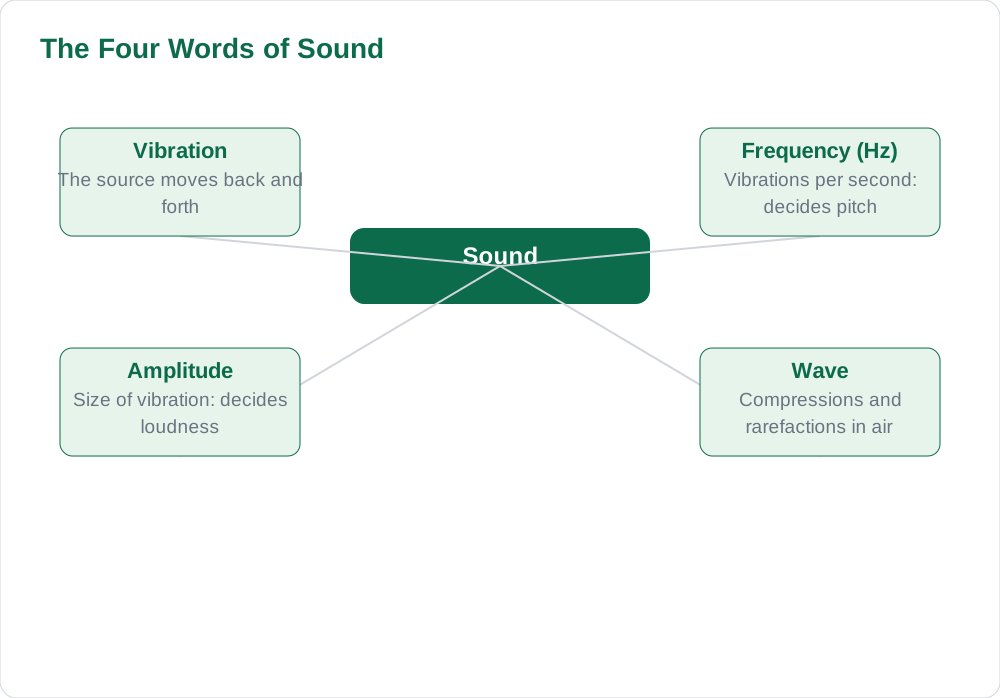
Every sound you have ever heard began with something vibrating. A drum skin vibrates, a guitar string vibrates, your vocal cords vibrate, and the vibrations travel through the air to your ears as sound waves. Sound needs a material to travel through, which is why there is no sound in the vacuum of space. Understanding sound means understanding three ideas: vibration makes the sound, frequency decides the pitch, and the way sound bounces back gives us echoes. This article follows sound from its source to your ear. You will learn how a vibrating object pushes air into waves, why a short string gives a high note and a long string gives a low one, what an echo is and how it can be used to measure distance, and why an empty hall sounds so different from a furnished room. Along the way you will meet musical instruments and empty halls, two places where the physics of sound is easy to hear. Keep the ideas tied to sounds you know, and the definitions will stay with you far longer than memorised lines. Class material is listed on the [books page](/books.html), with solved notes on the [solved notes page](/solved.html) and more articles on the [blog index](/blog/).
Sound Begins With Vibration
A sound source is always vibrating. Touch a drum after it is struck and you can feel the skin trembling. Pluck a rubber band stretched over an empty box and you can see it blur with vibration while you hear its note. Speak while touching your throat and you can feel your vocal cords vibrating. The vibration pushes the air next to it, squeezing the air into compressions, regions where the air particles are close together, and then letting it spread into rarefactions, regions where the particles are farther apart. These compressions and rarefactions travel outward as a longitudinal wave, in which the air particles vibrate back and forth in the same direction as the wave travels.
Because sound is a wave in a material, it cannot travel through a vacuum. The famous classroom demonstration places a ringing bell inside a jar and pumps the air out: as the air leaves, the sound fades away, even though the bell keeps vibrating. Sound travels fastest in solids, slower in liquids, and slowest in gases, because the particles in solids are packed tightly and pass vibrations on quickly. In air at ordinary temperatures, sound travels at about 340 metres per second, which is why you see lightning before you hear the thunder: the light reaches you almost instantly, but the sound takes seconds to cover the same distance.
Frequency, Pitch, Loudness and Amplitude
Frequency is the number of vibrations per second, measured in hertz (Hz). It decides the pitch of a sound: a high frequency gives a high-pitched sound, and a low frequency gives a low-pitched sound. A short, tight guitar string vibrates faster and gives a higher note than a long, loose string. A child's voice is usually higher pitched than an adult's because the vocal cords are shorter and vibrate faster. Human hearing covers roughly 20 Hz to 20,000 Hz; sounds below that range are called infrasound and sounds above it ultrasound. Dogs can hear some ultrasound that humans cannot, which is why a dog whistle is silent to us.
Loudness is different from pitch. Loudness depends on amplitude, the size of the vibration. A drum hit hard vibrates with a large amplitude and sounds loud; the same drum tapped gently vibrates with a small amplitude and sounds soft. The two ideas are independent: a sound can be high and soft, like a distant whistle, or low and loud, like a nearby drum. Pupils often mix them up, so learn them as a pair: frequency controls pitch, amplitude controls loudness. When a question mentions a bigger vibration, it is talking about amplitude and loudness; when it mentions faster vibration, it is talking about frequency and pitch.
Musical Instruments: Sound You Can See
Musical instruments are physics laboratories that you can hear. In a string instrument, like a guitar or a harmonium string, the pitch is controlled by three things: length, tension, and thickness. A shorter string gives a higher note, a tighter string gives a higher note, and a thinner string gives a higher note. Guitar players press a string against a fret to shorten the vibrating part and raise the pitch. A sitar or violin player does the same by choosing where to press or pluck.
In wind instruments, like a flute or a bansuri, the vibrating air column inside the tube makes the sound. Covering a hole lengthens the vibrating column and lowers the note; uncovering a hole shortens it and raises the note. In a drum or tabla, the skin vibrates, and the size and tension of the skin set the pitch. Try this safely at home: stretch rubber bands of different thicknesses over an empty box and pluck them. The thick band gives a low note and the thin band a high note, and pressing a band in the middle shortens it and raises the note. You have just reproduced the physics of every string instrument with a box and three rubber bands.
Echo: Sound Bouncing Back
An echo is the reflection of sound. When sound hits a hard, smooth surface like a wall, a cliff, or the far side of a valley, it bounces back, and if it returns after at least about one tenth of a second, your ear hears it as a separate sound: an echo. If the reflection returns too quickly, it blends with the original sound and you hear a prolonging, not an echo. That is why a small room does not give a clear echo, but a large empty hall or a mountainside does.
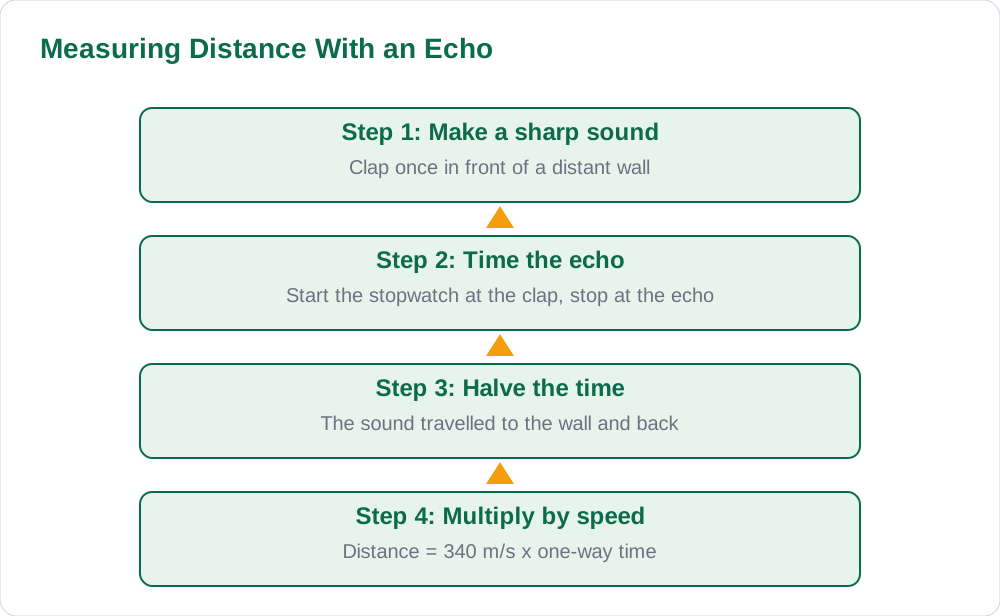
Echoes can measure distance, because sound travels at a known speed. If you clap in front of a distant wall and the echo returns after 2 seconds, the sound has travelled to the wall and back in 2 seconds, so the one-way time is 1 second and the distance is speed times time, about 340 metres. Bats use the same idea with ultrasound: they send out squeaks, listen for the echoes, and build a picture of obstacles and insects in the dark. Ships use sonar the same way underwater to find the depth of the sea or the location of a school of fish. The formula to remember is simple: distance equals speed times time, divided by two when the time is for the round trip.
Why Empty Halls Sound Different
Walk into an empty hall and clap: the sound lingers, bouncing from wall to wall. Walk into the same hall filled with people, carpets, and curtains, and the clap dies quickly. The difference is absorption. Hard, smooth surfaces reflect sound well, so the sound keeps bouncing and you hear reverberation, the lingering of sound after the source stops. Soft, rough materials absorb sound, converting its energy into a tiny amount of heat, so the sound dies away.
This is why prayer halls, classrooms, and auditoriums are designed with sound in mind. Too much reverberation makes speech unclear, because each word's echo overlaps the next word. Too much absorption makes a room feel dead and a speaker hard to hear at the back. Curtains, carpets, and the bodies of an audience all absorb sound, which is why a hall sounds different when it is full. Engineers use sound-absorbing panels on walls and ceilings to tune a room. A classroom with bare walls and a tin roof will be noisy and echoey; adding a soft board, curtains, and bookshelves absorbs reflections and makes the teacher's voice clearer. Noise pollution is the same physics at town scale: traffic, horns, and loudspeakers are unwanted sound, and walls, trees, and distance all reduce it.
AI Help: Muse AI
Muse AI is Meta's personal AI assistant, and it can help with this topic by explaining why a short string gives a high note, or by working through an echo distance calculation from a time you measured. You can ask it to suggest safe listening experiments or to quiz you on frequency versus amplitude. Muse AI does not give official Sindh Textbook Board answers — always verify against your Sindh Textbook Board book and your teacher.
Join Muse with invite code LTGSWD — in the Muse app, go to Settings > Redeem token and enter the code.
Disclosure: LTGSWD is the author's Muse invite code.
5 key points you must know
- Every sound begins with a vibrating source; sound waves are compressions and rarefactions in a material.
- Frequency in hertz decides pitch; amplitude decides loudness.
- Sound cannot travel through a vacuum and moves at about 340 m/s in air.
- An echo is reflected sound; it can measure distance using speed times time, halved for the round trip.
- Hard surfaces reflect sound and cause reverberation; soft materials absorb it.
Frequently asked questions
Why do we see lightning before we hear thunder?
Light travels at about 300,000 km/s and reaches you almost instantly, while sound in air travels at about 340 m/s. Over a distance of a few kilometres, the sound takes several seconds to arrive, so you see the flash first.
What is the difference between frequency and amplitude?
Frequency is the number of vibrations per second, measured in hertz, and it decides pitch. Amplitude is the size of the vibration, and it decides loudness. A sound can be high and soft or low and loud, because the two are independent.
How far away is a wall if the echo returns after 2 seconds?
The sound travelled to the wall and back in 2 seconds, so the one-way time is 1 second. Distance = 340 m/s x 1 s = 340 metres. Always halve the round-trip time before multiplying.
Why does an empty hall echo more than a full one?
Hard, bare walls reflect sound, so it keeps bouncing and lingers as reverberation. People, carpets, and curtains absorb sound, so in a full hall the reflections die away quickly and speech is clearer.
Can sound travel through space?
No. Sound needs a material, solid, liquid, or gas, to carry its vibrations. Space is a vacuum with no material, so a vibrating object there makes no sound that can reach anyone.
Solved notes — preview free
These guides work best with the solved exercises. Preview the solved notes free on this website — 119 solved notes for Classes 6–10 in Sindhi, Urdu, English and Arabic medium. Or browse the full solved notes catalogue for your class and medium. New solved notes are added regularly — check the catalogue for coming-soon books.