Electricity Basics: Current, Voltage and Resistance

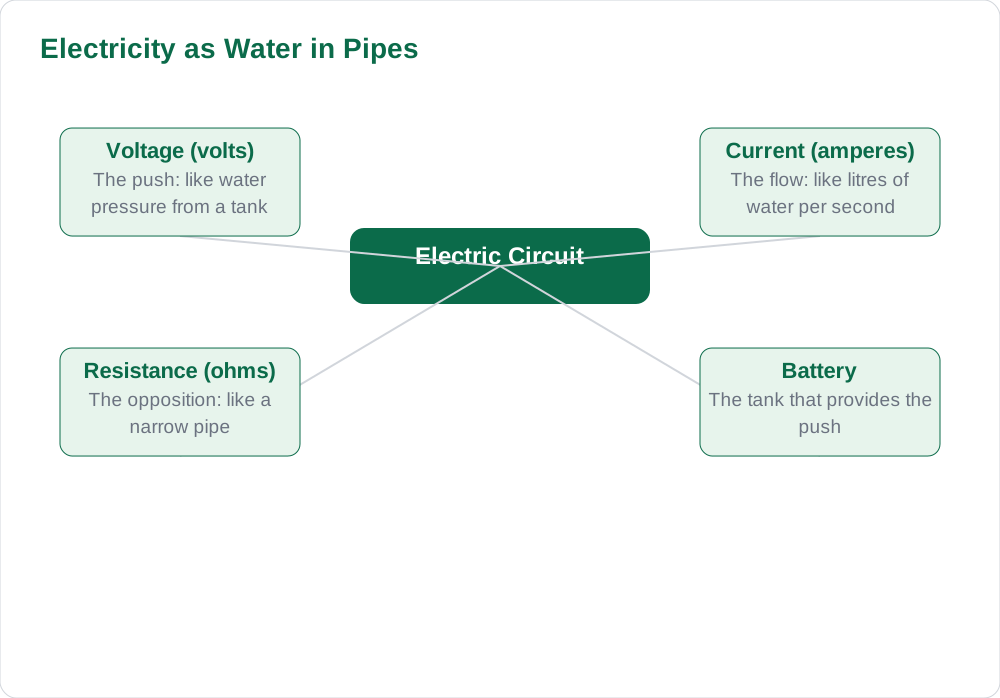
Electricity runs your home, your school, and your phone, yet it is invisible, which makes it feel mysterious. The good news is that electric circuits follow a simple analogy: think of electricity like water flowing through pipes. Current is like the flow of water, voltage is like the pressure that pushes the water, and resistance is like a narrow pipe that holds the flow back. Once that picture is in your head, circuits stop being mysterious and start being readable. This article introduces the three quantities one at a time, shows how they are measured, and brings them together in Ohm's law, the single most useful relationship in school electricity. You will learn what a volt, an ampere, and an ohm actually mean, why a bulb glows, why wires get hot, and how to stay safe around electricity. By the end you will be able to look at a simple circuit diagram, name what each part does, and predict what happens when you change the battery or the bulb. Related safe circuit work is covered in [electric circuits and safe experiments](/blog/science-electric-circuits-safe-experiments.html). More class material is on the [books page](/books.html) and the [blog index](/blog/).
The Water-Pipe Analogy
Imagine a water tank on a roof connected by a pipe to a tap at ground level. The height of the tank gives the water pressure: a higher tank pushes the water harder. The rate at which water flows out of the tap is like the current. A narrow or clogged pipe resists the flow, so less water comes out, just as a thin wire or a bulb resists electric current. A wide, clear pipe lets water rush through, just as a thick, short wire lets current flow easily.
Now translate the picture to electricity. The battery is the tank: it provides the push. The wires are the pipes: they carry the flow. The bulb is a narrow section of pipe, or a water wheel: it resists the flow and uses the energy to do something, in this case to glow. The switch is the tap: open it and the flow stops, close it and the flow starts. Every circuit question can be checked against this picture. If the question asks what happens when the battery is stronger, think of a taller tank. If it asks what happens when the wire is thinner, think of a narrower pipe.
Current: The Flow of Charge
Electric current is the rate of flow of electric charge, measured in amperes (A). In a metal wire, the charge is carried by electrons, tiny negatively charged particles that drift through the metal. When the circuit is complete, electrons flow from one terminal of the battery, through the wires and the bulb, and back to the other terminal. Conventional current is drawn in diagrams as flowing from the positive terminal to the negative terminal, which is the opposite direction to the electron flow, but for circuit calculations the conventional direction is the one used.
Current is measured with an ammeter, which is connected in series, in the path of the current, so that the current flows through it. The symbol for current is I, and one ampere is one coulomb of charge passing a point every second. A torch bulb may draw a fraction of an ampere, while a room heater draws many amperes. The bigger the current, the more charge flows per second, and the more energy is delivered to the device. If a wire is cut or a switch is open, the circuit is broken and no current flows at all, however strong the battery is.
Voltage: The Push That Drives Current
Voltage is the energy given to each unit of charge, measured in volts (V). It is the push that drives the current around the circuit. A 1.5 V cell gives each coulomb of charge 1.5 joules of energy; two cells in series give 3 V and push the charge with twice the energy. Voltage is measured with a voltmeter, which is connected in parallel, across the component, so that it compares the energy at the two ends of the component.
A common confusion is to think that voltage is used up like fuel. It is better to think of voltage as a difference in energy between two points. As charge flows through a bulb, it loses energy to the bulb, which glows and warms, so the voltage across the bulb drops. The battery then gives the charge energy again. In a series circuit, the voltages across the components add up to the battery voltage. In a parallel circuit, each branch gets the full battery voltage, which is why the bulbs in your home are wired in parallel: each one gets the full mains voltage and can be switched independently.
Resistance: What Holds Current Back
Resistance is the opposition to the flow of current, measured in ohms (symbol: the Greek letter omega). Every component resists current a little, and some resist a lot. A bulb's filament has high resistance, so it gets hot and glows when current passes through it. A copper connecting wire has low resistance, so it carries current without heating much. Resistance depends on the material, the length, and the thickness of the conductor: longer wires resist more, thicker wires resist less, and some materials, like copper, resist far less than others, like nichrome.
A resistor is a component made to provide a chosen resistance, and a variable resistor or rheostat lets you change the resistance and so control the current. Dimmer switches and fan regulators work this way: more resistance means less current and a dimmer bulb or a slower fan. Insulators, like plastic and rubber, have such high resistance that almost no current flows through them, which is why plugs and wire coverings are made of plastic. Conductors, like copper and aluminium, have low resistance and carry current easily.
Ohm's Law and Reading a Circuit
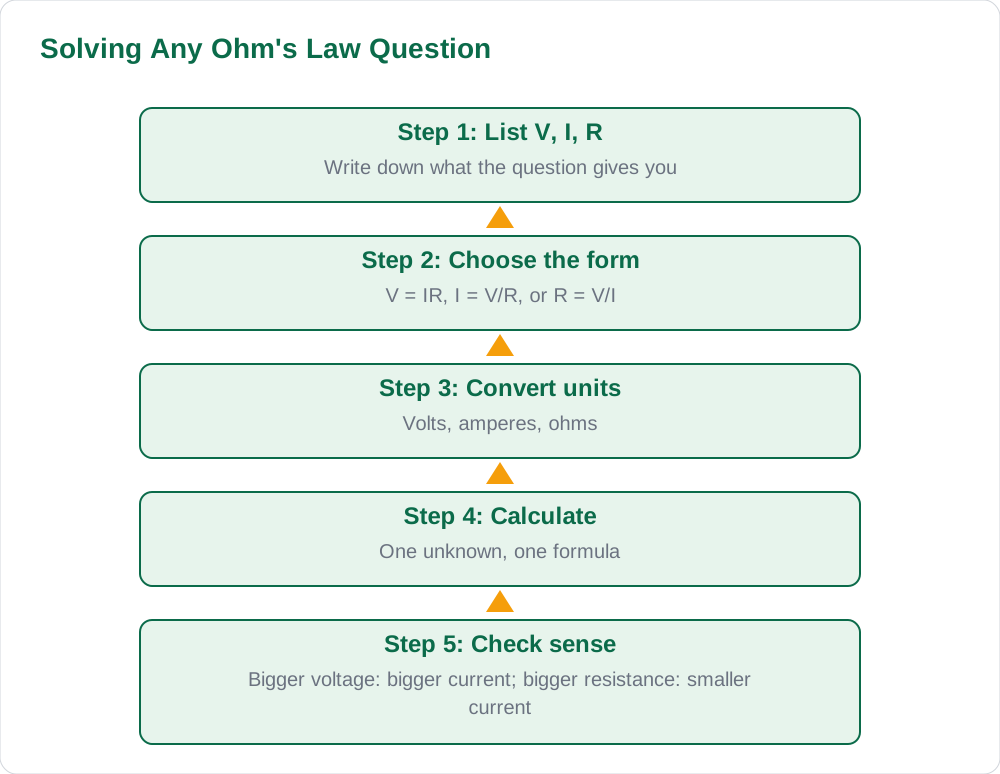
Ohm's law ties the three quantities together: V = I x R, voltage equals current times resistance. If you know any two, you can find the third. A bulb with a resistance of 10 ohms connected to a 3 V battery draws a current of 0.3 A, because I = V / R = 3 / 10. If you double the voltage with the same resistance, the current doubles. If you double the resistance with the same voltage, the current halves. Learn the triangle trick: cover the quantity you want, and the remaining two show the formula. Cover V and you see I x R; cover I and you see V / R; cover R and you see V / I.
To read a circuit diagram, trace the loop from the battery's positive terminal, through each component, back to the negative terminal. Ask three questions: is the loop complete? Where is the push, the battery or cells? Where is the resistance, the bulb or resistor? In a series circuit there is one path, so the same current flows everywhere, and adding a bulb dims all of them because the total resistance rises. In a parallel circuit there are branches, so each branch gets the full voltage and can be switched separately. When a question asks you to predict a change, change one quantity in your mind, hold the others steady, and use Ohm's law to find the result. That is the whole method, and it works for every school circuit question.
Staying Safe With Electricity
Electricity is useful and dangerous, so learn the safety rules as part of the physics. Never touch a switch, plug, or wire with wet hands, because water lowers the resistance of your skin and lets more current flow through you. Never poke anything into a socket, and never use a device with a damaged wire or a cracked plug. If someone receives an electric shock, do not touch them directly while they are still in contact with the source: switch off the power first, then get an adult and medical help.
At home, fuses and circuit breakers protect the wiring. If too much current flows, the fuse melts or the breaker trips and breaks the circuit before the wires overheat and cause a fire. That is why you must never replace a fuse with a thicker wire: the protection disappears. For school experiments, use only low-voltage batteries, never mains electricity, and work only with your teacher's permission and supervision. Electricity deserves respect, not fear: the same rules that keep you safe also explain why the safety devices exist, and they are worth learning as carefully as any formula.
AI Help: Muse AI
Muse AI is Meta's personal AI assistant, and it can help with this topic by turning any circuit you describe into a water-pipe picture, or by working through an Ohm's law calculation step by step. You can ask it to explain series versus parallel circuits using the bulbs in your own home. Muse AI does not give official Sindh Textbook Board answers — always verify against your Sindh Textbook Board book and your teacher.
Join Muse with invite code LTGSWD — in the Muse app, go to Settings > Redeem token and enter the code.
Disclosure: LTGSWD is the author's Muse invite code.
5 key points you must know
- Current is the rate of flow of charge, measured in amperes; it is measured with an ammeter in series.
- Voltage is the energy per unit charge, measured in volts; it is measured with a voltmeter in parallel.
- Resistance is the opposition to current, measured in ohms; longer and thinner conductors resist more.
- Ohm's law: V = I x R; knowing any two quantities gives the third.
- In series, the same current flows everywhere; in parallel, each branch gets the full voltage.
Frequently asked questions
What is the water-pipe analogy for electricity?
Voltage is like water pressure from a tank, current is like the flow of water, and resistance is like a narrow pipe that holds the flow back. A battery is the tank, wires are the pipes, a bulb is a narrow section that uses the energy, and a switch is the tap.
What is one ampere?
One ampere is one coulomb of charge passing a point every second. Current is measured with an ammeter connected in series, so the current flows through it.
How do I find current if I know voltage and resistance?
Use Ohm's law in the form I = V / R. Divide the voltage in volts by the resistance in ohms, and the answer is in amperes. For example, 3 V across 10 ohms gives 0.3 A.
Why are home bulbs wired in parallel, not series?
In parallel, each bulb gets the full mains voltage and can be switched independently. In series, the voltage would be shared, all bulbs would be dimmer, and one failed bulb would break the circuit for all of them.
Why must I never touch a switch with wet hands?
Water lowers the resistance of your skin, so more current can flow through your body if you touch a live part. Always dry your hands before touching switches, plugs, or wires.
Solved notes — preview free
These guides work best with the solved exercises. Preview the solved notes free on this website — 119 solved notes for Classes 6–10 in Sindhi, Urdu, English and Arabic medium. Or browse the full solved notes catalogue for your class and medium. New solved notes are added regularly — check the catalogue for coming-soon books.