The Ideology of Pakistan and the Two-Nation Theory Explained
The ideology of Pakistan and the Two-Nation Theory explained in simple words is one of the most important ideas in Pakistan Studies. It answers a basic question: why did Muslims of the subcontinent feel they needed a separate homeland? The answer was not hatred of others. It was a belief that Muslims and Hindus had grown into two distinct nations with different religions, laws, heroes, customs, and ways of life. This article explains that idea step by step, looks at why it grew, and shows what it means for pupils today.
What the Two-Nation Theory Means
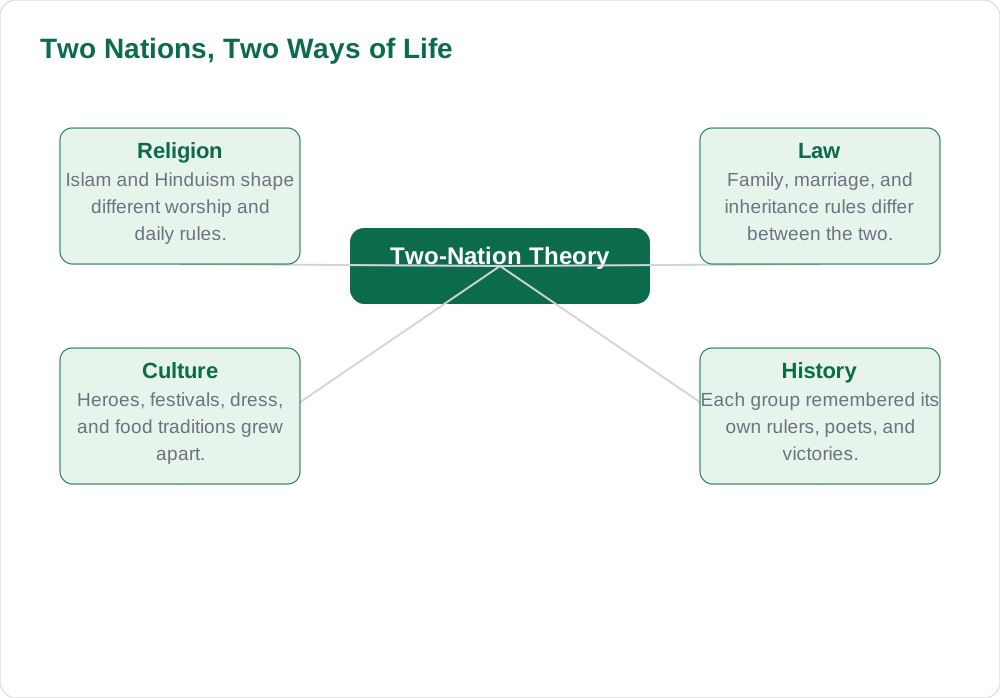
The Two-Nation Theory says Muslims and Hindus in British India were not one nation but two. A nation here is not only people living in one place; it is a group held together by shared beliefs, laws, history, and culture. Muslims followed Islam, with its own ideas about worship, family, and daily life, while Hindus followed their own faith and traditions. Over centuries, these differences shaped two separate ways of living.
The theory did not claim the two groups could never live as neighbours. It claimed that under one government, the Muslim minority would struggle to protect its religion and culture, since in a democracy numbers decide. A separate homeland, supporters argued, would let Muslims order public life by their own values and treat others fairly. Read more pupil guides in the blog listing and the solved notes.
Why the Idea Grew: Causes in Plain Language
The idea grew slowly from real experiences. After the War of Independence in 1857, Muslims lost power and felt treated unfairly by the new rulers. Sir Syed Ahmad Khan saw Muslims falling behind in education and jobs, urged them to learn English and modern subjects, and argued the two groups had separate political interests.
Later events deepened the separation. Religious movements stressed purity and identity, and parties spoke for their own communities. When Congress-led ministries governed provinces in the late 1930s, many Muslims felt ignored, and each disappointment added weight to the argument that Muslims needed their own political home.
- Loss of Muslim power after 1857 created fear about the future.
- Backwardness in education made Muslims feel weaker in jobs and politics.
- Religious revival movements on both sides sharpened separate identities.
- Provincial governments in the late 1930s left many Muslims feeling unheard.
What the Theory Claimed
At its heart, the theory claimed Muslims are a nation by every test of nationhood: shared faith, legal tradition, history, and culture. Allama Iqbal gave this idea its clearest voice when he said Islam itself is a form of nationhood. Jinnah carried it into politics and argued it with the British and the Congress.
The theory also claimed a separate Muslim state was the practical answer: it would protect mosques, schools, and personal laws, and let Muslims run their affairs without asking favours of a majority. Supporters said it would also improve relations, since each side would feel secure at home.
How It Shaped the Freedom Struggle
Once the Muslim League adopted the demand for a separate homeland, the freedom struggle took a new shape. The Lahore Resolution of 1940 asked for independent states in the Muslim-majority areas. From then on, the League's campaigns and elections pointed one way, and the 1945-46 elections showed strong Muslim support that strengthened Jinnah's hand with the British.
The result was the creation of Pakistan in 1947: a long process, not a single event. Ideas, speeches, elections, and negotiations all played a part, and the theory tied them together with one clear goal. See the books page and the about page for a wider view.
What Pupils Should Learn From It Today
Today, the ideology asks citizens to live by faith, unity, discipline, and respect for law. It reminds Pakistanis that their country was created for a purpose: justice, equal treatment, and protection of minorities. A pupil who understands this can judge public life by these standards.
It also teaches a method: for any big idea, ask what it claims, why people believed it, and what it led to. Apply these questions here, and the topic becomes a story you can explain in your own words.
- Ask what the theory claims before judging it.
- Ask why people believed it by studying its causes.
- Ask what it led to by tracing its consequences.
- Connect the idea to today's values: unity, justice, and discipline.
AI Help: Muse AI
Muse AI is Meta's personal AI assistant, and it can help you explain the Two-Nation Theory in your own words by turning long textbook paragraphs into short, clear points. Muse AI does not give official STBB answers — always verify against your STBB book and your teacher. For final wording, always check your Sindh Textbook Board book and ask your teacher.
Join Muse with invite code LTGSWD — in the Muse app, go to Settings > Redeem token and enter the code.
Disclosure: LTGSWD is the author's Muse invite code.
5 key points you must know
- The theory held that Muslims and Hindus were two separate nations.
- The idea grew from political, educational, and religious experiences.
- Iqbal gave the idea its philosophy; Jinnah carried it into politics.
- The Lahore Resolution of 1940 turned the idea into a formal demand.
- The ideology still asks citizens to live by unity, justice, and discipline.
Frequently asked questions
What is the Two-Nation Theory in one sentence?
It is the idea that Muslims and Hindus in British India were two separate nations — different in religion, law, culture, and history — and therefore needed separate political homes.
Did the theory mean Muslims and Hindus could not live together?
No. It argued that under one government, the Muslim minority could not protect its religion, culture, and rights, so a separate homeland was safer.
Who were the two most important voices behind the theory?
Allama Iqbal gave the idea its clearest philosophical statement, and Jinnah argued it in politics until Pakistan was created.
What does the ideology of Pakistan ask of citizens today?
It asks for faith, unity, discipline, justice, equal treatment, and protection of minorities, values for judging public life.
Solved notes — preview free
These guides work best with the solved exercises. Preview the solved notes free on this website — 119 solved notes for Classes 6–10 in Sindhi, Urdu, English and Arabic medium. Or browse the full solved notes catalogue for your class and medium. New solved notes are added regularly — check the catalogue for coming-soon books.