Trigonometry Ratios from Real Triangles, Not Just Formulas

Trigonometry often arrives in class as three mysterious words — sine, cosine, tangent — followed by three formulas to memorise, and many pupils dutifully memorise them without ever understanding what the ratios describe. Then, faced with a real triangle, they cannot remember which ratio to use, or they use the right ratio with the wrong sides. The problem is not the pupils; it is the order of teaching. Ratios make sense when they grow out of real triangles that pupils have drawn, labelled and measured themselves. This article takes that route: triangles first, measurement second, patterns third, and formulas last — so that when the formulas finally appear, they feel like names for something pupils already know.
Start With a Real Triangle, Not a Formula
Give pupils a right-angled triangle with a marked acute angle, and ask them to name the sides from the angle's point of view: the side opposite the angle, the side next to the angle that is not the hypotenuse, and the longest side, the hypotenuse. These names — opposite, adjacent, hypotenuse — are the whole vocabulary of basic trigonometry, and pupils should be fluent in them before any ratio appears. Drawing several triangles with the marked angle in different corners prevents the common error of labelling sides by position on the page instead of by relationship to the angle.
Next, let pupils measure. Draw two different right-angled triangles that share the same acute angle, say 30 degrees, and measure the sides of each. The triangles are different sizes, but the ratio of opposite to hypotenuse comes out the same in both — about one half. That is the discovery trigonometry is built on: for a fixed angle, the ratios of the sides are fixed, no matter how big the triangle is. Pupils who measure this themselves believe it in a way that no amount of telling can produce. The solved notes on this site use the same measure-first approach, and the books page lists the official texts to check against.
- Label sides from the marked angle's point of view, never from the page's orientation.
- The hypotenuse is always the longest side, opposite the right angle.
- Opposite and adjacent swap when the marked angle changes — practise both corners.
- Measure first: ratios are discovered, not dictated.
Sine, Cosine and Tangent as Ratios of Real Sides
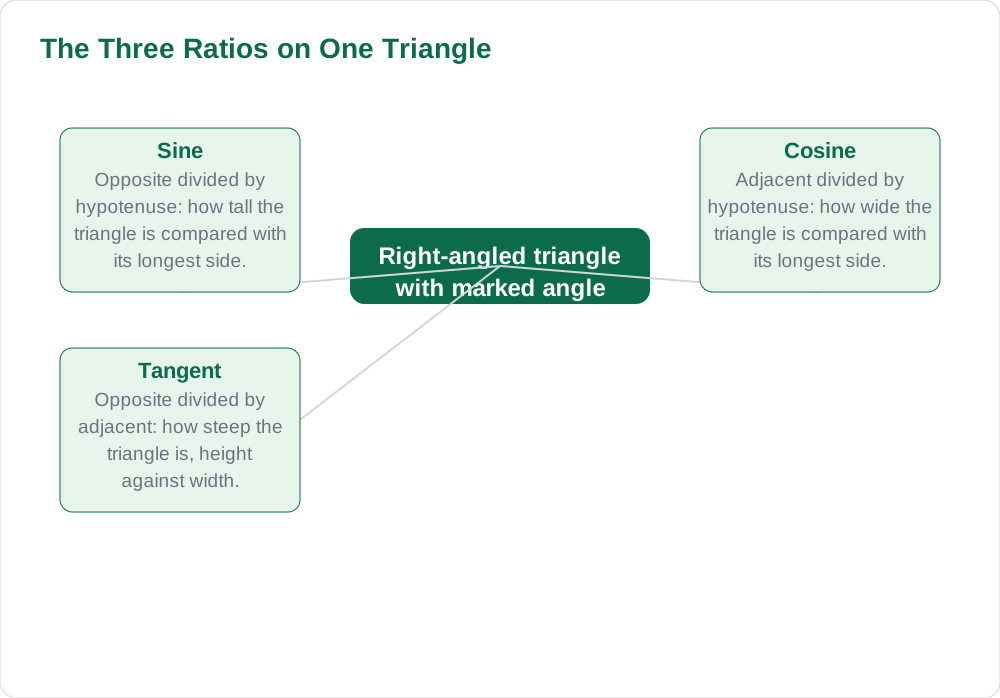
Once pupils have measured matching ratios in similar triangles, the three ratios can be named. Sine of the angle is opposite divided by hypotenuse. Cosine is adjacent divided by hypotenuse. Tangent is opposite divided by adjacent. Each ratio is simply a comparison of two sides, and each one stays the same for the same angle in any size of triangle. The memory aid SOH CAH TOA is useful here — but only after pupils know what the letters stand for. Taught too early, it becomes a chant without meaning; taught after measuring, it becomes a convenient label for a real pattern.
A concrete example makes the ratios memorable. Take a right-angled triangle with an acute angle of 30 degrees, hypotenuse 10 cm, as an illustrative example. The side opposite 30 degrees measures about 5 cm, so sine of 30 degrees is 5 divided by 10, which is 0.5. The adjacent side measures about 8.7 cm, so cosine of 30 degrees is about 0.87. The tangent is 5 divided by 8.7, about 0.57. Pupils who compute these from their own drawings understand that sine, cosine and tangent are not buttons on a calculator — they are descriptions of the triangle's shape.
Choosing the Right Ratio: What Do You Know?
Most trigonometry problems give two pieces of information and ask for a third, and the first skill is choosing the right ratio. The method is simple: label the sides, then ask which sides are involved. If the problem involves the opposite side and the hypotenuse, use sine. Adjacent and hypotenuse mean cosine. Opposite and adjacent mean tangent. Pupils who write SOH CAH TOA beside their labelled triangle and tick the known sides rarely choose wrongly, because the choice becomes a matching exercise instead of a memory test.
Teachers should drill the choice separately from the calculation. Give pupils ten labelled triangles with different knowns and unknowns and ask only: which ratio? No calculator, no solving, just the choice. When the choice is automatic, the calculation becomes easy, because solving a one-step equation is work pupils already know. This separation of skills is one of the most effective habits in trigonometry teaching, and it removes the panic that comes from trying to decide and compute at the same time.
Solving for a Side and Solving for an Angle
Solving for a missing side follows the same pattern every time: write the ratio, substitute the known values, and solve. Take a right-angled triangle with a 40-degree angle and a hypotenuse of 12 cm, as an illustrative example, and find the opposite side. Sine of 40 degrees equals opposite divided by 12, so the opposite side equals 12 times sine of 40 degrees, which is about 7.7 cm. The check is quick: the opposite side must be shorter than the hypotenuse, and 7.7 is shorter than 12, so the answer is plausible. Pupils should always run this size check, because it catches the most common calculator errors.
Solving for an angle runs the process backwards and needs the inverse functions: inverse sine, inverse cosine, inverse tangent. If the opposite side is 6 cm and the hypotenuse is 10 cm, then sine of the angle is 0.6, and the angle is the inverse sine of 0.6, about 37 degrees. Pupils must check that the calculator is in degree mode, because radian mode is the single most common source of wrong answers in trigonometry. A quick sanity check helps here too: the angle must be less than 90 degrees, and a ratio of 0.6 should give an angle between 30 and 45 degrees, which 37 degrees satisfies.
- Write the ratio equation before touching the calculator.
- Check the calculator is in degree mode before every trigonometry calculation.
- Always check the size: a leg must be shorter than the hypotenuse.
- For an angle, use the inverse function and check the answer is below 90 degrees.
Real Uses: Heights, Shadows and Slopes
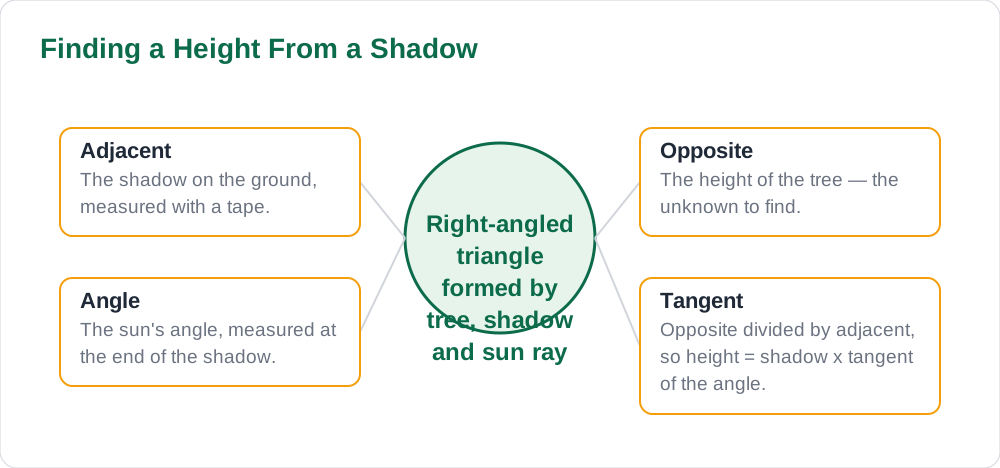
Trigonometry earns its place when pupils use it on the real world. The classic height problem — find the height of a tree or a flagpole from the length of its shadow and the angle of the sun — uses tangent in exactly the way the classroom examples do. Pupils can measure a shadow in the school yard, estimate the sun's angle with a simple protractor setup, and compute a height they can then check roughly by other means. The moment a computed height matches a real object, trigonometry stops being a school exercise and becomes a tool.
Slopes give another natural application: a ramp's steepness is a tangent, and the angle of a roof or a hillside is a trigonometry problem waiting to be measured. Teachers can set a project where pupils estimate the height of the school building from measured shadows and angles, then compare estimates across groups. Differences between groups lead to the best discussions: which measurements were hardest, where did errors creep in, and how could the method be improved? That is real mathematical thinking, and it grows directly out of triangles pupils drew themselves. For exam checking habits, see the guide to checking maths answers in exams, and browse more guides on the blog.
AI Help: Muse AI
Muse AI is Meta's personal AI assistant, and it can help with this topic by labelling a triangle from a description, naming which ratio fits the known sides, or making extra practice problems that use shadows, heights and slopes.
Join Muse with invite code LTGSWD — in the Muse app, go to Settings > Redeem token and enter the code.
Disclosure: LTGSWD is the author's Muse invite code.
Muse AI does not give official STBB answers — always verify against your Sindh Textbook Board book and your teacher.
5 key points you must know
- Label the sides from the marked angle: opposite, adjacent, hypotenuse.
- For a fixed angle, side ratios are fixed in any size of triangle.
- Sine is opposite over hypotenuse; cosine is adjacent over hypotenuse; tangent is opposite over adjacent.
- Choose the ratio by which sides are involved, then solve one step at a time.
- Check every answer: calculator in degrees, leg shorter than hypotenuse, angle below 90 degrees.
Frequently asked questions
What is the easiest way to remember sine, cosine and tangent?
Use SOH CAH TOA — Sine = Opposite over Hypotenuse, Cosine = Adjacent over Hypotenuse, Tangent = Opposite over Adjacent. But first make sure you can label opposite, adjacent and hypotenuse from any marked angle, because the memory aid only helps if the labels are right.
Why is the ratio the same in a big triangle and a small triangle?
Because triangles with the same angles are similar: all their sides grow by the same factor. If every side doubles, then opposite divided by hypotenuse still gives the same number, because the doubling cancels. That is why the ratio belongs to the angle, not to the size of the triangle.
How do I know whether to use sine, cosine or tangent?
Label the triangle, then look at which sides the problem involves. Opposite and hypotenuse mean sine; adjacent and hypotenuse mean cosine; opposite and adjacent mean tangent. Write the ratio equation with the known values before calculating, and the choice becomes a matching exercise.
Why is my calculator giving the wrong angle?
The most common cause is radian mode instead of degree mode. Check the calculator display before calculating: it should show DEG or D, not RAD or R. Another common error is pressing sine instead of inverse sine when solving for an angle. Always sanity-check the answer — an acute angle must be below 90 degrees.
When do I use inverse sine, cosine or tangent?
Use the inverse function when you know the sides and need the angle. If you know the opposite and hypotenuse, compute opposite divided by hypotenuse, then take the inverse sine of that number. The inverse function undoes the ratio function and returns the angle that produces it.
Solved notes — preview free
These guides work best with the solved exercises. Preview the solved notes free on this website — 119 solved notes for Classes 6–10 in Sindhi, Urdu, English and Arabic medium. Or browse the full solved notes catalogue for your class and medium. New solved notes are added regularly — check the catalogue for coming-soon books.