Supporting Islamiat Long Answers with Evidence and References
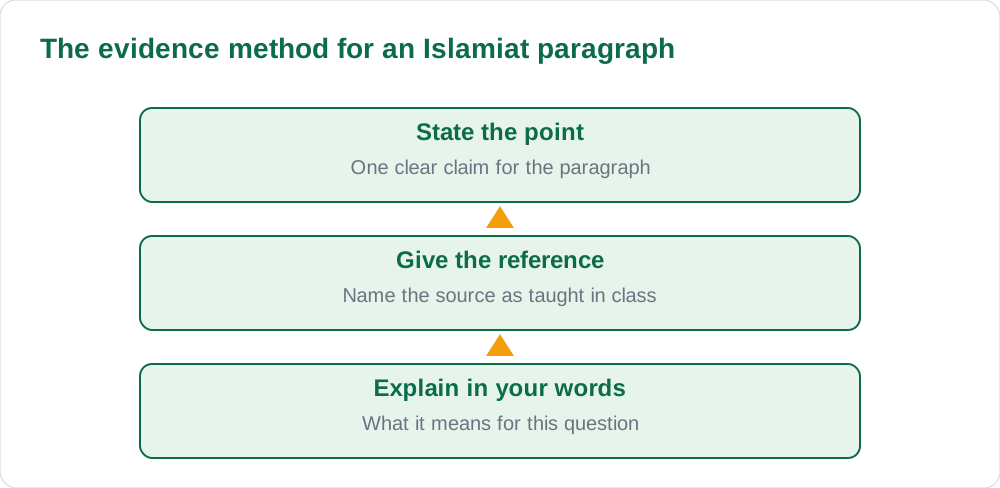
Supporting Islamiat long answers evidence references is a skill of method, not memory tricks: the examiner wants to see that your answer rests on sound sources and that you understand them, not that you can fill a page with quotations. A strong Islamiat long answer states a point clearly, supports it with a reference to the relevant source as taught in your class, and then explains in your own words what that reference means for the question. This guide describes that method in general terms — how to choose a reference, how to present it honestly, and how to explain it — and it deliberately does not invent or quote specific sacred texts as exam answers. Always work from your own Sindh Textbook Board book and your teacher's guidance.
Why evidence matters in an Islamiat answer
An Islamiat long answer without evidence reads as personal opinion, however sincerely held. Evidence shows that the point comes from the tradition and teaching studied in class, not from the writer's own invention. That is why examiners value answers that name the source of a teaching, place it in its context, and explain its relevance to the question. Evidence does not mean quantity: one well-chosen, well-explained reference supports a point better than several references listed without explanation.
Evidence also protects you as a writer. When you attribute a teaching to its source and explain it in your own words, you show respect for the material and avoid presenting your own summary as if it were the text itself. This distinction matters in Islamiat more than in most subjects, because accuracy and honesty about sources are part of the subject's own values. An answer that is careful about its sources is, in that sense, already practising what the subject teaches.
Choosing a reference you can genuinely use
Choose references only from material you have actually studied in your STBB book and class. A reference you half-remember is dangerous: a small error in wording or attribution can undermine an otherwise good answer, and an invented reference is worse than none at all. Before the exam, make a short list of the references you know confidently for each major topic, and practise writing them accurately. In the exam, use only references from that confident list.
Match the reference to the point, not the other way round. First decide what point the paragraph needs to make, then ask which studied reference genuinely supports it. If no reference you know fits the point, make the point as general reasoning and say so, rather than forcing an unsuitable reference into place. The examiner rewards a point that is honestly supported more than a point decorated with an irrelevant quotation. For help with planning points in advance, see Writing Answer Outlines for Long Questions Before Drafting.
Presenting a reference honestly and respectfully
Present a reference by naming its source and, where your class teaching provides it, its location in the book or chapter, and then give the teaching in the form your teacher taught it — paraphrase where you are paraphrasing, and quote only where you are certain of the exact wording. Never present a paraphrase as an exact quotation, and never invent wording and attribute it to a sacred source. If you are unsure of the exact words, write the teaching in your own words and attribute the idea to its source; that is honest, accurate, and far safer than a guessed quotation.
Keep the presentation brief. A reference should support the paragraph, not take it over: a few lines of reference followed by your own explanation is the right balance. Write respectfully and plainly, without exaggeration or decoration, and keep the focus on what the reference means for the question. If your teacher has given specific guidance on how references should be presented in your class, follow that guidance above any general advice in this article.
- Use only references you have studied in your STBB book and class.
- Name the source clearly; do not leave a teaching unattributed.
- Paraphrase honestly — never present your summary as an exact quotation.
- Quote exactly only when you are certain of the wording.
- Keep the reference short and follow it with your own explanation.
Explaining the reference in your own words
The explanation is where most marks are earned, because it shows understanding rather than recall. After giving the reference, explain what it means in plain language: what teaching it conveys, how it connects to the question, and what conclusion follows from it. A reference followed by no explanation asks the examiner to do the thinking; a reference followed by a clear explanation proves that you did it. Aim for two or three sentences of explanation per reference, directly tied to the question's wording.
Avoid two opposite errors. One is repeating the reference in different words and calling that an explanation — it adds nothing. The other is drifting away from the reference into general discussion that no longer uses it. A good test is to cover the reference and read only your explanation: does it still answer the question and show why the reference matters? If it does, the explanation is doing its job. If it merely restates the reference, rewrite it to draw out the implication.
Building a full answer from evidence-based paragraphs
A full Islamiat long answer is usually three or four evidence-based paragraphs framed by an introduction and a conclusion. The introduction states the issue and the line the answer will take; each body paragraph makes one point, supports it with a reference, and explains it; the conclusion brings the points together and states the overall teaching or lesson. This shape keeps the answer balanced: no single paragraph carries the whole argument, and no reference stands without explanation. The general frame is set out in Introduction, Body, Conclusion: A Frame for Long Questions.
In revision, practise the method on topics from your own book: for each topic, write one paragraph that states a point, gives a reference you know confidently, and explains it in your own words. Ask your teacher to check a sample paragraph for accuracy of attribution — that single check is worth more than pages of unchecked practice. You can also browse books and solved notes to organise your revision, but always verify any reference against your own STBB book before using it in an answer.
AI Help: Muse AI
Muse AI is Meta's personal AI assistant. You can ask it to explain a concept in simple words, summarise a lesson, or make practice questions for revision.
For this topic, ask Muse AI to help you practise explaining a studied teaching in your own words, or to check whether a draft paragraph's explanation really follows from its reference.
Join Muse with invite code LTGSWD — in the Muse app, go to Settings > Redeem token and enter the code.
Disclosure: LTGSWD is the author's Muse invite code.
Muse AI does not give official STBB answers — always verify against your Sindh Textbook Board book and your teacher.
5 key points you must know
- One well-chosen, well-explained reference beats several unexplained ones.
- Use only references you have actually studied in your STBB book and class.
- Paraphrase honestly; quote exactly only when certain of the wording.
- Explain each reference in your own words and tie it to the question.
- Have your teacher check sample paragraphs for accuracy of attribution.
Frequently asked questions
Should I quote or paraphrase a reference in an Islamiat answer?
Paraphrase unless you are certain of the exact wording. A paraphrase that honestly attributes the teaching to its source is accurate and safe; a guessed quotation attributed to a sacred source is a serious error. When you do quote, quote exactly and briefly.
How many references should a long answer contain?
Usually one good reference per body paragraph is enough — three or four in a full answer. Quality and explanation matter far more than quantity, and a paragraph with no explanation earns little even if its reference is correct.
What if I cannot remember a reference for a point?
Make the point as general reasoning and do not invent a reference. An honestly unsupported point, clearly argued, scores better than a fabricated reference, which can damage the credibility of the whole answer.
How do I explain a reference without just repeating it?
Draw out its implication for the question: what teaching it conveys, why it matters here, and what conclusion follows. Cover the reference and read only your explanation — if it still answers the question, it is a real explanation.
Solved notes — preview free
These guides work best with the solved exercises. Preview the solved notes free on this website — 119 solved notes for Classes 6–10 in Sindhi, Urdu, English and Arabic medium. Or browse the full solved notes catalogue for your class and medium. New solved notes are added regularly — check the catalogue for coming-soon books.