Huqooq-ul-Ibad: Duties to Parents, Teachers and Neighbours
Huqooq-ul-Ibad means the rights of people, the duties we owe to one another. Islam teaches two kinds of duties: Huqooq Allah, the rights of Allah, such as prayer and fasting, and Huqooq-ul-Ibad, the rights of people, such as kindness to parents, respect for teachers, and care for neighbours. Both kinds matter, and neither is complete without the other. A person who prays regularly but treats parents rudely or neighbours unkindly has missed a great part of the faith. For Class 6 pupils, Huqooq-ul-Ibad is a practical lesson: how we behave toward the people around us every day. This guide explains duties to parents, teachers, and neighbours with examples pupils can practise.
What Huqooq-ul-Ibad Means and Why It Matters
Huqooq-ul-Ibad means that every person around us has rights that we must respect. Parents have the right to obedience and kindness. Teachers have the right to respect and attention. Neighbours have the right to safety and good treatment. Friends, classmates, younger children, older people, workers, and guests all have rights too. These rights are not favours we grant when we feel kind. They are duties that Islam places on us, and Allah will ask us about them.
This teaching matters because faith is proved in how we treat people. Prayer builds a bond with Allah, and Huqooq-ul-Ibad builds a bond with people. A pupil who understands both will pray with focus and behave with kindness. A pupil who ignores the rights of people will find that even good worship feels hollow. Teachers can open a discussion: name one right that a parent, a teacher, and a neighbour each hold, and one way we sometimes forget that right. Honest answers make the lesson real.
- Huqooq-ul-Ibad: the rights of people, owed as duties.
- Parents, teachers, neighbours, friends, and elders all hold rights.
- These rights are duties, not optional favours.
- Faith is proved in how we treat people, not only in worship.
Duties to Parents: Kindness, Obedience, and Gratitude
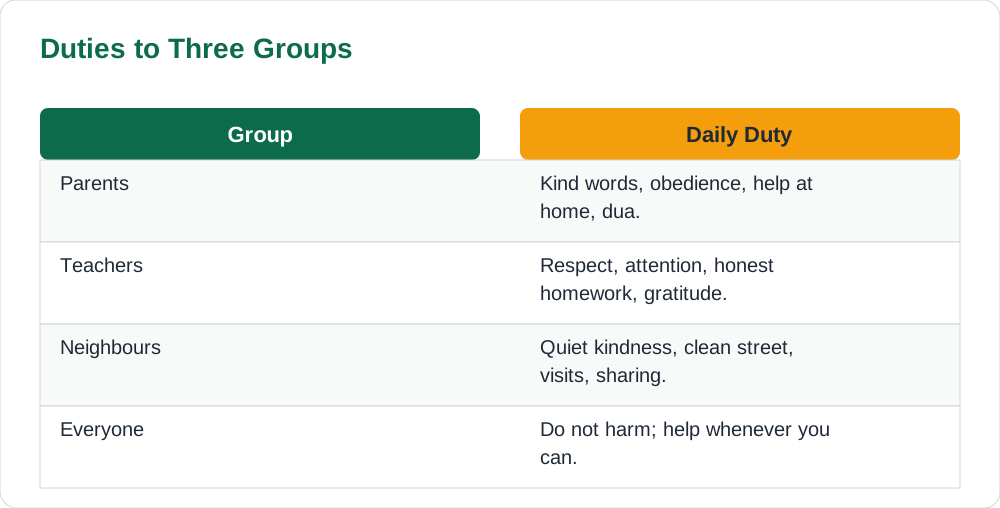
Parents hold the highest place among people after Allah and His Messenger. A mother carries, feeds, and cares for her child through years of sleepless nights, and a father works, provides, and protects. Islam teaches that children must treat parents with kindness, speak to them gently, obey them in what is good, and never raise their voice in anger. Even when parents grow old and need help, children must serve them with patience and love.
Pupils can practise duties to parents in daily life. They can greet parents politely, listen when parents speak, help with housework without being asked, study with effort so that parents sacrifices bear fruit, and make dua for parents. They should avoid arguing, answering back, or ignoring a parent call. A small act, such as bringing a glass of water to a tired parent or helping a mother carry bags, is a form of worship when done with love. Parents sacrifices deserve gratitude in words and in actions.
Duties to Teachers: Respect, Attention, and Gratitude
Teachers hold a high place in Islam, because they pass on knowledge, which is a light for life. Pupils owe teachers respect, attention, and gratitude. Respect means greeting the teacher politely, standing when the teacher enters, listening without interrupting, and speaking with good manners. Attention means keeping eyes on the lesson, keeping notebooks ready, and doing homework honestly. Gratitude means thanking teachers for their effort, not only on special days but through good behaviour every day.
Pupils can practise duties to teachers by arriving on time, by keeping the classroom clean, by asking questions politely, and by never mocking or disturbing a lesson. When a pupil disagrees, the pupil should express it calmly and respectfully, not with rudeness. A pupil who respects teachers gains more from every lesson, because a respectful heart is open to learning. Teachers, in turn, should treat pupils with fairness and kindness, remembering that their rights and duties meet in mutual respect.
- Respect: polite greeting, listening without interrupting, good manners.
- Attention: ready notebooks, focused eyes, honest homework.
- Gratitude: thank teachers through good behaviour every day.
- Disagree calmly and respectfully, never with rudeness.
Duties to Neighbours: Safety, Kindness, and Sharing
Neighbours hold strong rights in Islam. A good neighbour does not harm, disturb, or trouble those who live nearby. This means keeping noise down, keeping the street clean, not blocking a neighbour path, and not looking into a neighbour house. It also means positive kindness: greeting neighbours, visiting them when they are ill, sharing food on happy occasions, and helping in times of need. A neighbour in trouble should find a helping hand next door, not a closed door.
Pupils can practise duties to neighbours in simple ways. They can greet elderly neighbours politely, help carry shopping, keep play quiet near a neighbour who is ill or studying, and share a small gift of food on Eid or a happy day. They should never tease a neighbour children, throw rubbish near a neighbour door, or make noise late at night. A class project can map the neighbourhood and list one kind act for each nearby home. Small kindness to neighbours builds a peaceful street.
Study Method: A Duties Chart for Home and School
The best way to study Huqooq-ul-Ibad is to practise it with a chart. Pupils can draw three columns: parents, teachers, neighbours. Under each column, they write two duties and one act they will do this week. Each evening, they tick the acts they completed and note one act they will improve tomorrow. At the end of the week, they review the chart with a parent or teacher and set one new goal. This chart turns a lesson into daily behaviour.
For revision, pupils can define Huqooq-ul-Ibad in one sentence, list three duties to parents, three to teachers, and three to neighbours, and answer questions such as: why are duties to people joined to duties to Allah? What happens when a person prays but treats neighbours badly? What is one duty I forgot this week, and how will I keep it next week? Short written answers and class discussion both work well. More values and character lessons are available on the blog and in the STBB books collection.
- Draw three columns: parents, teachers, neighbours.
- Under each, write two duties and one weekly act.
- Tick completed acts each evening and plan improvements.
- Review weekly with a parent or teacher.
AI Help: Muse AI
Muse AI is Meta's personal AI assistant, and it can help with this topic by explaining Huqooq-ul-Ibad with fresh home and school examples, or by making short practice questions and a duties chart for revision.
Join Muse with invite code LTGSWD — in the Muse app, go to Settings > Redeem token and enter the code.
Disclosure: LTGSWD is the author's Muse invite code.
Muse AI does not give official STBB answers — always verify against your Sindh Textbook Board book and your teacher.
5 key points you must know
- Huqooq-ul-Ibad means the rights of people, owed as duties.
- Parents deserve kindness, obedience, gratitude, and care in old age.
- Teachers deserve respect, attention, honest work, and gratitude.
- Neighbours deserve safety, quiet kindness, visits, and sharing.
- Faith is proved in how we treat people, not only in worship.
Frequently asked questions
What is Huqooq-ul-Ibad?
Huqooq-ul-Ibad means the rights of people: the duties we owe to parents, teachers, neighbours, friends, and others. They stand beside Huqooq Allah, the rights of Allah, and neither is complete without the other.
What are the main duties to parents?
Treat parents with kindness, speak gently, obey them in what is good, help at home without being asked, study with effort, and make dua for them. Serve them with patience when they grow old.
What are the main duties to teachers?
Respect teachers, listen without interrupting, keep notebooks ready, do homework honestly, greet politely, and show gratitude through good behaviour every day.
What are the main duties to neighbours?
Do not harm or disturb neighbours, keep noise down and streets clean, greet them, visit them when ill, share food on happy occasions, and help in times of need.
Can a person be good if they pray but treat people badly?
No. Prayer and good treatment belong together. A person who prays but is rude to parents, teachers, or neighbours has missed a great part of the faith. See the solved notes page for more study help.
Solved notes — preview free
These guides work best with the solved exercises. Preview the solved notes free on this website — 119 solved notes for Classes 6–10 in Sindhi, Urdu, English and Arabic medium. Or browse the full solved notes catalogue for your class and medium. New solved notes are added regularly — check the catalogue for coming-soon books.