How to Write Answers for Urdu Textbook Exercises
Urdu textbook exercises test more than memory: they test whether a pupil understood the lesson, can explain a word or idea, and can express it clearly in Urdu. Many pupils struggle because they either copy the lesson word for word or write a vague answer that misses the question entirely. The method in this article solves both problems. Every answer is built from three parts: a reference to the lesson, the meaning in the pupil's own words, and an example where one fits. With that structure, Urdu exercise answers become accurate, complete, and genuinely the pupil's own work.
Start from the Lesson, Not from Memory
Every Urdu exercise answer begins in the lesson itself. The pupil reads the question, then finds the relevant part of the lesson: the paragraph, the poem's verse, or the passage where the word or idea appears. Reading that part in context matters because Urdu words often carry different meanings in different places, and the exercise usually tests the meaning the lesson uses. A pupil who answers from a dictionary alone, or from general knowledge, may give a correct meaning that is still the wrong answer for this lesson.
Context also supplies the reference that strengthens an answer. Noting where an idea appears in the lesson, for example which paragraph or event it belongs to, shows the examiner that the pupil studied the lesson rather than memorised an isolated answer. This does not mean quoting long passages; a short reference, such as naming the incident or character involved, is enough. The habit of always starting from the lesson keeps answers grounded and prevents the drift into general writing that weakens so many Urdu answers.
The Three-Part Answer: Reference, Meaning, Example
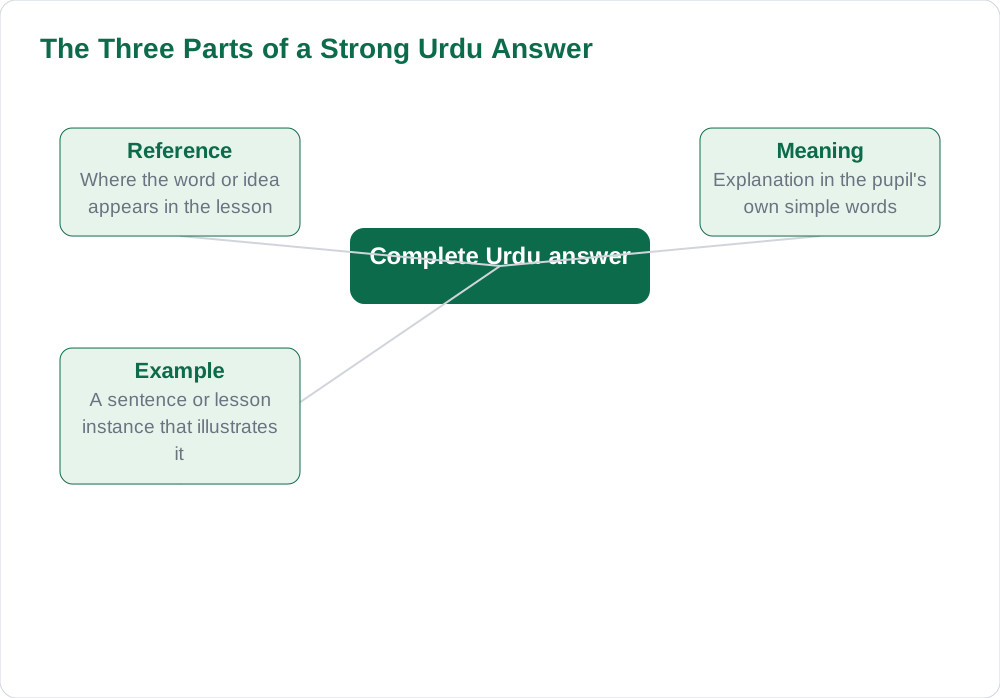
A complete Urdu exercise answer usually has three parts. First, the reference: a brief note of where the word, idea, or event comes from in the lesson. Second, the meaning: an explanation in the pupil's own words, using simple and clear Urdu, of what it means or why it matters. Third, where the question allows it, an example: a short sentence showing the word or idea in use, or an instance from the lesson that illustrates it. These three parts together answer the question fully, and each part can be checked separately during revision.
Not every question needs all three parts. A question that asks only for a meaning needs the meaning, perhaps with one short example, while a question about an event needs reference and explanation. The pupil should judge from the command word what is needed, and include every part the question asks for without adding parts it does not. An answer that follows this structure is easy to mark: the examiner finds the reference, the meaning, and the example in order, instead of hunting through a jumbled paragraph. The same discipline of checking against the book is covered in How to Check Your Answers Against the Textbook.
Writing in Your Own Words
Writing in your own words is the hardest part of Urdu exercises, and the most valuable. It means understanding the lesson point well enough to say it differently, without losing its meaning. A useful technique is to close the book after reading the passage, say the meaning aloud in simple words as if explaining it to a younger pupil, and then write down what was said. If the spoken version is clear, the written version usually is too. If the spoken version stalls, the passage needs another read, and that is useful information, not failure.
Pupils should not fear simple wording. Examiners reward clarity over decoration, and a plain sentence that says exactly what is meant scores better than a flowery sentence that says nothing clearly. Difficult words from the lesson should be used where they belong, because they show command of the lesson's vocabulary, but they should sit inside sentences the pupil fully understands. Over time, this practice builds real Urdu writing skill, which is worth far more than a notebook full of copied answers.
Handling Word Meanings and Grammar Questions
Word-meaning questions deserve special care. The pupil should give the meaning the lesson uses, then add a short example sentence that proves the meaning fits. An example sentence is the best test of a meaning: if the sentence sounds right, the meaning is probably right, and if it sounds wrong, the meaning needs re-checking. For grammar questions, such as identifying a word type or correcting a sentence, the pupil should state the rule briefly and then apply it, rather than only giving the corrected form. Showing the rule demonstrates understanding, which is what grammar exercises test.
For questions about a poem or story, the answer should stay close to the text. A pupil may explain a verse in prose, but the explanation must follow what the verse actually says, not what the pupil imagines it says. Reading the verse twice, noting its key words, and then explaining it line by line in simple prose is a reliable method. Adding personal opinions that the text does not support weakens the answer, so opinions should be kept out unless the question explicitly asks for one.
- Meanings: give the lesson's meaning, then prove it with an example sentence.
- Grammar: state the rule briefly, then apply it to the given example.
- Poetry: explain verse by verse, staying close to what the text says.
- Stories: name the event or character before explaining its importance.
Checking and Fair-Copying Urdu Answers
Before an Urdu answer is final, it needs two checks. The first is a content check against the lesson: does the answer say what the lesson says, and has any part of the question been missed. The second is a language check: spelling, especially of lesson vocabulary, and sentence structure. Urdu spelling errors are easy to make and costly, because they can change a word's meaning entirely, so key words should be compared letter by letter with the book. Reading the answer aloud once catches sentences that are incomplete or tangled.
The fair copy should be written neatly, since Urdu script rewards careful letter formation and clear spacing between words. A fair copy that is hard to read loses marks even when its content is good, because the examiner cannot credit what cannot be read. Once the fair copy is clean, file it with the rest of the subject's notes so it can be revised before tests. The folder method in How to Organise a Solved-Notes Folder by Subject and Chapter keeps Urdu answers findable all year, and the drafting stages in A Drafting Workflow for Solved Notes: From Rough Answer to Fair Copy apply directly to Urdu answers. You can also find your class books through the books listing.
AI Help: Muse AI
Muse AI is Meta's personal AI assistant, and it can help with Urdu exercises in a practical way. A pupil can ask Muse to explain a difficult Urdu word or verse in simpler words, which makes writing the meaning in one's own words much easier.
Join Muse with invite code LTGSWD — in the Muse app, go to Settings > Redeem token and enter the code.
Disclosure: LTGSWD is the author's Muse invite code.
Muse AI does not give official STBB answers — always verify against your Sindh Textbook Board book and your teacher.
5 key points you must know
- Always start from the lesson passage, not from memory or a dictionary alone.
- Build answers from reference, meaning, and example where the question allows.
- Explain in your own simple words; clarity beats decoration.
- Prove word meanings with an example sentence that sounds right.
- Check spelling letter by letter against the book before fair-copying.
Frequently asked questions
Should Urdu answers be copied exactly from the lesson?
No. Copying teaches nothing and fails in exams, where the book is not available. Read the passage, understand it, then write the answer in your own words, keeping the lesson's key vocabulary. Solved notes should be used to check your version, not to replace it.
What if a word has more than one meaning?
Give the meaning the lesson uses, shown by the context where the word appears. Your example sentence should match that context. If two meanings both seem possible, re-read the passage around the word; the surrounding sentences usually settle it.
How do I answer a question about a poem?
Read the verse twice, note its key words, and explain it in simple prose line by line. Stay close to what the verse actually says and do not add opinions the text does not support, unless the question asks for your opinion.
How long should an Urdu exercise answer be?
Long enough to include every part the question asks for: reference, meaning, and example where relevant. A meaning question may need only two or three sentences, while an explanation question needs a full paragraph. Match length to the command word, not to a fixed number of lines.
Solved notes — preview free
These guides work best with the solved exercises. Preview the solved notes free on this website — 119 solved notes for Classes 6–10 in Sindhi, Urdu, English and Arabic medium. Or browse the full solved notes catalogue for your class and medium. New solved notes are added regularly — check the catalogue for coming-soon books.