How to Solve Islamiat Exercises Step by Step
Islamiat exercises reward careful reading more than fast writing. Many pupils lose marks not because they do not know the lesson, but because they answer from memory, skip part of the question, or write a general answer instead of the specific one the exercise asks for. A steady method fixes all three problems: read the question properly, locate the answer in the lesson, draft it in your own words, and verify it against the book before calling it finished. This step-by-step approach works for every kind of Islamiat exercise, from short questions to longer explanations, and it builds the habit of accuracy that examiners notice.
Step One: Read the Question Twice
The first step is slower than most pupils expect, and that is the point. Read the exercise question twice, and on the second reading underline or note the command word: explain, describe, state, list, or give reasons. The command word decides the shape of the answer. A question that asks for reasons needs more than a definition, and a question that asks for a list needs separate points rather than one long paragraph. Pupils who skip this step often write a good answer to the wrong question, which earns little credit no matter how well it is written.
Reading twice also reveals when a question has more than one part. Many Islamiat exercises ask two things in one sentence, for example a meaning and an example, or a definition and its importance. Noting both parts before writing prevents the common mistake of answering only the first half. A useful habit is to rewrite a long question as two short questions in rough work, then answer each one in turn. This takes less than a minute and protects the pupil from the most avoidable mark loss in the subject.
Step Two: Locate the Answer in the Lesson
With the question understood, the pupil opens the Islamiat textbook and finds the passage the question comes from. This is not a waste of time; it is the step that makes the answer accurate. The pupil reads the passage slowly, looking for the exact points the question asks about, and notes the key terms as they appear in the book. Using the book's own terms matters in Islamiat, where precise vocabulary carries meaning, and a pupil who replaces a book term with a vague synonym weakens the answer without realising it.
Locating also means resisting the temptation to write from memory alone. Memory is useful for revision, but it quietly drops details and changes wording, and an exercise answer built only on memory often misses the point the question is testing. The textbook is the authority for exercise answers, so every answer should be traceable to a passage the pupil can point to. If the passage cannot be found, the pupil should re-read the lesson heading and subheadings, which usually show where the topic is covered. Keep your answers with your other notes by following the folder system in How to Organise a Solved-Notes Folder by Subject and Chapter.
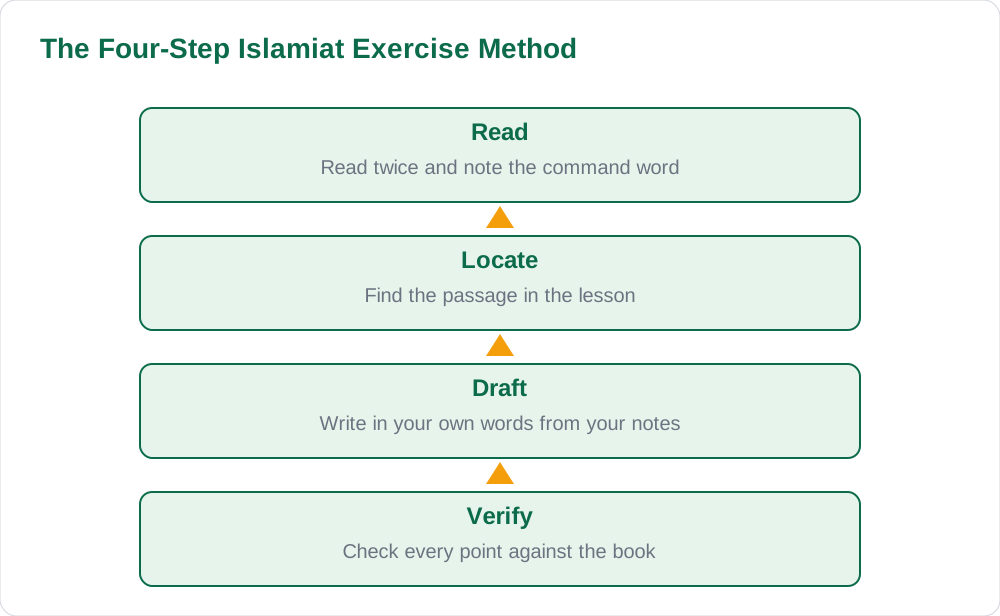
Step Three: Draft in Your Own Words
Drafting means turning the located points into an answer written by the pupil, not copied word for word from the book. Copying feels safe, but it teaches nothing, and in an exam the pupil will not have the book to copy from. A good draft keeps the book's key terms and order of ideas, but expresses them in the pupil's own sentences. This forces real understanding: a pupil who cannot rephrase a point probably does not understand it yet, and the draft stage reveals that gap while there is still time to re-read the passage.
A strong draft also follows a simple shape. The first sentence answers the question directly, so the reader knows at once what the answer is about. The middle sentences give the explanation, reasons, or points the question asks for, in the same order as the lesson presents them. The last sentence closes the answer, either by restating the main point or by noting its importance. This shape works for short and long answers alike, and pupils who use it consistently produce answers that examiners find easy to mark generously.
Step Four: Verify Before You Finish
Verification is the step most pupils skip, and it is the step that protects marks. The pupil reads the finished draft against the question and the textbook passage, checking three things: every part of the question is answered, every key term matches the book, and nothing has been added that the lesson does not support. An answer that passes all three checks can be written as a fair copy with confidence. An answer that fails any check goes back to the drafting stage for correction, which is far cheaper than learning the wrong version during revision.
Verification also covers language. Islamiat answers should use respectful, careful wording, and sentences should be complete rather than fragments. Spelling of key terms deserves a second look, because a misspelled term can change meaning or look careless. A final read aloud, even quietly, catches awkward sentences that silent reading misses. Pupils who verify every answer build solved notes they can trust, and trust in one's notes makes revision calm instead of anxious. The verification habit is explained further in How to Check Your Answers Against the Textbook.
- Answer check: every part of the question, including second parts, is covered.
- Term check: key words match the textbook, not a guessed synonym.
- Accuracy check: nothing added that the lesson does not support.
- Language check: complete sentences, careful wording, correct spelling of terms.
Common Mistakes to Avoid in Islamiat Exercises
The most common mistake is writing a general answer when the question asks for something specific. A question about one lesson topic should not drift into general religious knowledge, however true that knowledge may be, because examiners mark the asked topic, not general knowledge. Staying inside the lesson passage keeps the answer focused and complete. A second common mistake is answering only from memory and missing the lesson's own points, which is why locating the passage matters even when the pupil feels confident.
A third mistake is writing too little for a question that asks for explanation, or too much for a question that asks for a short answer. Matching length to the command word is a skill that improves with practice, and the draft stage is where it should be practised. Finally, some pupils copy answers from solved notes without working through the method themselves, which leaves them helpless in exams. Solved notes are best used to check a self-written answer, not to replace writing it. Start from the [home page](/) to find the Islamiat books for your class, and use the solved notes collection as a checking aid after you have drafted your own answer.
AI Help: Muse AI
Muse AI is Meta's personal AI assistant, and it can help with Islamiat exercises in a useful way. A pupil can ask Muse to explain a difficult term or concept in simpler words before drafting, which makes the locate-and-draft steps much easier.
Join Muse with invite code LTGSWD — in the Muse app, go to Settings > Redeem token and enter the code.
Disclosure: LTGSWD is the author's Muse invite code.
Muse AI does not give official STBB answers — always verify against your Sindh Textbook Board book and your teacher.
5 key points you must know
- Read every question twice and note its command word before writing.
- Locate the answer in the lesson passage; do not rely on memory alone.
- Draft in your own words, keeping the book's key terms and order.
- Verify every answer against the question and the book before fair-copying.
- Use solved notes to check your own answer, never to replace writing it.
Frequently asked questions
Should I memorise the lesson before attempting exercises?
Read the lesson once with understanding first, then attempt the exercises with the book open. Exercises are a learning tool, not only a test: working through them with the passage beside you teaches the lesson far better than memorising first and writing later.
What if I cannot find the passage for a question?
Re-read the lesson headings and subheadings to find the right section, then read that section slowly. If the question still seems unconnected, ask your teacher; do not guess an answer or copy one from elsewhere, because a guessed answer teaches the wrong content.
Is it wrong to use solved notes for Islamiat?
No, provided you use them correctly: write your own answer first using the read-locate-draft-verify method, then compare it with the solved note to find gaps. Using solved notes as a shortcut without drafting first leaves you unprepared for exams.
How long should an Islamiat exercise answer be?
Match the command word: a short question needs two or three sentences, while an explanation needs a paragraph with reasons. When unsure, write enough to cover every part of the question completely, and no more; padding with general knowledge does not earn extra marks.
Solved notes — preview free
These guides work best with the solved exercises. Preview the solved notes free on this website — 119 solved notes for Classes 6–10 in Sindhi, Urdu, English and Arabic medium. Or browse the full solved notes catalogue for your class and medium. New solved notes are added regularly — check the catalogue for coming-soon books.