A Daily Loop Method for Keeping Hifz Fresh

Daily loop method keeping hifz fresh solves the most common hifz problem: pupils memorise a Surah, leave it for weeks, and then forget it. Memory fades without revision, but long cramming sessions are tiring and unreliable. The daily loop method fixes this with three short parts each day: a little new learning, revision of recent material, and a quick touch of old material. In this guide, you will learn how to run the loop in fifteen minutes a day, track your progress, and keep every Surah you have memorised strong. Always recite from your own mushaf or STBB book.
Why Hifz Fades Without a Loop
Forgetting is normal. When you learn something new, your memory is strongest on the first day and fades quickly unless you revisit it. If you revise a Surah the next day, then a few days later, then weekly, the memory becomes much stronger.
The loop also keeps hifz enjoyable. Instead of one long, exhausting session, you do three short parts that feel fresh. Each part has a different purpose, so your mind stays active. You can find more hifz help in the solved notes and on the books page.
The Three Parts of the Daily Loop
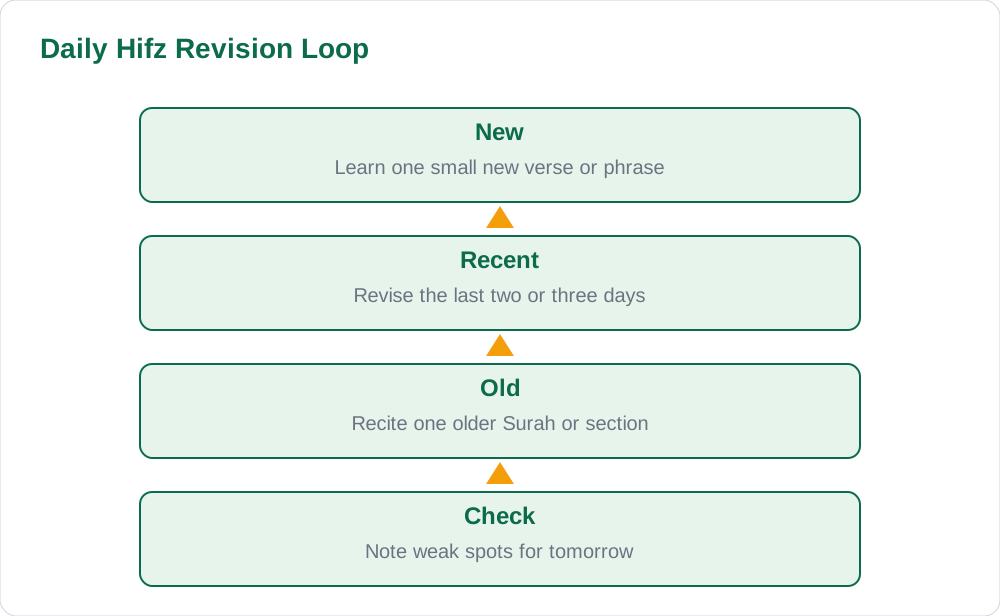
The loop has three parts. First, new: learn a small new portion, such as one verse or one phrase, using the slow repeat method. Second, recent: revise what you learned in the last two or three days, joining it with the new portion. Third, old: recite one older Surah or section from earlier weeks.
Give each part about five minutes. If you have no new portion on a given day, use the new time for extra revision of a weak Surah. The key is consistency: a short loop every day beats a long session once a week.
Running the Loop in Fifteen Minutes
Set a fixed time for the loop, such as after Fajr or before homework. Start with new material when your mind is freshest. Then move to recent revision, joining the new portion with the last few days. Finish with old revision, reciting one older Surah from memory.
Use a timer or a simple routine to keep the loop short. Five minutes for new, five for recent, and five for old is a good balance. If a Surah feels weak, give it the new slot the next day instead of adding fresh material.
- Fix one daily time for the loop, such as after Fajr or before homework.
- Start with new material while your mind is freshest.
- Join new and recent material together before old revision.
- Give weak Surahs the new slot instead of adding fresh material.
Tracking Weak Spots and Progress
A small tracker makes the loop far more effective. Keep a notebook page with three columns: Surah, last revised, and weak spots. After each loop, write one line about what went well and one weak spot to fix tomorrow. This takes one minute but saves hours of relearning.
Review the tracker every Friday. Pick the weakest Surah and give it the old slot for three days in a row. Praise yourself for Surahs that stay strong, and do not worry if progress is slow. Steady tracking turns hifz from guesswork into a clear, calm system.
- Track Surah, last revised date, and weak spots in a notebook.
- Write one strong point and one weak spot after each loop.
- Give the weakest Surah the old slot for three days in a row.
- Review the tracker every Friday and plan the next week.
Keeping the Loop Going Long Term
The loop works long term because it is short and repeatable. Do not skip it for many days, and do not double it to catch up after a break. If you miss a day, simply restart the loop the next day with recent and old revision.
Pair the loop with a weekly recitation to a listener, such as a parent, teacher, or elder. For more Surah methods to use inside the loop, see the Surah Al-Qadr guide and browse the blog for more hifz plans.
AI Help: Muse AI
Muse AI is Meta's personal AI assistant, and it can help you plan a daily hifz revision loop or make a simple tracker for new, recent, and old Surahs. Muse AI does not give official STBB answers — always verify against your STBB book and your teacher. Always check any explanation against your Sindh Textbook Board book and ask your teacher if anything is unclear.
Join Muse with invite code LTGSWD — in the Muse app, go to Settings > Redeem token and enter the code.
Disclosure: LTGSWD is the author's Muse invite code.
5 key points you must know
- Memory fades without revision, so revisit every Surah on a schedule.
- Daily loop: a little new learning, recent revision, and one old recitation.
- Run the loop in about fifteen minutes at a fixed daily time.
- Track weak spots in a notebook and fix one weak Surah at a time.
- Recite to a listener once a week to check accuracy.
Frequently asked questions
How long should the daily hifz loop take?
About fifteen minutes: five minutes each for new, recent, and old revision. Short daily loops build stronger memory than long weekly cramming sessions.
What should I do if I miss a day?
Simply restart the loop the next day with recent and old revision. Do not try to double the loop to catch up, because long sessions tire the mind and weaken accuracy.
How do I choose which old Surah to revise?
Use your tracker. Pick the Surah you revised longest ago or the one with the most weak spots. Give the weakest Surah the old slot for three days in a row.
Should I learn new material every day?
Not always. If a recent Surah feels weak, use the new slot for extra revision instead of adding fresh material. The loop stays honest when weak Surahs get attention first.
Solved notes — preview free
These guides work best with the solved exercises. Preview the solved notes free on this website — 119 solved notes for Classes 6–10 in Sindhi, Urdu, English and Arabic medium. Or browse the full solved notes catalogue for your class and medium. New solved notes are added regularly — check the catalogue for coming-soon books.