Ghazwa Khyber in Clear Sequence: Courage and Discipline
Ghazwa Khyber is an important event in early Islamic history. It took place at Khyber, a place with strong forts north of Madinah, where groups hostile to the Muslims had gathered and were preparing trouble. The Muslims marched to Khyber under the leadership of the Holy Prophet Muhammad (peace be upon him), and after a hard campaign the forts were overcome and peace was restored. For Class 6 pupils, the story of Khyber is not only about a battle. It is a lesson in courage, discipline, justice, and trust in Allah. This guide tells the story in clear sequence and draws out lessons pupils can use in daily life.
The Background: Why the Muslims Marched to Khyber
To understand Khyber, pupils must first understand the background. After the Treaty of Hudaibiya, the Muslims had peace with the Quraysh, but other groups continued to stir hostility against Madinah. Khyber had become a centre where opponents gathered, stored supplies, and planned against the Muslims. The Muslims could not simply ignore a growing threat to their homes and families. A community that wishes to live in peace must sometimes act firmly to stop a danger before it grows.
The march to Khyber was therefore a defensive step, taken after other paths had been tried. The Holy Prophet (peace be upon him) led the Muslims with clear purpose and discipline. There was no cruelty and no desire for plunder. The aim was to remove a threat, restore safety, and establish a just settlement. Pupils can discuss an important question: what is the difference between fighting for defence and justice, and fighting out of anger or greed? The story of Khyber helps answer that question clearly.
- Khyber had become a centre of hostility against Madinah.
- The march was a defensive step to restore safety.
- The aim was justice and peace, not cruelty or plunder.
- Good leadership kept the campaign disciplined and purposeful.
The Campaign in Clear Sequence
The campaign at Khyber was hard. The forts were strong, built on high ground, with thick walls and stored supplies. The Muslims had to advance fort by fort, with patience and planning. Each stage required courage, because the defenders were prepared and the ground was difficult. Yet the Muslims pressed on with steady discipline, following orders, helping one another, and trusting in Allah. The famous courage of Hazrat Ali (RA) in this campaign is remembered in Islamic history as an example of bravery joined to faith.
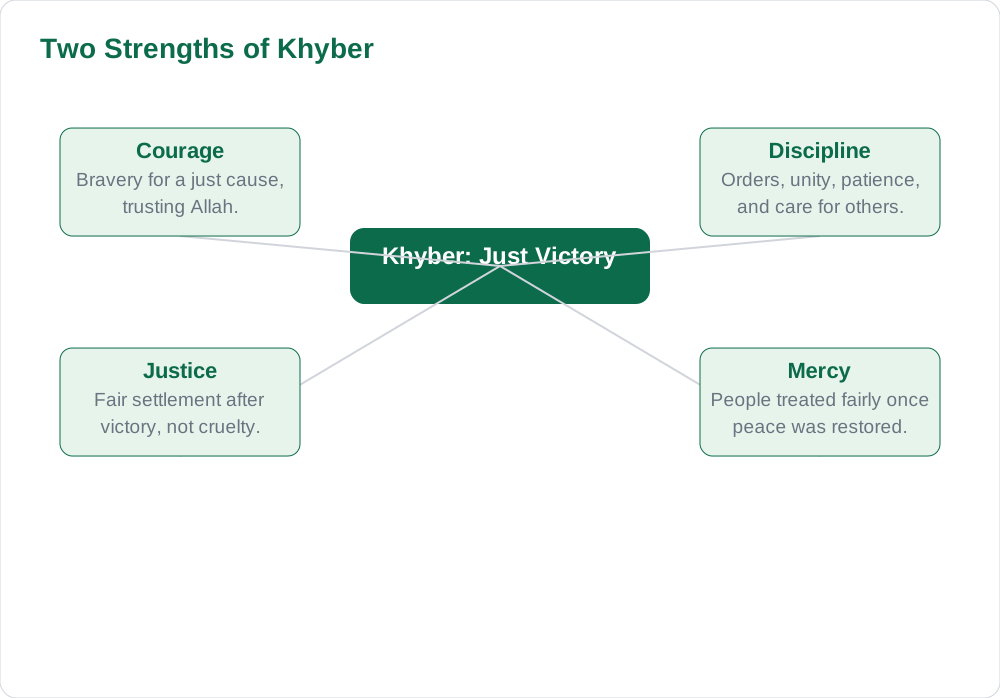
Step by step, the forts were overcome. When the campaign ended, the people of Khyber were treated with justice. They were not driven out or punished with cruelty. Instead, a fair settlement was made, allowing them to stay and work the land under agreed terms. This settlement shows the character of Islamic leadership: firm in the face of threat, but just and merciful after victory. Pupils should remember that true victory is not only winning a battle. It is winning with justice and mercy.
Courage: Bravery Joined to Faith
Courage is one of the great lessons of Khyber. Courage does not mean feeling no fear. It means doing what is right even when fear is present. The Muslims at Khyber faced strong forts, hard ground, and determined defenders, yet they went forward because the cause was just and their trust was in Allah. The example of Hazrat Ali (RA) shows courage joined to faith: strength used for justice, never for show, never for cruelty, and never for personal pride.
Pupils can practise courage in daily life in smaller but real ways. Standing up for a classmate who is being teased is courage. Telling the truth when a lie would be easier is courage. Trying again after failing a test is courage. Admitting a mistake and apologising is courage. Teachers can ask pupils to name one brave act they saw this week, and to explain what made it brave. Courage, like a muscle, grows when it is used for good purposes.
- Courage means doing what is right even when fear is present.
- At Khyber, courage was joined to faith and discipline.
- Strength was used for justice, never for cruelty or pride.
- Daily courage: defending others, telling truth, trying again.
Discipline: The Quiet Strength Behind Victory
Behind the courage of Khyber stood discipline. Discipline means following orders, keeping ranks, caring for supplies, and looking after one another. An army without discipline falls apart, however brave its soldiers. The Muslims at Khyber moved as one body, obeying the leadership of the Holy Prophet (peace be upon him) and holding to their purpose through a long and tiring campaign. Discipline turned individual bravery into shared strength.
Pupils practise the same discipline in school life. Arriving on time, keeping notebooks in order, finishing homework before play, listening when the teacher speaks, and working quietly in a group are all forms of discipline. A class that is disciplined can achieve far more than a class of clever but disorderly pupils. The lesson of Khyber is that discipline is not a punishment. It is the quiet strength that lets courage achieve its purpose. Families can support this by keeping a steady homework and prayer routine at home.
Study Method: Sequencing the Story and Its Lessons
The best way to study Khyber is to sequence it. Pupils can draw a simple timeline with four boxes: background, march, campaign, settlement. Under each box, they write two sentences in their own words. Then they add a second row: one lesson under each box. For example, under settlement they might write justice and mercy. This two-row timeline turns a long story into a clear picture that is easy to remember and easy to explain to someone else.
For revision, pupils can answer questions such as: why did the Muslims march to Khyber? What made the campaign hard? What did courage and discipline look like at Khyber? How were people treated after the victory? What is one lesson I can apply this week? Group discussion helps here, because pupils hear different answers and correct each other kindly. More Islamic history help is available on the blog and in the STBB books collection.
- Draw a four-box timeline: background, march, campaign, settlement.
- Write two sentences under each box in your own words.
- Add one lesson under each box.
- Practise explaining the timeline to a partner.
AI Help: Muse AI
Muse AI is Meta's personal AI assistant, and it can help with this topic by retelling Ghazwa Khyber in clear sequence, explaining courage and discipline with school examples, or making short practice questions about the story.
Join Muse with invite code LTGSWD — in the Muse app, go to Settings > Redeem token and enter the code.
Disclosure: LTGSWD is the author's Muse invite code.
Muse AI does not give official STBB answers — always verify against your Sindh Textbook Board book and your teacher.
5 key points you must know
- Khyber was a defensive campaign to remove a growing threat and restore safety.
- The forts were strong, and the campaign required patience and planning.
- Courage means doing what is right even when fear is present.
- Discipline turned individual bravery into shared strength.
- Victory at Khyber was followed by a just and merciful settlement.
Frequently asked questions
Where was Khyber and why does it matter?
Khyber was a place with strong forts north of Madinah. It matters because groups hostile to the Muslims had gathered there, and the campaign restored safety and established a just peace.
Why did the Muslims march to Khyber?
They marched as a defensive step after hostility and plotting against Madinah had grown at Khyber. The aim was to remove the threat and restore safety, not to seek cruelty or plunder.
What made the campaign at Khyber hard?
The forts were strong and built on high ground, with thick walls and stored supplies. The Muslims had to advance fort by fort, with patience, planning, and steady discipline.
What is the lesson of courage at Khyber?
Courage means doing what is right even when fear is present. At Khyber, courage was joined to faith and used for justice, never for show or cruelty.
How were people treated after the victory?
They were treated with justice. A fair settlement allowed them to stay and work the land under agreed terms, showing that true victory joins firmness with mercy. See also The Treaty of Hudaibiya for a companion lesson in peace-making.
Solved notes — preview free
These guides work best with the solved exercises. Preview the solved notes free on this website — 119 solved notes for Classes 6–10 in Sindhi, Urdu, English and Arabic medium. Or browse the full solved notes catalogue for your class and medium. New solved notes are added regularly — check the catalogue for coming-soon books.