Simulate a Past Paper at Home Under Timed Conditions
Reading notes feels like preparation, but it is not the same as performing. In an exam you must recall under time pressure, choose what to answer first, write quickly and legibly, and keep going when a question stumps you. None of those skills are trained by rereading. Simulating a past paper at home under timed conditions trains all of them at once — and it makes exam day feel familiar instead of frightening. This guide shows you how to run a realistic mock at home: setting up the room, choosing the paper, keeping strict time, and — most importantly — marking it honestly afterwards and learning from the result. One well-run mock teaches you more about your exam readiness than a week of casual rereading.
Why Simulation Beats Rereading
Rereading gives a false feeling of knowing. The words look familiar, so you believe you have learned them — but recognising a fact on the page is not the same as recalling it under pressure on a blank answer sheet. A timed mock removes the illusion. It shows you exactly what you can produce, in the time allowed, with no notes. That honest picture is the starting point for real improvement.
Simulation also trains exam skills that notes cannot: pacing, question selection, handwriting under pressure, and recovering from a stuck question. Pupils who have run several mocks walk into the exam hall with a plan they have already tested, a pace they already know, and nerves they have already practised calming. The exam feels like another rehearsal, not a first performance.
Choose the Right Paper and Set Up the Room
Choose a past paper or practice paper that matches your real exam: the same subject, the same number of questions, the same marks, and the same time limit. If your school or board provides past papers, use those; if not, ask your teacher for a practice paper or build one from your textbook exercises, keeping the mark pattern realistic. Do not pick an easy paper to feel good — pick a realistic one to get a true picture.
Set up a quiet corner with a clear desk or table, a chair, your pens, and a clock or watch you can see. Clear the desk of books, notes, and your phone — in the real exam you will have none of these. Tell your family you are doing a timed mock and ask not to be disturbed. The more the setup resembles the exam hall, the more the practice transfers.
- Use a paper that matches the real exam in subject, marks and time limit.
- Clear desk, visible clock, pens only — no books, notes or phone.
- Tell your family in advance so the mock runs undisturbed.
Run the Mock With Strict Time and Rules
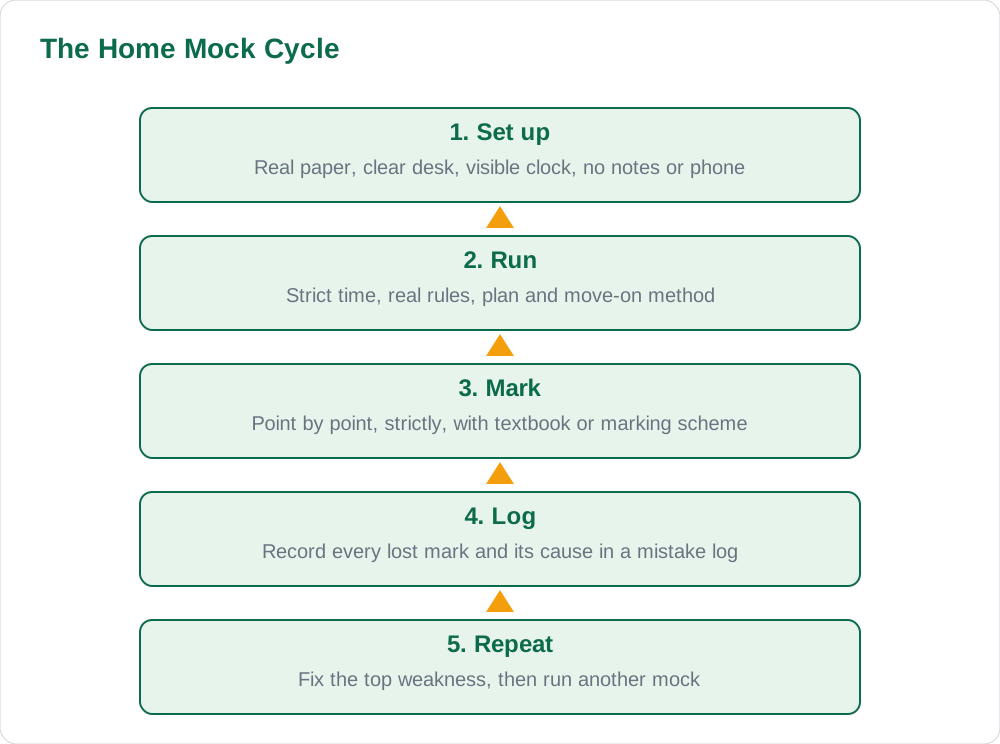
Start the clock and follow the real exam rules: no notes, no phone, no asking for help, no extra time. Use the five-minute planning routine at the start — scan, rank, divide time — then write in your planned order. If you get stuck, practise the move-on method: breathe, park the question, return later. The point of the mock is to practise the whole performance, including the hard moments.
When the time is up, stop writing, exactly as you would in the exam. It is tempting to finish one last sentence, but stopping on time teaches you the discipline the real exam demands — and it makes your result honest. A mock where you took an extra fifteen minutes tells you nothing about your real readiness.
Mark It Honestly and Without Mercy
Marking is where most of the learning happens, so do it carefully. Use the marking scheme if one is available, or the textbook and your notes to check each answer. Give marks point by point, the way an examiner would — no generous marks for almost right. Be honest about what earned marks and what did not; a flattering mark helps nobody.
If a teacher, parent, or older sibling can mark it for you, even better — a second pair of eyes catches the errors you cannot see in your own work. Ask them to mark strictly and to note where your answers drifted off topic, missed parts, or lacked structure. Their comments are the raw material for your next round of improvement.
Turn the Result Into a Mistake Log
After marking, do not just note the score — analyse it. Sort your lost marks into causes: knowledge gaps (I did not know this), technique errors (I misread the question, ran out of time, missed a part), and careless slips (wrong unit, copying error, unlabelled diagram). Most pupils discover that technique and careless errors cost as many marks as knowledge gaps — and those are the fastest to fix.
Write the top three causes in a mistake log with one fix each: for example, Misread command words — underline keywords on every question. Review the log before your next mock, and check whether the same errors appear again. Improvement in mocks is rarely about studying more; it is about repeating fewer errors.
How Many Mocks, and When
Quality beats quantity. Two or three well-run mocks per subject, spaced across the revision period, are worth far more than ten rushed ones. Run the first mock early enough to leave time to fix what it reveals — ideally at least a week before the exam. Run the last mock a few days before the real paper, so the routine is fresh but you still have a day to rest.
Do not run a mock the night before the exam. The night before is for light review and sleep. Your last mock should leave you confident, not exhausted. For planning and checking routines to use inside each mock, see how to manage time during exams, how to avoid common exam mistakes, and how to revise the night before.
AI Help: Muse AI
Muse AI is Meta's personal AI assistant, and it can help you prepare mocks: ask it to turn a revision topic into a set of practice questions with a mark pattern, then run the mock yourself under strict time and mark your answers against your textbook. Muse AI does not give official Sindh Textbook Board answers — always verify against your Sindh Textbook Board book and your teacher.
Join Muse with invite code LTGSWD — in the Muse app, go to Settings > Redeem token and enter the code.
Disclosure: LTGSWD is the author's Muse invite code.
5 key points you must know
- A timed mock shows what you can actually produce under pressure — rereading cannot.
- Use a realistic paper: same subject, marks and time limit as the real exam.
- Run the mock with strict rules: no notes, no phone, no extra time.
- Mark point by point, strictly, using the textbook or marking scheme.
- Sort lost marks by cause in a mistake log, and fix the top causes before the next mock.
Frequently asked questions
How many mocks should I do per subject?
Two or three well-run mocks per subject are enough. Space them across the revision period so each one leaves time to fix what it revealed.
Where do I find past papers?
Ask your teacher first, or use practice papers your school provides. You can also build a realistic paper from textbook exercises, keeping the mark pattern close to the real exam.
Should I time every practice question, or only full mocks?
Both help, but full timed mocks are essential. Short timed drills train speed; full mocks train pacing, stamina and recovery from stuck questions.
What if my mock score is much lower than I hoped?
That is the mock doing its job. Analyse the lost marks by cause, fix the top three, and run another mock. A low mock score before the exam is useful information, not a verdict.
Can I do a mock with a friend?
Yes, if you both follow strict rules and do not talk during the paper. Mark each other's work afterwards — a second pair of eyes catches errors you miss in your own answers.
Solved notes — preview free
These guides work best with the solved exercises. Preview the solved notes free on this website — 119 solved notes for Classes 6–10 in Sindhi, Urdu, English and Arabic medium. Or browse the full solved notes catalogue for your class and medium. New solved notes are added regularly — check the catalogue for coming-soon books.