Writing a Précis: A Summary Method for English
A precis is a short, faithful summary of a longer passage. The writing precis summary method English pupils need is not about copying sentences or dropping random lines. It is a disciplined way to read carefully, find the central argument, remove examples and repetition, and then rewrite the meaning in your own words at about one-third of the original length. This skill matters far beyond examinations. It trains you to separate what an author is really saying from what is only decoration, and it helps you revise faster, answer comprehension questions better, and write clearer essays. In this guide you will learn a step-by-step method you can use on any passage, from a textbook paragraph to a newspaper editorial. You will also see common mistakes to avoid and a simple checklist to test your finished precis before you hand it in.
What a Precis Is and What It Is Not
A precis restates the main ideas of a passage in fewer words, in the same order, and in the same tone. If the original is serious, your precis stays serious. If the original argues for something, your precis shows that argument. You do not add your own opinion, new examples, or extra facts. You also do not copy whole sentences. The goal is to prove that you understood the passage well enough to say it again more briefly.
A precis is not a list of points, not a paraphrase of one paragraph, and not a personal reaction. It is a connected piece of writing, usually in one paragraph, written in your own words. It keeps proper nouns, key numbers, and decisive facts, but it drops illustrations, repetitions, quotations, and rhetorical flourishes. Think of it as the skeleton of the passage: everything essential remains, everything extra is gone. Pupils who treat a precis as a miniature essay, with a clear beginning, middle, and end, usually score better than those who simply compress sentences one by one.
Step One: Read, Underline, and Find the Main Idea
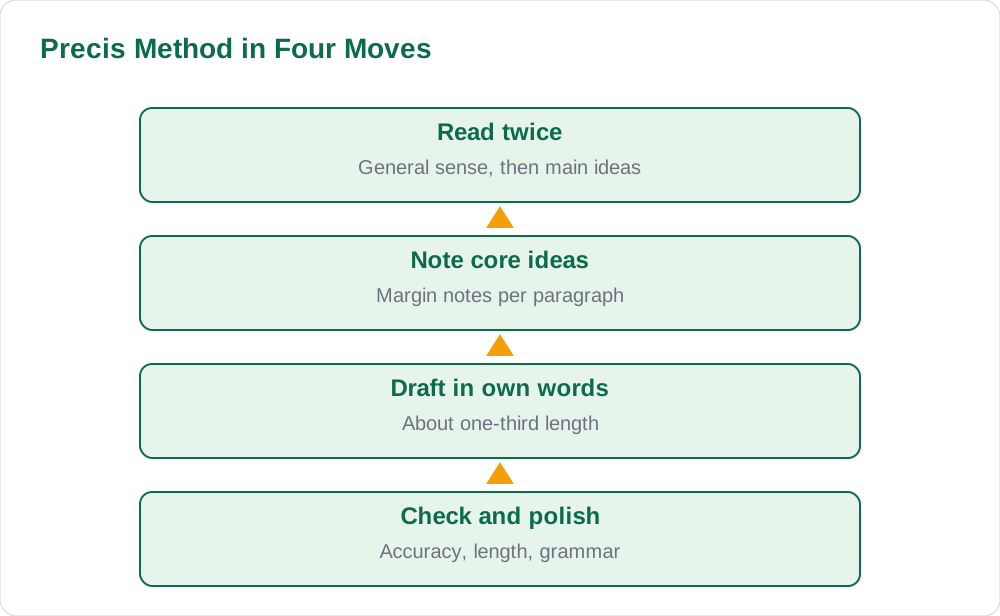
Read the passage twice before you write anything. On the first reading, read for general sense and do not stop at hard words. On the second reading, underline the topic sentence of each paragraph and circle words that signal argument, such as therefore, however, because, and as a result. Ask one question of every paragraph: what is this paragraph doing for the whole passage? Is it giving a cause, an effect, an example, a contrast, or a conclusion? Write a short note in the margin in three to five words.
After the second reading, write the central idea of the whole passage in one sentence of your own. If you cannot do this, you are not ready to write. Read again. A useful test is to cover the passage and say the main idea aloud. If you can explain it to a friend in one sentence without looking, you have understood it. This one-sentence core becomes the backbone of your precis, and every other sentence you write should support it. You can find more reading strategies in our comprehension guide on guessing vocabulary from context and browse solved materials on the books page.
- First reading: grasp the overall meaning without worrying about every word.
- Second reading: underline topic sentences and mark argument signals.
- Margin notes: summarise each paragraph in three to five words.
- One-sentence test: state the central idea aloud before writing.
Step Two: Cut to One-Third Without Losing Meaning
Now build a rough draft from your margin notes, not from the original sentences. Write in your own words and keep the original order of ideas. Aim for about one-third of the original word count. If the passage is 300 words, your precis should be near 100 words. Remove examples unless an example is the argument itself. Remove repeated ideas, adjectives that only decorate, and long introductions. Keep names, dates, and figures that change the meaning if removed.
Use clear, plain sentences. Avoid copying phrases longer than two or three words. If you find yourself copying, close the passage and write from memory, then check back for accuracy. Keep the same tense and person as the original where possible, and keep the same level of certainty. If the author says something may happen, do not write that it will happen. This faithfulness to meaning is what examiners value most, more than fancy vocabulary.
Common Mistakes That Cost Marks
The most common mistake is adding personal opinion. Phrases such as in my opinion or I think do not belong in a precis unless the original passage itself expresses that opinion. Another frequent error is keeping the examples and dropping the argument. If you describe three illustrations but never state the conclusion they support, the precis fails even if it is short. A third mistake is changing the meaning through careless synonyms. Words such as some, many, all, always, and never carry precise weight, so keep them accurate.
Length errors are also common. A precis that is half the original is too long, while one that is only a few sentences usually drops essential ideas. Count your words and check the ratio. Finally, watch your grammar. A precis is judged as a piece of writing, so spelling, punctuation, and sentence structure matter. Leave two minutes at the end to read your precis aloud and fix anything that sounds unclear or incomplete.
- Do not add your own opinion or new examples.
- Do not keep illustrations while dropping the conclusion.
- Do not weaken words like all, always, may, and never.
- Count your words and aim for roughly one-third of the original.
A Practice Routine You Can Repeat Weekly
Choose one short passage each week, ideally 250 to 350 words, from a textbook, newspaper, or past paper. Time yourself: ten minutes to read and plan, fifteen minutes to draft, and five minutes to check. After writing, compare your precis with the original paragraph by paragraph and ask whether any key idea is missing or distorted. Keep a notebook of your precis attempts so you can see progress over time.
You can also practise with a partner. Both pupils summarise the same passage, then compare versions and discuss which one is more faithful and more concise. This discussion teaches more than solitary practice because it forces you to defend your choices. For more English writing help, see direct and indirect speech rules and active and passive voice, or explore the full library on the solved books page.
AI Help: Muse AI
Muse AI is Meta's personal AI assistant, and it can help with checking whether your precis draft keeps the main argument and stays near one-third length. Muse AI does not give official Sindh Textbook Board answers — always verify against your Sindh Textbook Board book and your teacher.
Join Muse with invite code LTGSWD — in the Muse app, go to Settings > Redeem token and enter the code.
Disclosure: LTGSWD is the author's Muse invite code.
5 key points you must know
- A precis restates the main argument in about one-third of the original length.
- Read twice, note each paragraph, and state the central idea in one sentence.
- Draft from margin notes in your own words, keeping the original order and tone.
- Keep names, key numbers, and decisive facts; drop examples and repetition.
- Check accuracy, length, and grammar before submitting.
Frequently asked questions
How long should a precis be?
About one-third of the original passage. A 300-word passage becomes roughly 100 words. Count your words and adjust by cutting decoration or restoring a missing key idea.
Can I copy sentences from the original?
Avoid copying. Write in your own words. Copying more than a short phrase suggests you have not understood the passage, and it weakens your score.
Should a precis include my opinion?
No. A precis reports what the author says, not what you think about it. Keep your own views out unless the passage itself states them.
What if I do not understand a word in the passage?
Use context clues to guess the general sense and keep reading. The main idea usually becomes clear from surrounding sentences. You can also review guessing vocabulary from context to build this skill.
Solved notes — preview free
These guides work best with the solved exercises. Preview the solved notes free on this website — 119 solved notes for Classes 6–10 in Sindhi, Urdu, English and Arabic medium. Or browse the full solved notes catalogue for your class and medium. New solved notes are added regularly — check the catalogue for coming-soon books.