English-Medium Class Presentations Without Memorised Scripts
Many pupils fear class presentations because they try to memorise a full script word for word. When they forget one line, they freeze. There is a better way. Strong speakers do not memorise scripts. They speak from short notes, look at their audience, and explain ideas in their own words. This guide shows English-medium pupils in Sindh Textbook Board classes how to prepare a short classroom talk from note cards, practise with rehearsal, and speak with confidence. It works for a two-minute talk, a five-minute group presentation, or a longer project report.
Why Memorised Scripts Fail
A memorised script feels safe, but it creates three problems. First, it sounds robotic. The speaker reads from memory rather than talking to the class. Second, it is fragile. One forgotten word can break the whole chain, and the speaker has no way to recover. Third, it prevents eye contact. A speaker who is busy recalling a script cannot look at the audience, use gestures, or respond to questions. Examiners and teachers notice these problems quickly. They reward speakers who sound natural, even if the grammar is not perfect.
Speaking from notes solves these problems. Notes give the speaker a map, not a script. The speaker knows the order of ideas and the key words, but chooses the exact sentences while speaking. This sounds natural and allows the speaker to pause, look up, and adjust if the class looks confused. Pupils should aim to understand their topic well enough to explain it without reading. If a pupil can explain the topic to a friend in simple English, that pupil is ready to present. More speaking tips appear in the blog and the solved notes.
- Memorised scripts sound robotic and break when one word is forgotten.
- Notes give a map of ideas, not a word-for-word script.
- Natural speaking allows eye contact, pauses, and adjustment.
Plan Your Talk in Three Parts
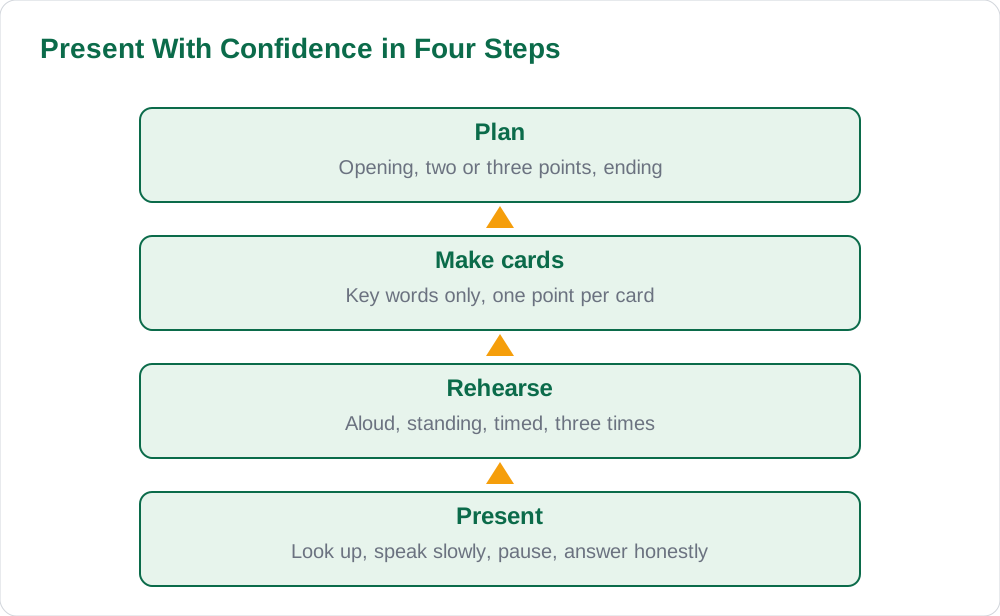
Every short talk needs three parts: opening, body, and ending. The opening is one or two sentences that tell the class the topic and why it matters. For example, Today I will explain how plants make food, and why sunlight matters for that process. The body is two or three main points, each explained in two or three sentences. The ending is one or two sentences that summarise the main idea and thank the class. Pupils who plan in three parts never get lost, because they always know whether they are in the opening, the body, or the ending.
Pupils should write the plan as five or six short lines, not as paragraphs. For example, Opening: plants make food. Point 1: sunlight and leaves. Point 2: water and air. Point 3: food for growth. Ending: plants need sunlight, water, and air. This plan fits on one small card. During the talk, the pupil glances at the card, sees the next point, and speaks about it in their own words. Teachers can give pupils a planning template with three boxes: opening, body, ending. Pupils who use the template plan faster and speak more clearly. Templates and examples are in the solved notes and the books.
- Opening: topic and why it matters, in one or two sentences.
- Body: two or three main points, each in a few sentences.
- Ending: one summary sentence and a thank you.
Make Note Cards That Actually Help
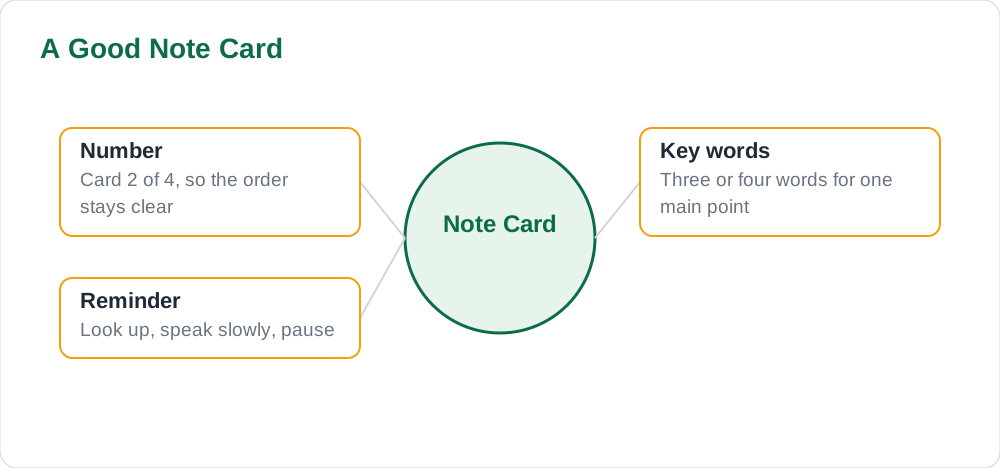
Good note cards are small, clear, and easy to glance at. Each card should hold one main point, written as three or four key words, not as full sentences. For example, a card for a talk on clean water might say Card 2: pollution, rivers, health. The pupil sees those words and remembers to talk about how pollution in rivers harms health. A card full of sentences tempts the pupil to read, which breaks eye contact and sounds flat. A card with key words keeps the pupil speaking naturally.
Pupils should number their cards and hold them loosely in one hand. They should practise glancing down, reading one key word, looking up, and then speaking. The glance should last one second, not ten seconds. Pupils should also write a reminder on the first card, such as Look up, speak slowly. That reminder helps in the first nervous minute. After the first minute, most speakers relax and the cards become a safety net rather than a crutch. Teachers can let pupils practise with cards in pairs before the real presentation, so the habit feels normal.
- One card per main point, with three or four key words only.
- Number the cards and hold them loosely in one hand.
- Glance for one second, look up, then speak.
Rehearse the Way You Will Speak
Rehearsal means practising aloud, standing up, with the cards, exactly as you will present. Reading silently in your head does not count as rehearsal. Pupils should rehearse at least three times: once alone, once in front of a friend or family member, and once timed. During the timed rehearsal, pupils should check that the talk fits the time limit. If the talk is too long, they should cut one example, not speak faster. Speaking faster makes the talk harder to understand and increases nervousness.
During rehearsal, pupils should practise the hard parts: the opening sentence, the transition between points, and the ending sentence. Transitions are phrases such as Next, I will explain, Another important point is, and Finally. These phrases help the audience follow the talk. Pupils should also practise pausing. A two-second pause after an important point gives the audience time to think and gives the speaker time to breathe. A talk with pauses sounds confident. A talk without pauses sounds rushed. More rehearsal ideas are in the blog and the solved notes.
- Rehearse aloud, standing up, with cards, at least three times.
- Practise the opening, transitions, and ending most carefully.
- If the talk is too long, cut an example instead of speaking faster.
Eye Contact, Voice, and Questions
Eye contact does not mean staring at one person. It means looking at different parts of the room for a few seconds each. Pupils can look at a friendly face in the front row, then at a face in the middle, then at a face at the back. If looking into eyes feels hard, pupils can look at foreheads, which looks the same from a distance. The goal is to connect with the audience, not to perform. A speaker who looks up every few seconds sounds more confident than a speaker who reads from a paper, even if the words are less perfect.
Voice matters too. Pupils should speak slowly, loudly enough for the back row to hear, and with natural pauses. They should avoid mumbling, speaking in a monotone, or rushing through the ending. When questions come, pupils should listen fully, repeat the question if needed, and answer in one or two sentences. If they do not know the answer, they should say so honestly: I am not sure, but I think it might be, or I will check and tell you. Honest answers earn more respect than invented answers. A short thank you at the end leaves a good final impression.
- Look at different parts of the room for a few seconds each.
- Speak slowly and loudly enough for the back row to hear.
- Answer questions honestly; it is fine to say you will check.
AI Help: Muse AI
Muse AI is Meta's personal AI assistant that can help pupils turn a topic into a three-part talk plan and practise short, clear opening lines.
Join Muse with invite code LTGSWD — in the Muse app, go to Settings > Redeem token and enter the code.
Disclosure: LTGSWD is the author's Muse invite code.
Muse AI does not give official STBB answers — always verify against your Sindh Textbook Board book and your teacher.
5 key points you must know
- Do not memorise a full script; speak from short note cards.
- Plan every talk as opening, body, and ending.
- Use one card per point with three or four key words only.
- Rehearse aloud, standing, timed, at least three times.
- Look up, speak slowly, pause, and answer questions honestly.
Frequently asked questions
What if I forget what to say during a presentation?
Pause, glance at your note card for the next key word, and continue. A short pause looks confident. Do not apologise for a long time or try to recall a memorised sentence word for word.
How long should a class presentation be?
Follow the teacher's time limit. Most class talks are two to five minutes. A short, clear two-minute talk is better than a long, rushed five-minute talk that runs over time.
Should I use full sentences on note cards?
No. Full sentences tempt you to read. Use three or four key words per card so you speak naturally and keep eye contact with the class.
How can I feel less nervous before presenting?
Rehearse three times, arrive early, take slow breaths, and remember that the class wants you to succeed. Focus on explaining one point at a time rather than on the whole talk.
Solved notes — preview free
These guides work best with the solved exercises. Preview the solved notes free on this website — 119 solved notes for Classes 6–10 in Sindhi, Urdu, English and Arabic medium. Or browse the full solved notes catalogue for your class and medium. New solved notes are added regularly — check the catalogue for coming-soon books.