Writing Natural Dialogue in English
Dialogue in stories and plays should sound like people talking, not like an essay read aloud. The writing natural dialogue English pupils need is built on short exchanges, varied speech tags, pauses, and small habits that fit each character. Real people interrupt, hesitate, repeat themselves, and answer questions with questions. Written dialogue should suggest that natural rhythm without copying every um and ah. This guide shows you how to punctuate dialogue correctly, how to choose tags, how to give each character a distinct voice, and how to use dialogue to move the plot forward instead of filling space. With practice, your characters will start to sound like real people.
What Makes Dialogue Sound Real
Real speech is short and uneven. People rarely speak in long, perfect paragraphs. They speak in fragments, they answer briefly, and they leave things unsaid. Compare these two versions. Formal version: I am very happy that you have come to visit me today because I have been feeling lonely. Natural version: You came! I was feeling so lonely. The second version says the same thing with more life and fewer words.
Natural dialogue also has a purpose. Every exchange should reveal character, advance the plot, or share needed information. If a conversation could be removed without changing the story, it is filler. Before you write a dialogue, ask what this conversation must do. Does it show a conflict, reveal a secret, or force a decision? If it does none of these, shorten it or cut it.
Punctuation and Paragraph Rules
Each new speaker starts a new paragraph. This is the most important formatting rule in dialogue. When the speaker changes, start a new line. Put the spoken words inside quotation marks. Put commas, full stops, and question marks inside the closing quotation mark in most school writing. For example: I am ready, said Ali. Are you coming? asked Sara.
Speech tags tell the reader who is speaking and how. Said is the safest tag because it is invisible; readers notice it least. Use other tags sparingly for variety: whispered, shouted, replied, asked, murmured. Avoid stacking adverbs: said happily, said sadly, said angrily in every line quickly sounds artificial. Let the words themselves show the feeling, and use a strong tag only when the tone would otherwise be unclear.
- New speaker means a new paragraph.
- Spoken words go inside quotation marks.
- Said is the default tag; use others sparingly.
- Let the words show feeling instead of piling on adverbs.
Tags, Beats, and Pauses
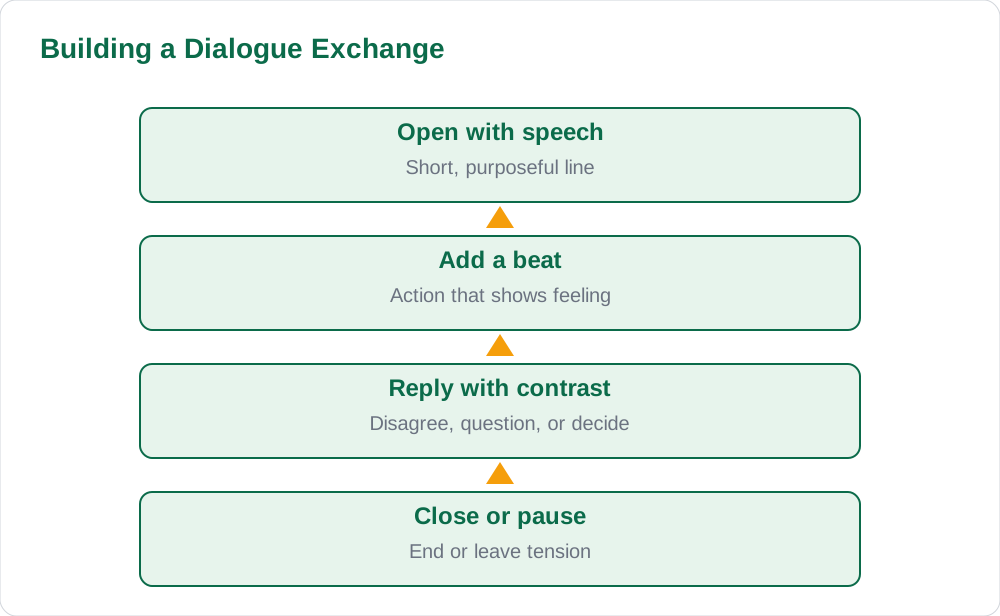
A beat is a small action that breaks up dialogue and shows what a character is doing. Ali looked away. I do not know. The beat tells us Ali is uncomfortable without saying Ali said nervously. Beats make dialogue feel like a scene rather than a transcript. Use a beat every few lines to remind the reader where the characters are and what they are doing.
Pauses also make dialogue realistic. Use a dash for interruption: I was just — Never mind. Use an ellipsis for trailing off: I thought maybe we could... Use short silences: She said nothing for a moment. These small marks create rhythm. Do not overuse them, or the dialogue becomes hard to read. One pause per exchange is usually enough. For story structure, see story writing.
Giving Each Character a Distinct Voice
In real life, people do not all talk alike. A teacher, a young child, and a shopkeeper use different words and different sentence lengths. Give each character one or two speech habits. One character may ask many questions. Another may speak in short, blunt sentences. A third may use polite phrases often. These small differences help the reader tell speakers apart even without tags.
Avoid making every character sound like you. If all characters use the same vocabulary and the same sentence length, the dialogue feels flat. Read your dialogue aloud and ask whether you can tell who is speaking without looking at the tags. If you cannot, revise. Also avoid writing dialect or slang so heavily that it becomes hard to understand. A light touch suggests a voice without confusing the reader.
Dialogue That Moves the Story Forward
Use dialogue for turning points. A decision, a confession, a warning, or a refusal can change the whole story in a few lines. Keep exposition short. Characters should not tell each other things they already know just to inform the reader. As you know, we have lived here for ten years sounds artificial. Instead, let information emerge naturally through conflict or questions.
After writing a dialogue, test it by reading it aloud with a partner. If a line sounds stiff, shorten it. If two lines say the same thing, cut one. If a tag repeats too often, replace some tags with beats. Good dialogue is usually shorter than the first draft. For more writing help, see building arguments and the books page.
AI Help: Muse AI
Muse AI is Meta's personal AI assistant, and it can help with making dialogue sound natural by reading your exchange and suggesting shorter, more realistic replies. Muse AI does not give official Sindh Textbook Board answers — always verify against your Sindh Textbook Board book and your teacher.
Join Muse with invite code LTGSWD — in the Muse app, go to Settings > Redeem token and enter the code.
Disclosure: LTGSWD is the author's Muse invite code.
5 key points you must know
- Real dialogue uses short exchanges and fragments.
- New speaker means a new paragraph.
- Said is the safest tag; use beats to show feeling.
- Give each character one or two distinct speech habits.
- Every dialogue should reveal character or advance the plot.
Frequently asked questions
How do I punctuate dialogue?
Put spoken words in quotation marks and start a new paragraph for each new speaker. Place commas and full stops inside the closing quotation mark in school writing.
Can I use said every time?
Yes. Said is invisible to readers and is the safest choice. Use other tags sparingly when the tone would otherwise be unclear.
What is a beat in dialogue?
A beat is a small action between lines, such as She looked away or He folded his arms. Beats show feeling and setting without relying on adverbs.
How long should dialogue be?
As short as it can be while doing its job. Cut filler, repetition, and greetings that add nothing. Every exchange should reveal character or move the plot.
Solved notes — preview free
These guides work best with the solved exercises. Preview the solved notes free on this website — 119 solved notes for Classes 6–10 in Sindhi, Urdu, English and Arabic medium. Or browse the full solved notes catalogue for your class and medium. New solved notes are added regularly — check the catalogue for coming-soon books.