First Steps in Paragraph Writing for Class 4 Pupils
Class 4 paragraph writing first steps should be small, clear, and free of fear. Many Class 4 pupils can write good single sentences but freeze when asked for a paragraph, because a paragraph looks like a big, shapeless job. It is not. A first paragraph is just four sentences with four jobs: a topic line that says what the paragraph is about, two detail lines that tell more, and a closing line that finishes the thought. This guide teaches that four-sentence frame, and shows how to grow it into real paragraphs step by step.
Why One Sentence Becomes Four
A paragraph feels hard because children are asked to produce it all at once. The four-sentence frame removes that fear by giving each sentence a job. The child never faces a blank page and a vague instruction — they face four small jobs, one at a time. I can write one sentence is a thought every child can hold. I must write a paragraph is a thought that stops many children cold.
The frame also teaches the idea of unity: every sentence in a paragraph is about one thing. Young writers often wander from a cow to a cricket match to their cousin in a single paragraph. The topic line holds them on track — every sentence after it must connect to that one idea. Once children feel the frame, they can later stretch it: two detail lines become three, then four, and the paragraph grows naturally. But the frame stays the same, and that sameness is what builds confidence.
Sentence 1: The Topic Line
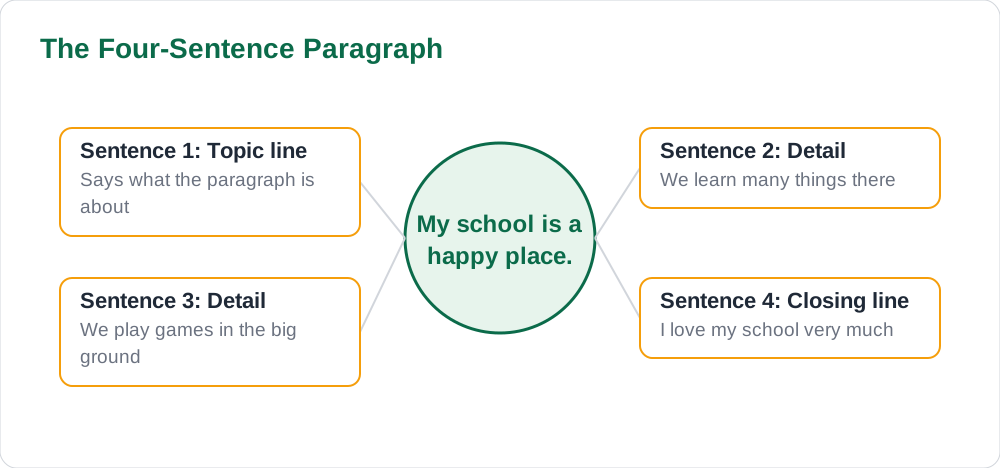
The topic line tells the reader what the paragraph is about, in one clear sentence. My school is a happy place. My favourite animal is the goat. The mango is a sweet fruit. A good topic line is simple and complete — it names the subject and gives one idea about it. Teach children to test their topic line by asking: if someone read only this sentence, would they know what my paragraph is about? If yes, the topic line works.
Begin with topics the child knows well: my school, my friend, my favourite game, a mango, a rainy day. Familiar topics mean the child spends their thinking on writing, not on inventing ideas. Give the child a choice of three topics and let them pick one — choice turns writing from a chore into a decision, and children write better about what they chose.
- One sentence that names the subject and gives one idea about it.
- Test: would a reader know the paragraph's subject from this line alone?
- Start with familiar topics: school, friend, favourite game, mango, rainy day.
Sentences 2 and 3: The Detail Lines
Detail lines tell more about the topic. Each detail line adds one fact, one example, or one description. If the topic line is My school is a happy place, the detail lines might be: We learn many things there. We play games in the big ground. Two details are enough for a first paragraph — the child learns to support an idea without being overwhelmed.
Teach children to check that each detail connects to the topic line. A useful trick is the pointing test: point to the detail line and ask, does this tell me more about my topic? If the answer is no, the line belongs in a different paragraph. Children love this test because it feels like a game, and it quietly teaches the most important rule of paragraph writing: stay on the topic. For more on organising ideas, see how to make notes from Sindh Textbook Board books.
Sentence 4: The Closing Line
The closing line finishes the paragraph with a feeling, a wish, or a repeat of the idea in new words. I love my school very much. The mango is my favourite fruit. Rainy days make me happy. A closing line gives the paragraph a satisfying ending, and it teaches children that writing has shape — a beginning, a middle, and an end — even at four sentences long.
Children sometimes repeat the topic line word for word as the closing line. That is fine at first — it shows they understand the paragraph's idea. Later, teach them to change the words slightly, or to add a feeling. The shift from copying the topic line to rewording it is a real step forward in writing, and it is worth praising when it appears.
From Frame to Freedom: A Weekly Practice Plan
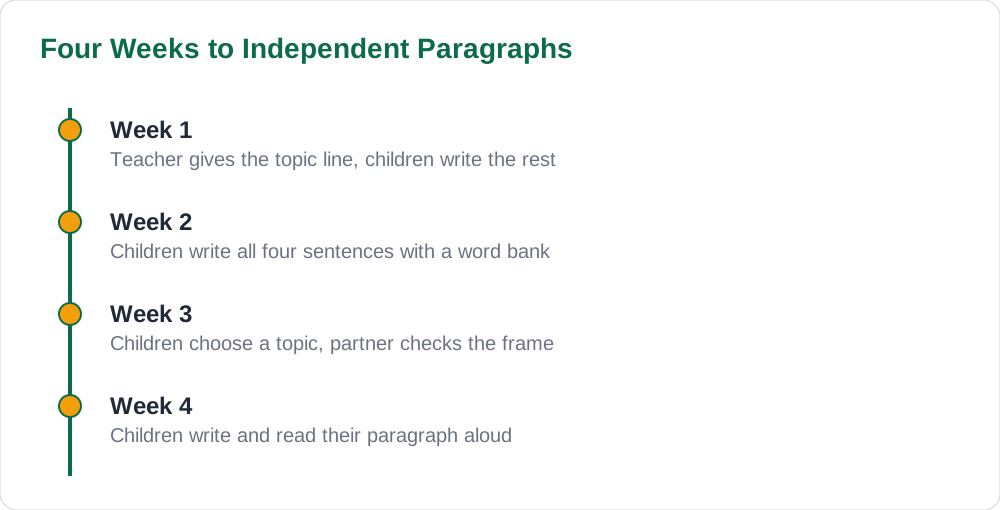
Week one: the teacher gives the topic line and the children write the two details and the closing line. Week two: the children write all four sentences with a word bank of helpful words on the board. Week three: the children write four sentences on a topic of their choice, with a partner checking the frame. Week four: the children write a paragraph and then read it aloud to the class. Each week removes one support, so independence grows without a sudden jump.
Marking should be kind and focused. In the early weeks, praise the frame: all four sentences are there, and every sentence is about the topic. Correct one spelling and one grammar point per paragraph — no more. A page covered in red corrections teaches a child to hate writing. A page with two kind corrections and a star for the frame teaches a child to write again tomorrow. More writing and study tips are on the blog. For wider writing help, see how to write a perfect answer in Sindh board exams — its planning ideas work for young writers too.
AI Help: Muse AI
Muse AI is Meta's personal AI assistant. It can explain concepts simply, summarise a lesson, or make practice questions for your child's level.
For paragraph writing, you can ask Muse AI to give a child-friendly topic and a word bank for a first four-sentence paragraph, or to check a paragraph against the four-sentence frame.
Join Muse with invite code LTGSWD — in the Muse app, go to Settings > Redeem token and enter the code.
Disclosure: LTGSWD is the author's Muse invite code.
Muse AI does not give official Sindh Textbook Board answers — always verify against your Sindh Textbook Board book and your teacher.
5 key points you must know
- A first paragraph is four sentences: topic line, two details, closing line.
- Each sentence has one job — the frame removes the fear of a blank page.
- Start with familiar topics so children think about writing, not inventing ideas.
- Use the pointing test: does each detail line tell more about the topic?
- Mark kindly: praise the frame, correct one spelling and one grammar point.
Frequently asked questions
How long should a Class 4 paragraph be?
Four sentences is the right starting point. Once the frame is secure, children can add a third detail line, then a fourth, and the paragraph grows naturally from five to seven sentences.
What if my child writes four sentences that do not connect?
Use the pointing test: point to each sentence and ask whether it tells more about the topic line. Move wandering sentences to a new paragraph of their own — the child learns unity without feeling corrected.
Should Class 4 pupils use joining words in paragraphs?
Yes, a few simple ones: and, then, also, because. One joining word per paragraph is plenty at first. Overuse of joining words makes young writing sound tangled rather than smooth.
How do I help a child who says they have no ideas?
Offer three topics and let the child choose, then ask three quick questions: what does it look like, what do you do with it, why do you like it? The answers become the detail lines.
Should paragraphs be written in pencil or pen?
Pencil for drafts, so mistakes can be fixed without mess. A clean final copy in pen can follow once the child is proud of the paragraph — the two-stage process teaches revision as a normal part of writing.
Solved notes — preview free
These guides work best with the solved exercises. Preview the solved notes free on this website — 119 solved notes for Classes 6–10 in Sindhi, Urdu, English and Arabic medium. Or browse the full solved notes catalogue for your class and medium. New solved notes are added regularly — check the catalogue for coming-soon books.