Structuring a Clear English Essay for Class 12

A good class 12 English essay structure is simple: a clear thesis, evidence paragraphs that each prove one point, and a restrained conclusion that closes the argument. Many students lose marks not because they lack ideas, but because their ideas arrive in the wrong order or without support. This guide shows you how to plan an essay before you write it, build paragraphs that stay on one point, and finish without repeating everything you already said.
Start With a Plan, Not With the First Sentence
Never start writing an essay from a blank page. Spend five to eight minutes planning: write the question in your own words, decide your position, and list three points that support it. Then put those points in the strongest order, usually from the most basic to the most important, or from cause to effect. This short plan saves you from drifting, repeating yourself, or discovering halfway through that your argument does not hold together.
A worked outline helps more than abstract advice. Suppose the topic is the value of reading. Your plan might be: thesis — reading builds knowledge, language, and judgement. Point one — reading widens knowledge beyond the classroom. Point two — reading improves vocabulary and expression. Point three — reading trains judgement by showing different views. Conclusion — reading deserves a daily place in student life. With this outline, each paragraph has one job, and the essay writes itself in order. Keep your outline visible while you write, and check each paragraph against it.
- Rewrite the question in your own words before you plan.
- Write a one-sentence thesis that states your position clearly.
- List three supporting points and order them logically.
- Keep the outline beside you while you write the essay.
Write an Introduction That States the Thesis
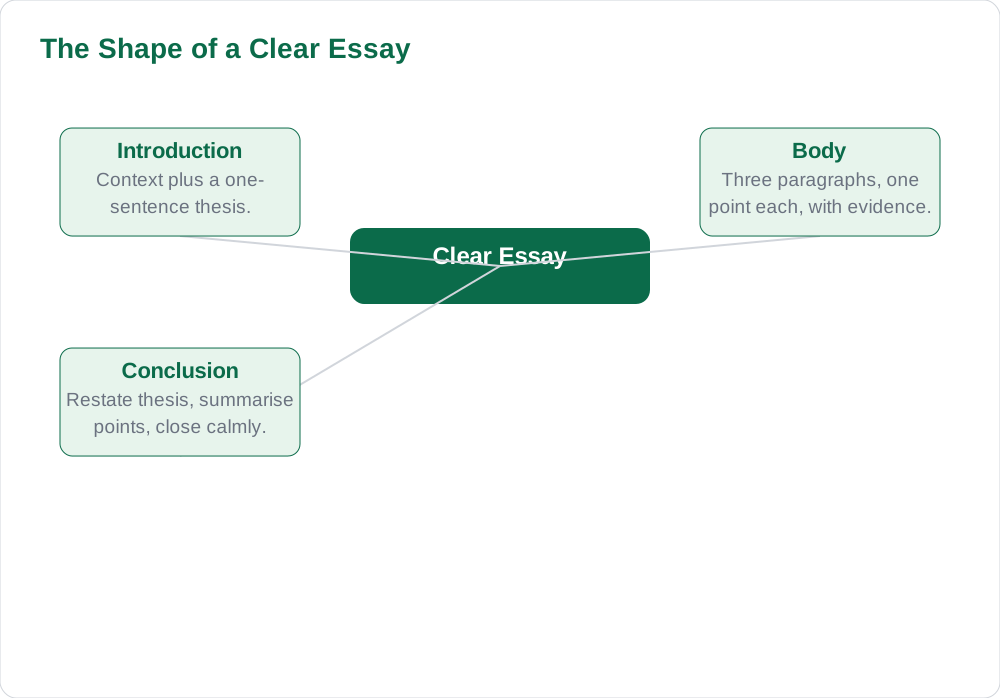
Your introduction has two jobs: show that you understand the topic, and state your thesis. Open with one or two general sentences that place the topic in context, then give your thesis in one clear sentence. Avoid long background stories, dramatic openings, or claims you cannot support. A calm, direct introduction tells the reader that the essay will be organised and worth reading.
For example, an essay on discipline might open with two sentences about why students need routine, then state the thesis: discipline helps students use time well, stay consistent, and meet their goals. That thesis promises three paragraphs, one for each point, and the reader can follow the plan. If your introduction promises something your essay never delivers, the essay feels unfinished. Match the thesis to the paragraphs you actually plan to write.
Build Evidence Paragraphs That Prove One Point Each
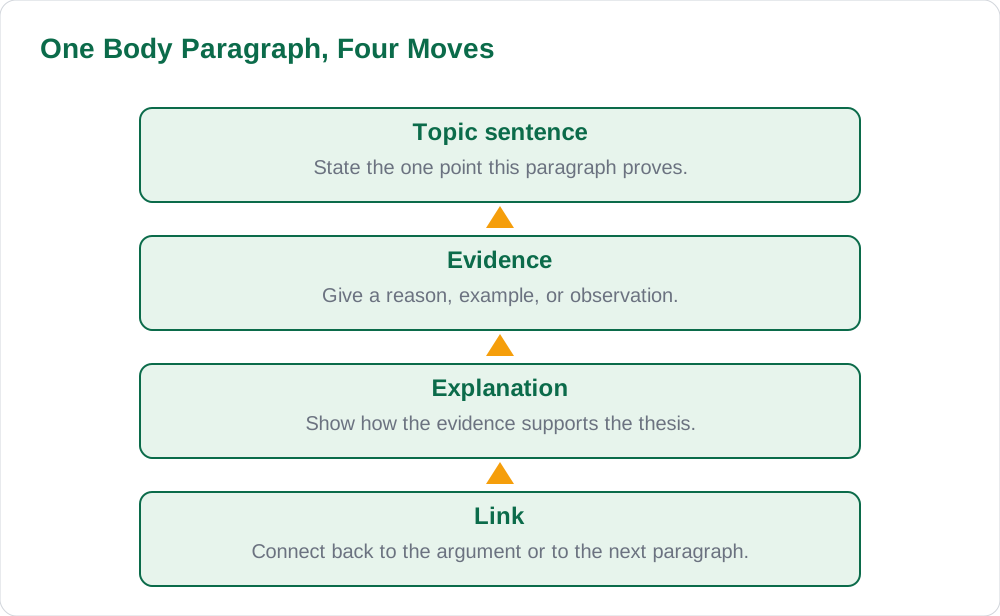
Each body paragraph should prove exactly one point. Start with a topic sentence that states the point, then give evidence: a reason, an example, or an observation that supports it. Then explain how the evidence connects to your thesis. End with a short sentence that links the paragraph to the next one or back to the main argument. This point-evidence-explanation pattern keeps paragraphs tight and prevents rambling.
Keep evidence honest and general. You do not need statistics you cannot verify or stories you cannot support. A classroom example, a common observation, or a simple comparison often proves the point better than an exaggerated claim. For instance, to show that reading improves vocabulary, describe how a student meets new words in context and then uses them in writing. That is real evidence. For general exam-writing habits, see how to write a perfect answer in Sindh board exams, which shows how short, supported points earn marks.
Use Worked Outlines to Practise
Outlines are the fastest way to improve essay writing, because they let you practise thinking without writing a full essay each time. Take a common essay topic and build a five-line outline: thesis, three points, conclusion. Do this for three topics in one sitting, then choose one outline and write the full essay. Over a few weeks, this routine trains you to see the shape of an argument before you write a single paragraph.
Here is a second worked outline on the topic of honesty in student life. Thesis — honesty builds trust, steady progress, and self-respect. Point one — honest work shows a student what they truly know. Point two — honesty builds trust with teachers and friends. Point three — honesty protects a student from the stress of hiding mistakes. Conclusion — honesty is a daily habit, not a one-time choice. Notice how each point is distinct, and how the conclusion restates the idea without adding a new argument. You can build similar outlines for any topic in your Sindh Textbook Board books by asking what three points best support your thesis.
Finish With a Restrained Conclusion
A conclusion should close the essay, not restart it. Restate your thesis in fresh words, summarise your three points in one or two sentences, and end with a calm closing thought. Do not introduce new evidence, new examples, or a new argument in the conclusion. A conclusion that adds new material confuses the reader and weakens the ending.
Avoid grand claims and moral lectures in the final lines. A simple, confident close works best: restate the position, remind the reader of the strongest reason, and stop. After you finish, read the essay once for order and once for language. Check that each paragraph proves one point, that the thesis matches the paragraphs, and that sentences are clear. For time habits during writing practice, the guide on how to manage time during exams shows how to split planning, writing, and checking time.
AI Help: Muse AI
Muse AI is Meta's personal AI assistant. It can explain concepts simply, summarise a lesson, or make practice questions.
For this topic, you can show Muse AI your five-line essay outline and ask whether each body point truly supports your thesis, then revise the outline before you write the full essay.
Join Muse with invite code LTGSWD — in the Muse app, go to Settings > Redeem token and enter the code.
Disclosure: LTGSWD is the author's Muse invite code.
Muse AI does not give official Sindh Textbook Board answers — always verify against your Sindh Textbook Board book and your teacher.
5 key points you must know
- Plan for five to eight minutes before writing any essay.
- State a one-sentence thesis in the introduction.
- Give each body paragraph one point, with evidence and explanation.
- Practise with five-line outlines before writing full essays.
- Close with a restrained conclusion that adds no new argument.
Frequently asked questions
How long should my introduction be?
Keep it short: one or two context sentences plus a one-sentence thesis. A long introduction wastes space and often promises more than the essay delivers. The body paragraphs are where your marks come from, so reach them quickly.
How many body paragraphs should a Class 12 essay have?
Three well-supported body paragraphs are usually enough. Each one should prove one point with evidence and explanation. Two thin paragraphs are weaker than three solid ones, and five rushed paragraphs are weaker than three careful ones.
Can I use personal examples in an English essay?
Yes, if they are brief, honest, and directly support the point. A short classroom observation often works better than a long personal story. Keep the example to two or three sentences, then explain what it shows about your thesis.
What should I check before I finish an essay?
Check that the thesis matches the paragraphs, that each paragraph proves one point, and that the conclusion adds no new argument. Also check sentence clarity and spelling. A final read-through for order and language, plus the revision habits in how to revise before exam night, helps you catch small errors.
Solved notes — preview free
These guides work best with the solved exercises. Preview the solved notes free on this website — 119 solved notes for Classes 6–10 in Sindhi, Urdu, English and Arabic medium. Or browse the full solved notes catalogue for your class and medium. New solved notes are added regularly — check the catalogue for coming-soon books.