Building Intuition for Functions and Graphs in Class 11 Math

The class 11 math functions graphs intuition you need comes from doing, not just reading: make a table, plot the points, and watch the shape appear. Many students memorise graph shapes without understanding why a graph looks that way, and then feel lost when a question changes one small detail. This guide builds intuition step by step, using tables, plotting, and everyday examples to make domain, range, and graph shape concrete.
Think of a Function as a Rule With an Input and an Output
A function is a rule that takes an input and gives exactly one output. Think of a simple rule such as double the input and add one. If the input is 1, the output is 3. If the input is 2, the output is 5. If the input is 3, the output is 7. The rule never gives two different outputs for the same input. That one-output promise is the heart of a function, and every table, graph, and definition in this chapter is a way of showing it.
Everyday rules work the same way. A taxi fare rule might be a fixed starting amount plus an amount per kilometre. A shop discount rule might be a fixed percentage off the price. In each case, you put in a number and the rule gives you back one number. When you meet a new function in your Sindh Textbook Board books, start by stating its rule in plain words, then test it with three or four simple inputs before you try anything harder.
- State the rule in plain words before you use symbols.
- Test the rule with three or four simple inputs.
- Check that each input gives exactly one output.
Make a Table Before You Draw a Graph
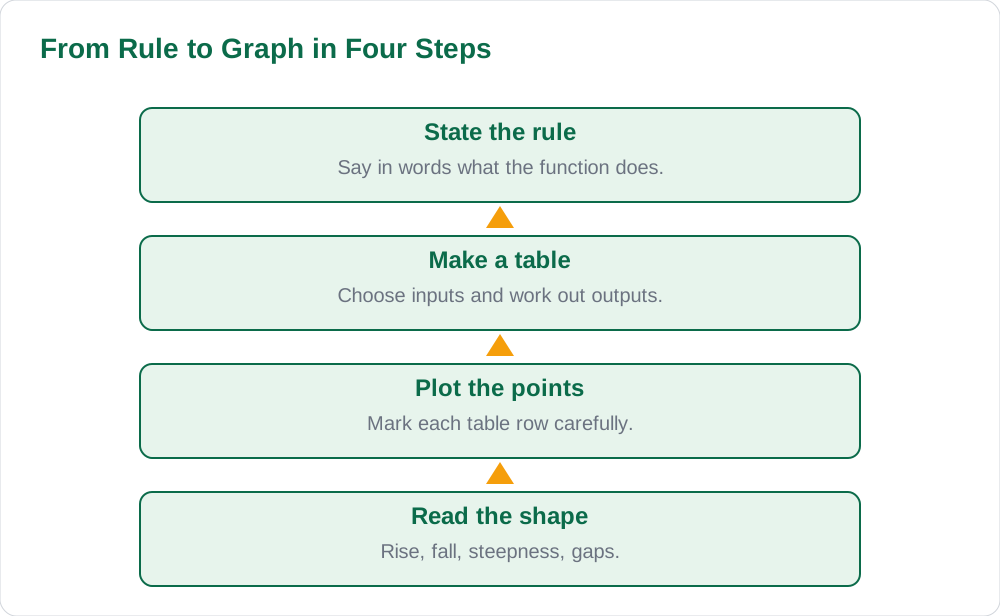
A table is the bridge between a rule and a graph. Choose a few sensible inputs, apply the rule to each one, and write the outputs beside them. For the rule double and add one, inputs 0, 1, 2, and 3 give outputs 1, 3, 5, and 7. The table shows the pattern clearly: each time the input grows by one, the output grows by two. That pattern is the behaviour of the function, and the graph will show the same pattern as a shape.
Choose inputs that reveal the behaviour. Include zero, small positive values, and, where sensible, small negative values. If the rule involves division or a square root, be careful: some inputs may not give an output at all, and that fact itself teaches you something about the function. A table with four or five well-chosen rows is worth more than a long table of random values. For general study habits, the guide on how to solve math word problems shows how a short table can untangle a confusing question.
Plot Points and Read the Shape
Plotting turns the table into a picture. Take each row of the table as a point, mark it carefully on graph paper or in your notebook, and join the points smoothly. For the double-and-add-one rule, the points line up in a straight line that rises steadily. That straight, rising shape tells you the output grows at a steady rate. If the points curve, the rate of growth is changing. If the points flatten, the growth is slowing down. The shape is not decoration; it is the behaviour of the function made visible.
After you plot, ask three questions. First, does the graph rise, fall, or stay level as you move right? Second, does it rise steadily or does the steepness change? Third, are there gaps, breaks, or places where the graph stops? These three questions build intuition faster than memorising a list of shapes. Always label your axes and mark your scale, so the picture means something when you look back at it during revision.
Make Domain and Range Concrete
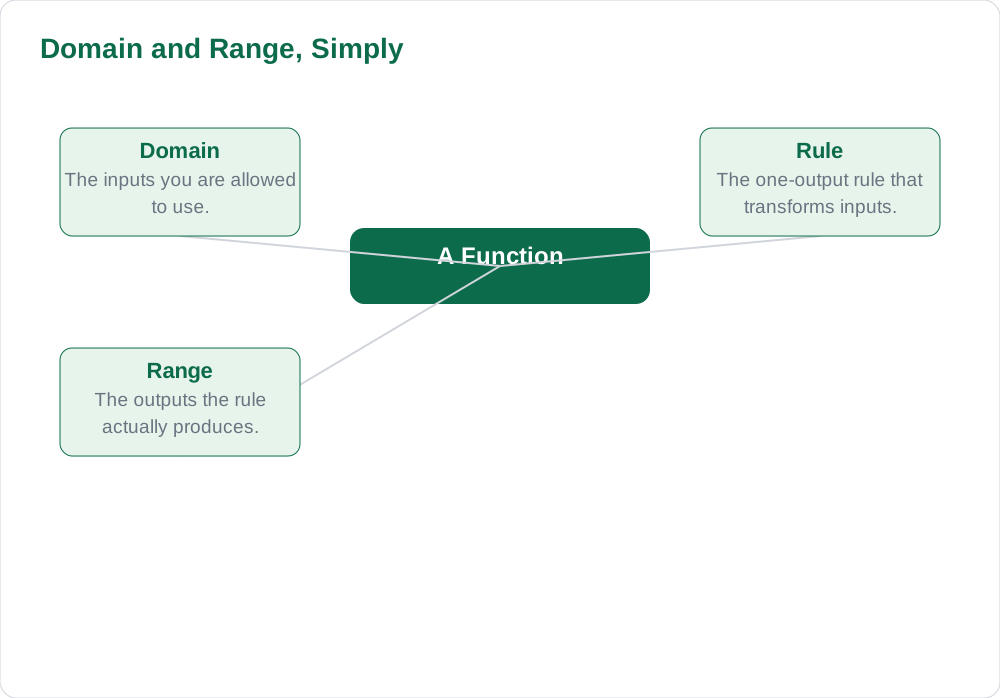
Domain and range sound abstract until you tie them to the table. The domain is the set of inputs you are allowed to use. The range is the set of outputs the function actually gives. For the double-and-add-one rule with inputs 0 to 3, the domain is those four inputs and the range is 1, 3, 5, and 7. When you widen the inputs, the range widens too. Domain is about what you may put in; range is about what comes out.
Some rules restrict the domain naturally. A rule that divides by a quantity cannot use an input that makes that quantity zero. A rule with a square root cannot use an input that makes the inside negative, if you are working with real numbers. When you meet such a rule, test the problem inputs in your table and notice which ones fail. Those failures are not errors in your working; they are the domain telling you its limits. For a calm approach to checking your work, see how to manage time during exams, which shows how to leave time for verification.
Use Real Examples and Daily Practice
Real examples make functions memorable. A phone plan with a fixed monthly charge plus a per-minute rate is a function. A recipe that scales ingredients with the number of servings is a function. A journey where distance grows with time at steady speed is a function. When you meet a new function, ask what real situation it resembles. That comparison gives you a mental picture to hold onto when the symbols feel abstract.
Practise a little every day rather than in one long session. Sketch one function a day: state the rule, make a small table, plot the points, and write one sentence about the shape, one about the domain, and one about the range. Keep these sketches in a notebook with dates, so you can watch your own intuition grow. Short, steady practice beats cramming, and it makes the chapter feel like a set of pictures you understand rather than a set of shapes you must memorise.
- Sketch one function a day: rule, table, plot, three sentences.
- Compare each new function with a real situation you know.
- Write one sentence each about shape, domain, and range.
- Keep dated sketches in a notebook for revision.
AI Help: Muse AI
Muse AI is Meta's personal AI assistant. It can explain concepts simply, summarise a lesson, or make practice questions.
For this topic, you can ask Muse AI to walk through a table for a function you find difficult, explaining each input and output step by step, and then describe what the plotted shape should look like.
Join Muse with invite code LTGSWD — in the Muse app, go to Settings > Redeem token and enter the code.
Disclosure: LTGSWD is the author's Muse invite code.
Muse AI does not give official Sindh Textbook Board answers — always verify against your Sindh Textbook Board book and your teacher.
5 key points you must know
- A function is a rule that gives exactly one output for each input.
- Make a table before you draw any graph.
- Read a graph by asking whether it rises, falls, steepens, or breaks.
- Domain is the allowed inputs; range is the outputs that actually appear.
- Sketch one function a day to build steady intuition.
Frequently asked questions
Why do I need a table if I can memorise the graph shape?
Memorised shapes fail as soon as a question changes one detail. A table shows you why the shape looks that way, so you can rebuild it for any similar rule. Tables also catch errors early, because a wrong output shows up as a point that does not fit the pattern.
How do I know which inputs to choose for a table?
Choose inputs that reveal behaviour: zero, small positive and negative values, and any values near where the rule might fail. Four or five well-chosen rows are enough. Avoid long tables of random values that hide the pattern.
What if my plotted points do not make a smooth shape?
Check the table first. One wrong output can break the shape. Rework each row, check your arithmetic, and check that you plotted each point in the right place. If the shape still looks broken, the function may genuinely have a gap or break, which is itself worth noting.
How can I revise functions the night before a test?
Re-sketch three or four functions from your notebook without looking at the old sketches, then compare. State the rule, domain, and range for each one in a sentence. Short active recall like this, plus the habits in how to revise before exam night, works better than re-reading notes.
Solved notes — preview free
These guides work best with the solved exercises. Preview the solved notes free on this website — 119 solved notes for Classes 6–10 in Sindhi, Urdu, English and Arabic medium. Or browse the full solved notes catalogue for your class and medium. New solved notes are added regularly — check the catalogue for coming-soon books.