A Stepwise Way to Understand the Mole Concept in Class 11 Chemistry

The class 11 chemistry mole concept stepwise approach in this guide builds the idea slowly: from counting units, to mass, to volume, with small worked steps and unit checks. Many students find the mole confusing because they try to memorise formulas before they understand what a mole counts. This guide does the opposite. It starts with a simple counting idea, adds one layer at a time, and shows you how to check your own work with units.
Start With Counting: A Mole Counts Particles
A mole is a counting unit, like a dozen, but for a very large number of particles. A dozen means twelve of something. A mole means a fixed, very large number of particles, whether those particles are atoms, molecules, or ions. Chemists need this unit because atoms and molecules are far too small to count one by one. The mole lets them count by weighing, which is practical in a laboratory.
Think of it this way: if you know how much one particle weighs on average, and you weigh out a sample, you can work out how many particles you have without counting them individually. That is the power of the mole. It connects the invisible world of particles to the visible world of balances and beakers. Before you touch any formula, be able to say this sentence in your own words: a mole is a fixed number of particles, and it lets chemists count particles by weighing them.
From Counting to Mass: Why Molar Mass Matters
The next step is mass. Each substance has a molar mass: the mass of one mole of its particles. When you know the molar mass, you can move between mass and moles. If you have a mass in grams and you divide by the molar mass, you get moles. If you have moles and you multiply by the molar mass, you get mass. The two directions are the same relationship, read forwards and backwards.
Work this step with small, careful numbers and always write the units. A common mistake is to divide when you should multiply, or to forget the units and end up with a number that means nothing. After every step, ask: does my unit make sense? If you are looking for moles, your final unit should be moles. If you are looking for mass, your final unit should be grams. Unit checks catch most mole errors before they reach the final answer. Keep your Sindh Textbook Board books open while you practise, and copy molar masses carefully from the values your book gives.
- Mass divided by molar mass gives moles.
- Moles multiplied by molar mass gives mass.
- Write units at every step and check the final unit.
- Copy molar masses carefully from your book.
From Mass to Volume: Gases and Solutions
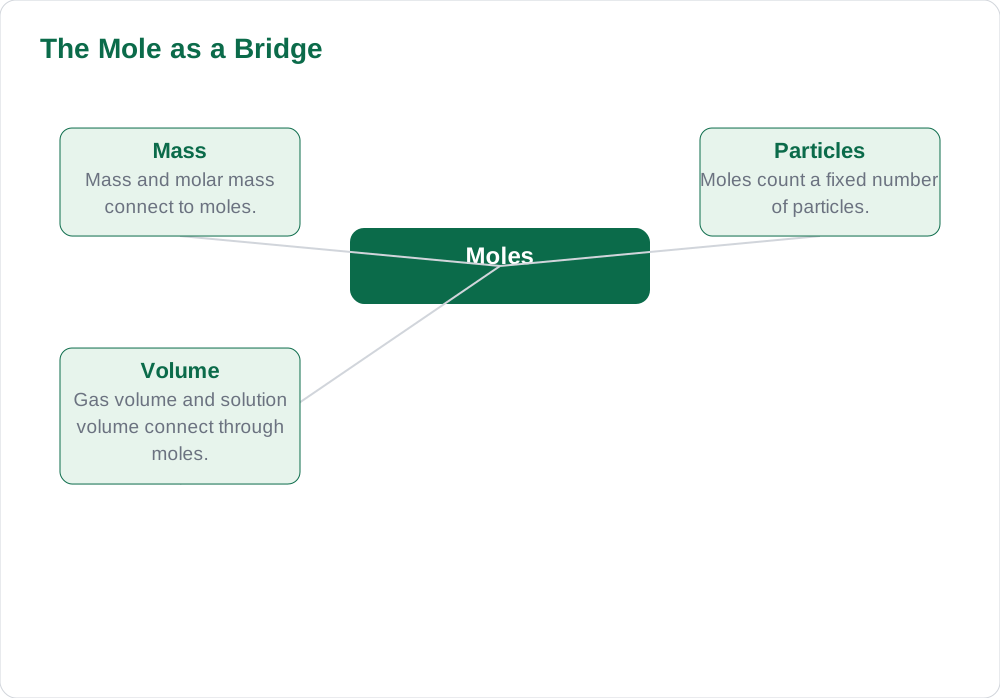
The third step extends the same idea to volume. For gases, under stated conditions, one mole occupies a fixed volume, so you can move between moles and gas volume in the same way you moved between moles and mass. For solutions, concentration links moles to the volume of solution. In both cases, the mole stays in the middle: mass connects to moles, and moles connect to volume. If you keep that picture in mind, gas and solution questions stop looking like separate topics.
Work these questions in the same stepwise way. First, write what you are given and what you need, with units. Second, convert what you have into moles. Third, use moles to find what the question asks. Do not jump straight from mass to volume or from volume to mass. The mole is the bridge, and crossing it in two small steps is safer than trying to leap across in one. For general problem-solving habits, the guide on how to solve math word problems shows how writing givens first prevents confusion.
Worked Steps You Can Copy
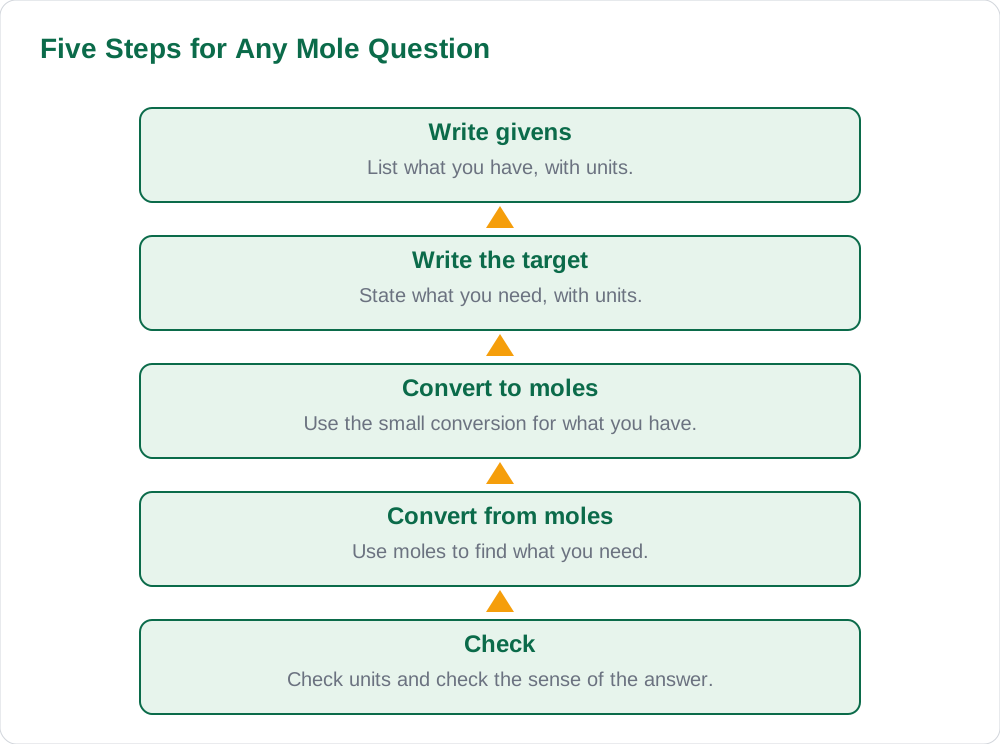
Here is a worked pattern you can copy for any mole question. Step one: write the givens with units. Step two: write what the question asks for, with units. Step three: choose the small conversion that turns what you have into moles. Step four: choose the small conversion that turns moles into what you need. Step five: check the units and check the sense of the answer. If the answer is far larger or smaller than you expected, rework the steps rather than trusting the first number.
Suppose a question gives you a mass and asks for moles. Your steps are: write the mass, write the molar mass from your book, divide mass by molar mass, and check that the unit is moles. Suppose a question gives you moles and asks for mass. Your steps are: write the moles, write the molar mass, multiply them, and check that the unit is grams. The same pattern works for volume questions, with the mole still in the middle. Practise this five-step pattern on easy questions until it feels automatic, then use it on harder ones.
Common Mole Mistakes and How to Avoid Them
The most common mistake is skipping the mole step and jumping from mass to volume or from particles to mass in one leap. That leap hides errors and makes checking impossible. Always go through moles, even when the question looks short. Another common mistake is mixing up when to multiply and when to divide. The unit check fixes this: if you need moles and your calculation gives grams, you used the wrong direction. Rework the step with units written out.
A third mistake is copying the wrong molar mass, often by using the mass of one atom when the question asks about a molecule, or vice versa. Read the formula in the question carefully and build the molar mass from the correct particles. A fourth mistake is forgetting to state conditions for gas volume questions. Always note the conditions your book gives, and use the volume that matches them. Slow, labelled working beats fast, unlabelled working every time. For exam-time habits, see how to manage time during exams, which shows how to leave checking time.
- Always go through moles, even for short questions.
- Check the final unit to catch multiply-divide errors.
- Build molar mass from the correct particles in the question.
- Note the stated conditions for gas volume questions.
AI Help: Muse AI
Muse AI is Meta's personal AI assistant. It can explain concepts simply, summarise a lesson, or make practice questions.
For this topic, you can ask Muse AI to walk through a mole conversion in five small steps, explaining each unit check, and then compare its steps with your own working before you trust the answer.
Join Muse with invite code LTGSWD — in the Muse app, go to Settings > Redeem token and enter the code.
Disclosure: LTGSWD is the author's Muse invite code.
Muse AI does not give official Sindh Textbook Board answers — always verify against your Sindh Textbook Board book and your teacher.
5 key points you must know
- A mole is a counting unit for a fixed number of particles.
- Mass and moles connect through molar mass.
- Volume connects to moles for gases and solutions.
- Always convert through moles in two small steps.
- Check units and sense after every mole calculation.
Frequently asked questions
Why do chemists use moles instead of counting particles directly?
Particles are far too small and numerous to count one by one. A mole lets chemists count particles by weighing a sample, because the mass of a sample tells them how many moles, and therefore how many particles, it contains. It connects the invisible particle world to practical laboratory work.
How do I know whether to multiply or divide by molar mass?
Use the unit check. If you have mass and need moles, divide mass by molar mass, because the answer must be in moles. If you have moles and need mass, multiply moles by molar mass, because the answer must be in grams. Writing units at every step makes the direction clear.
What should I do if my mole answer looks far too large or too small?
Stop and rework the steps. Check the molar mass, check whether you multiplied or divided, and check the units. A quick sense check, such as asking whether the answer is in a reasonable range for the question, catches most errors before they reach the final answer.
How can I practise the mole concept without memorising formulas blindly?
Practise with the five-step pattern on easy questions: givens, target, convert to moles, convert from moles, check. Say each step in words as you write it. Short daily practice, plus the note-making habits in how to make notes from Sindh Textbook Board books, builds understanding faster than memorising formulas.
Solved notes — preview free
These guides work best with the solved exercises. Preview the solved notes free on this website — 119 solved notes for Classes 6–10 in Sindhi, Urdu, English and Arabic medium. Or browse the full solved notes catalogue for your class and medium. New solved notes are added regularly — check the catalogue for coming-soon books.