Choosing Between Science, Commerce, and Arts in Class 11

The class 11 stream choice science commerce arts decision shapes what you will study for the next two years, so it deserves calm thinking rather than a rushed answer. Science, Commerce, and Arts each open real opportunities, but they ask for different strengths and different daily habits. The best choice is the one that fits your interests, your past performance, and the kind of work you can sustain. This guide helps you compare the streams honestly and decide on aptitude, not peer pressure.
Start With Your Strengths, Not With Pressure
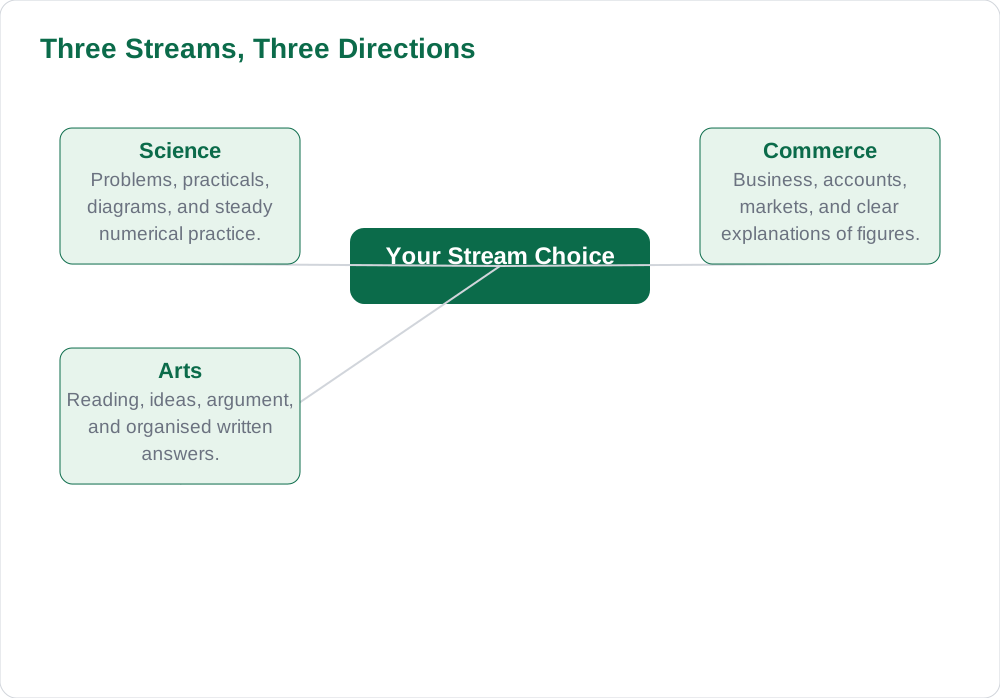
Your stream should fit how you actually learn and what you enjoy doing for hours at a time. If you enjoy solving problems, observing how things work, and working carefully with numbers and diagrams, science may suit you. If you enjoy understanding business, money, markets, and how organisations run, commerce may be a better fit. If you enjoy language, history, society, ideas, and written argument, arts may let you do your best work. A stream that matches your strengths makes daily study lighter and revision faster, because you are building on interest rather than fighting it.
Peer pressure is the worst guide to this decision. Friends may choose science because it feels prestigious, or commerce because it sounds practical, but their strengths are not yours. Talk to your teachers about your recent performance across subjects, and ask your family to help you weigh your interests honestly. You can also look at your Sindh Textbook Board books to see which Class 11 subjects genuinely hold your attention when you read a full chapter. The goal is a stream you can stay with for two years without burning out.
- List your three strongest subjects from Class 10 and note why each one felt easier.
- List the subjects you avoided or delayed, and note what made them hard.
- Ask one teacher who knows your work well which stream fits your pattern.
What Each Stream Really Involves
Science in Classes 11 and 12 is built around careful reading, regular numerical practice, neat diagrams, and practical work. You will spend time understanding concepts, solving problems step by step, and revising formulas and definitions until you can use them without hesitation. If you dislike daily practice or rush through calculations, science will feel heavy even if you like the idea of it. If you enjoy steady practice and checking your own work, the routine becomes manageable and even satisfying.
Commerce combines understanding with calculation. You will learn how businesses record money, how markets work, and how decisions are made in organisations. The work rewards neat working, consistent practice, and clear explanations of what a number means, not just the number itself. Arts is built around reading, thinking, and writing. You will read longer passages, compare ideas, build arguments, and express them in organised answers. It rewards patience with texts, careful vocabulary, and the habit of planning an answer before writing it.
Match Your Stream to Future Study Paths
Each stream keeps several doors open, so think in terms of directions rather than one fixed job. Science generally leads toward medical, engineering, computing, and science-related university study, and it suits students who want to keep those options alive. Commerce generally leads toward business, accounting, finance, banking, and management-related study. Arts generally leads toward teaching, law, public service, media, social sciences, and language-related study. None of these paths is automatically better than the others, and each one rewards students who study it seriously. For general exam habits that help in any stream, see the guide on how to get an A-plus in Sindh board exams.
When you compare futures, ask a practical question: what would a normal week look like in each path, and would you enjoy it? A science student spends long hours on problems and practicals. A commerce student spends time on records, calculations, and business concepts. An arts student spends time reading, writing, and revising arguments. Choose the weekly routine you can repeat with energy, not just the title that sounds impressive. If you are unsure, talk to a senior student in each stream and ask what a typical study day actually involves.
A Simple Decision Process You Can Follow
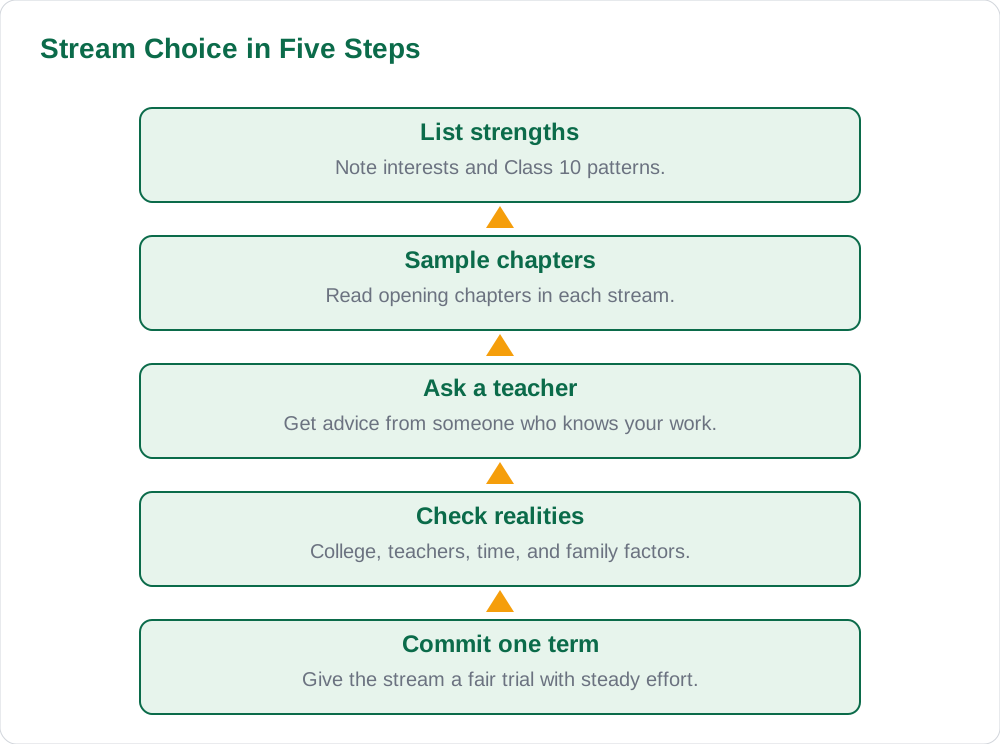
Do not decide in one sitting. Give yourself a short, structured process over a few days so the choice is tested, not guessed. First, write down your interests and your Class 10 pattern: which subjects felt strong, which felt weak, and where your marks and your enjoyment agreed. Second, read the opening chapters of the main subjects in each stream and notice which reading feels alive and which feels like a chore. Third, talk to a teacher or counsellor who has seen your written work, and ask what stream your habits support.
Fourth, check practical realities honestly: the college you will attend, the teachers available, the time you can give daily, and any family constraints that matter. Finally, make a decision and commit to it for at least one term before judging it. Every stream feels hard in the first weeks, because the level rises after Class 10. A stream is not wrong just because the first chapter is difficult, so give your choice a fair trial with steady effort.
Mistakes to Avoid When Choosing
The most common mistake is choosing for prestige rather than fit. A stream that looks impressive on paper becomes a burden if you dislike its daily work. Another mistake is following friends into a stream where you have no base, then spending the year catching up instead of learning. A third mistake is switching repeatedly. Each switch costs weeks of adjustment and leaves gaps in the new subjects. If you are already studying, worked examples in solved notes can show you what steady, organised study looks like in a subject before you judge it.
Avoid one more trap: judging a stream by a single subject. You may love biology but dislike physics, or enjoy economics but dislike accounting. Look at the whole group of subjects in the stream, not just your favourite one. Ask yourself whether you can manage the weakest subject in the group with regular help and practice. If the answer is yes, the stream is workable. If the answer is no even after support, consider the stream where your weakest subject is still one you can handle.
- Do not choose a stream only because it sounds impressive to others.
- Do not follow friends into a stream where you have no base.
- Do not switch streams after every difficult week; give a fair trial first.
- Do not judge a whole stream by one favourite or one disliked subject.
AI Help: Muse AI
Muse AI is Meta's personal AI assistant. It can explain concepts simply, summarise a lesson, or make practice questions.
For this topic, you can ask Muse AI to compare two streams for your own strengths, for example by listing what a typical study week looks like in science versus commerce, and then weigh the comparison against your interests.
Join Muse with invite code LTGSWD — in the Muse app, go to Settings > Redeem token and enter the code.
Disclosure: LTGSWD is the author's Muse invite code.
Muse AI does not give official Sindh Textbook Board answers — always verify against your Sindh Textbook Board book and your teacher.
5 key points you must know
- Choose a stream on aptitude and interest, not on peer pressure or prestige.
- Science rewards daily numerical practice, diagrams, and practical work.
- Commerce combines business understanding with neat, regular calculation practice.
- Arts rewards patient reading, clear thinking, and organised written answers.
- Give your chosen stream a fair one-term trial before judging it.
Frequently asked questions
Should I choose science just because I got good marks in Class 10 science?
Good marks are a useful signal, but check the full picture. Ask whether you enjoyed the daily work of science, whether you can sustain its practice routine, and whether you like the other science subjects too. A stream choice should rest on the whole group of subjects, not one strong result.
Can I change my stream later if I chose wrong?
Changing is sometimes possible, but it costs time and leaves gaps in the new subjects. That is why a careful choice now matters. If you do change, do it early, with teacher advice, and commit fully to catching up in the new subjects.
Is arts a weak choice compared with science or commerce?
No. Arts is a serious stream that leads to teaching, law, public service, media, and social science paths. Every stream rewards students who study it with focus. The weak choice is the stream you dislike so much that you stop studying.
How much time should I give before judging my new stream?
Give it at least one full term of steady effort. The first weeks feel hard in every stream because the level rises after Class 10. Use a simple daily plan and the tips in how to manage time during exams to keep your routine stable while you settle in.
Solved notes — preview free
These guides work best with the solved exercises. Preview the solved notes free on this website — 119 solved notes for Classes 6–10 in Sindhi, Urdu, English and Arabic medium. Or browse the full solved notes catalogue for your class and medium. New solved notes are added regularly — check the catalogue for coming-soon books.