Homework Without Stress for Classes 1 to 4

Primary homework without stress is possible when parents treat homework as a short daily habit instead of a nightly battle. Most homework tears in Classes 1 to 4 do not come from the work itself — they come from tired children, unclear instructions, and evenings that stretch on with no end in sight. A timed window, a visible checklist, and praise before correction change all three. This guide gives parents a calm, practical homework routine that protects the child's evening, the parent's patience, and the learning itself.
Why Homework Evenings Turn Into Battles
Three things usually go wrong. First, homework starts too late, when the child is already tired and hungry after school and play. Second, the session has no clear end, so the child feels trapped in work that might go on forever. Third, every mistake is corrected the moment it happens, so the child learns that homework means being told they are wrong. Any one of these is enough to make a child dread the homework table; together, they guarantee a nightly fight.
The fix is not to remove homework but to reshape it. A short, timed, predictable session with a clear finish line feels fair to a child. Praise-first feedback makes the child willing to hear corrections. And starting at the right time — after food, rest, and a little play, but before the evening gets late — means the child brings fresh energy to the work. Parents who make these three changes usually report calmer evenings within the first week.
The Timed Homework Window
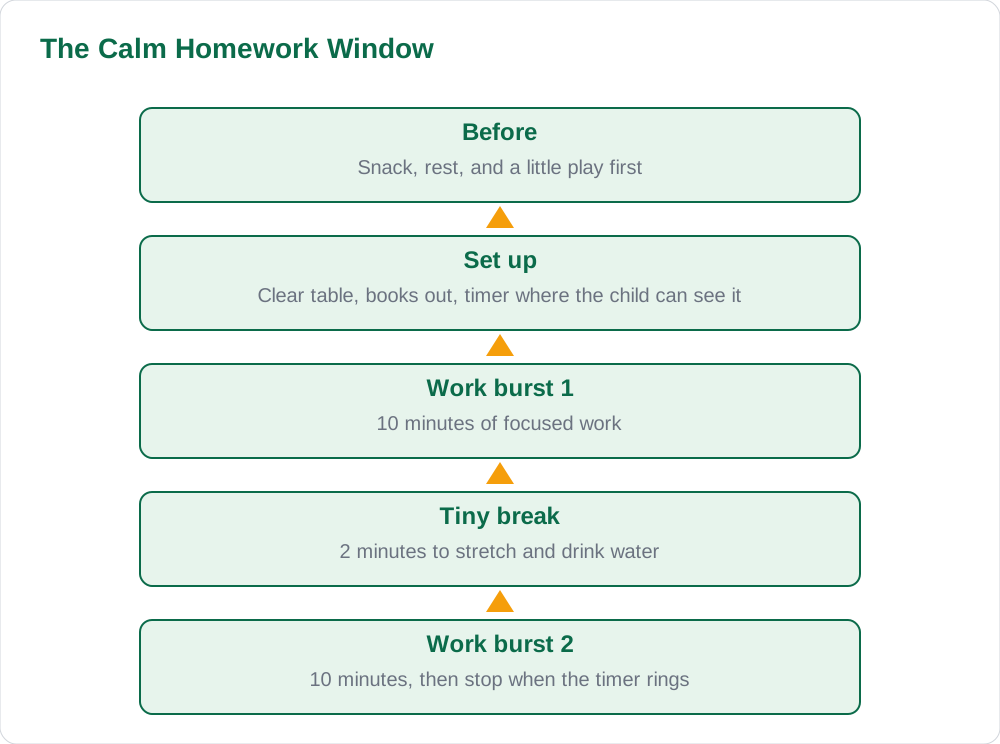
Set a fixed homework time and keep it every day, the same way school starts at a fixed time. For Classes 1 and 2, twenty minutes is enough. For Classes 3 and 4, thirty minutes is enough. Use a visible timer — a kitchen timer or a phone timer placed where the child can see it — so the end is real and not a matter of argument. When the timer rings, homework stops, even if a small part is unfinished. An unfinished page can be explained to the teacher; a nightly war cannot be undone.
Inside the window, work in short bursts with tiny breaks. A young child can focus well for about ten minutes, then needs two minutes to stretch, drink water, and reset. Two ten-minute bursts with a break between them feel much shorter than twenty unbroken minutes. If the child finishes early, the leftover time belongs to the child — never fill it with extra work, or the child learns that finishing fast only earns more work.
A Checklist the Child Can See
Young children cannot hold a whole evening of tasks in their heads. A simple written checklist — three or four items, each on its own line — turns homework from a vague mountain into a short list. Write it together at the start of the session: read page 12, copy five words, solve six sums. Let the child tick each item off as it is done. Ticking is satisfying, and the shrinking list shows the child that the end is coming.
Keep the checklist short and realistic. If the teacher has set more work than fits in the window, choose the most important items and note the rest for the teacher. A checklist with twelve items will defeat a seven-year-old before they start. A checklist with three items invites them to begin. For guidance on planning study time, see how to finish syllabus in 30 days — its planning ideas scale down well to daily homework.
- Write three or four tasks, one per line, at the start of the session.
- Let the child tick off each task as it is finished.
- If the work is too much for the window, pick the most important items and note the rest.
Praise First, Correct Second
The order of feedback matters enormously. When a parent looks at a page and starts with the mistakes, the child hears only that they failed. When the parent starts with what is right — three sums correct, neat handwriting on the first line, a word spelled correctly — the child feels seen, and then can hear one or two corrections without collapsing. The rule is simple: find two things to praise before you mention one thing to fix.
Corrections should be small and specific. Instead of saying the whole page is wrong, say: these two sums need another look, and this word needs its dot. Then let the child fix those two things themselves rather than watching the parent redo the work. A child who fixes their own mistake learns; a child who watches a parent fix it learns only that the parent will fix it. For more on building good habits, see how to make notes from Sindh Textbook Board books.
When Homework Is Too Much or Too Hard
Sometimes the problem is not the routine but the homework itself. If the child regularly cannot finish within the timed window, or cries over work they do not understand, that is information, not disobedience. Write a short, polite note to the teacher explaining what happened: how long the child worked, which part was hard, and what was left undone. Teachers would much rather know than receive a page completed by a parent at midnight.
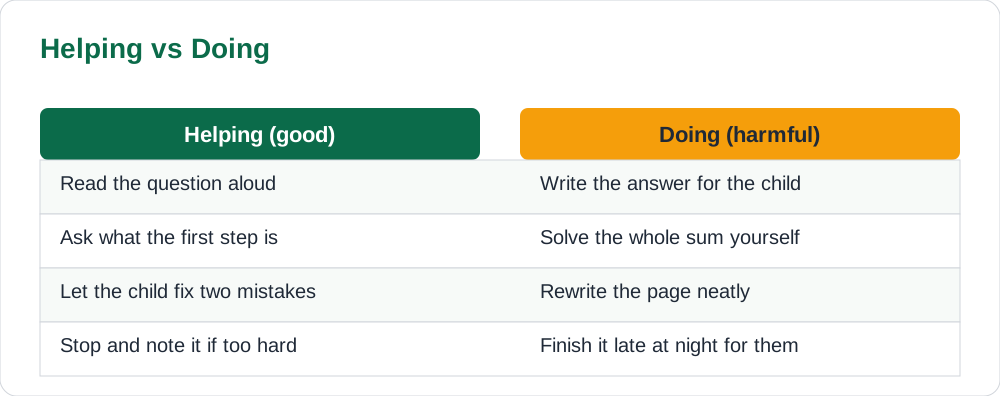
At home, never do the homework for the child. Helping means sitting nearby, reading the instruction aloud, and asking the child what they think the first step is. If the child truly cannot do it, stop and note it. Protecting the child's sleep and confidence is worth more than one finished worksheet. A child who trusts that homework time is safe will keep trying; a child who fears it will stop trying altogether. More tips for parents are on the blog.
AI Help: Muse AI
Muse AI is Meta's personal AI assistant. It can explain concepts simply, summarise a lesson, or make practice questions for your child's level.
For homework time, you can ask Muse AI to turn a homework task into a short child-friendly checklist, or to explain a homework question in simple words so you can guide your child without giving the answer.
Join Muse with invite code LTGSWD — in the Muse app, go to Settings > Redeem token and enter the code.
Disclosure: LTGSWD is the author's Muse invite code.
Muse AI does not give official Sindh Textbook Board answers — always verify against your Sindh Textbook Board book and your teacher.
5 key points you must know
- Fix a daily homework time — 20 minutes for Classes 1-2, 30 minutes for Classes 3-4.
- Use a visible timer so the end of homework is real, not argued over.
- Write a short checklist of three or four tasks the child can tick off.
- Praise two things before correcting one, and keep corrections small and specific.
- Never do the homework for the child — help, then stop and note it if it is too hard.
Frequently asked questions
What is the right time for homework after school?
After a snack, some rest, and a little play — usually one to two hours after coming home. A child who starts homework hungry or exhausted will struggle no matter how good the routine is.
Should I sit with my child during homework?
Sit nearby, especially for Classes 1 and 2, but let the child work. Your presence gives confidence; your constant interference takes away independence. Step back a little more each term as the child grows.
What if the teacher gives more homework than fits in the window?
Do the most important items, then stop and write a short note to the teacher. A polite note explaining the time spent and what was left undone helps the teacher adjust the load.
Should homework come before or after play?
A short play break first is better for most young children. They have sat all day at school; a little movement clears the mind. Keep the play short so homework still happens at its fixed time.
Is it fine to skip homework when my child is unwell or very tired?
Yes. One missed evening will not harm learning, but forcing work through tears will harm the child's attitude to homework. Write a brief note to the teacher and let the child rest.
Solved notes — preview free
These guides work best with the solved exercises. Preview the solved notes free on this website — 119 solved notes for Classes 6–10 in Sindhi, Urdu, English and Arabic medium. Or browse the full solved notes catalogue for your class and medium. New solved notes are added regularly — check the catalogue for coming-soon books.