Why BSEK Delayed the Matric Science Result for Super Checking
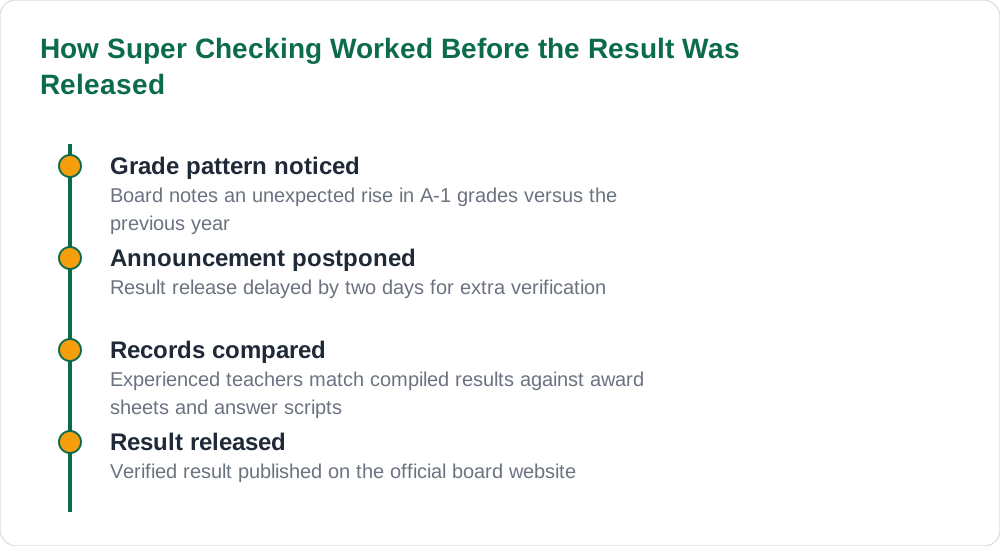
When a board result is delayed, students feel the wait most of all. In 2026, the Board of Secondary Education Karachi (BSEK) postponed the announcement of the Matric Science Group result by two days to run an extra verification process described by officials as super checking. The reason given was an unexpected rise in A-1 grades versus the previous year. Verification was assigned to experienced teachers who matched compiled results against award sheets and answer scripts. This article explains what happened, why boards delay results, what super checking actually involves, and what students should do while they wait. It does not present cheating allegations as established fact, because the verified record says only that officials cited the grade increase as the reason for the review.
What Happened: A Two-Day Delay for Extra Verification
BSEK postponed the announcement of the Matric Science Group result by two days so that an extra verification process could be completed before release. Officials described this process as super checking. The delay was short, but it felt long to students who had been waiting for months, and it raised questions on social media about what had gone wrong. The verified answer is less dramatic than many rumours suggested: the board saw a pattern it wanted to double-check, and it used the extra two days to check it before publishing results that thousands of students would rely on for college admission.
A two-day delay is a sign that a checking step exists, not a sign that every result is wrong. Boards handle hundreds of thousands of answer scripts, award sheets, and compiled entries, and even a careful system benefits from a final review when a figure looks unusual. The responsible response from students and parents is to wait for the official announcement on bsek.edu.pk rather than trusting forwarded messages. If you have now received your result, read our guide on how to check the BSEK Matric Science result for what to do next with your result card.
- BSEK postponed the Matric Science result announcement by two days
- The extra process was described by officials as super checking
- The delay happened before release, not after results were published
- Students should rely on the official website bsek.edu.pk for the result
Why the Board Ordered a Review: The Rise in A-1 Grades
The reason given for the review was an unexpected rise in A-1 grades versus the previous year. In the announced Matric Science result, more than 86,000 students secured A-1 and A grades in total, including 35,529 A-1 grades. When a grade count moves sharply in one year, a board has a duty to check whether the figures are correct before it publishes them. That duty exists whether the rise came from better preparation, easier papers, more generous marking, or a data-entry error, and the checking step is how the board separates a real trend from a mistake.
It is important to stay precise here. The verified record says that officials cited the grade increase as the reason for the review. It does not establish that cheating caused the increase, and this article does not present cheating allegations as established fact. Jumping from an unusual statistic to a conclusion about misconduct is unfair to the many students who earned high grades honestly. The correct response to an unusual figure is exactly what the board did: verify the data against the original records before publishing it.
- Reason given: an unexpected rise in A-1 grades versus the previous year
- More than 86,000 students secured A-1 and A grades, including 35,529 A-1 grades
- A sharp move in any grade count deserves verification before publication
- No cheating finding is established by the verified record
What Super Checking Actually Involves
Super checking, as described in the verified reports, means experienced teachers matching compiled results against the original records: the award sheets and the answer scripts. Think of it as a chain of evidence. The answer script is what the student wrote. The award sheet records the marks awarded for that script. The compiled result is the total that appears on the result card. If any link in that chain is wrong, the final result will be wrong too, so checkers compare each link against the one before it and look for mismatches, missing entries, or totals that do not add up.
This kind of checking is slow, careful work, which is why the board needed two extra days. A checker cannot simply glance at a spreadsheet and declare it correct. They must open the underlying records, compare figures, and resolve any difference before the result is released. That is also why boards use experienced teachers for the task: they understand marking schemes, award-sheet formats, and the kinds of errors that appear when large numbers of scripts are processed quickly. Students benefit from this care, because a result released after verification is more trustworthy than one rushed out with an error still inside it.
- Checkers compare compiled results with award sheets
- Award sheets are compared with the original answer scripts
- Mismatches, missing entries, and wrong totals are investigated
- Experienced teachers carry out the verification
What the Delay Means for Students and Parents
For students, the practical meaning of the delay is simple: the result you eventually received had passed one more layer of checking than usual. That does not make every individual result perfect, and boards still offer scrutiny and rechecking for students who believe a paper was marked unfairly. But it does mean the board took the grade pattern seriously enough to verify it before publication, which is what a responsible examination body should do. If your result surprised you, read our guide on how scrutiny and rechecking work in Sindh so you understand the process and its limits before you apply.
For parents, the delay is a reminder to judge results on evidence, not on rumours. A delayed result is not proof of a scandal, and a high grade is not proof of unfairness. The fairest response is to celebrate honest achievement, support the student whose result was disappointing, and ask the school for subject-wise guidance on what to do next. If a student passed, the next question is college and stream choice, covered in our guide on what to do after the Matric Science result. If a student missed a paper, the next question is the board rule for reappearance.
- The released result passed one extra layer of verification
- Scrutiny and rechecking remain available for students who dispute marking
- Judge results on evidence, not on social media rumours
- Celebrate honest achievement and support students who were disappointed
How to Handle Result Anxiety While You Wait
Waiting for a board result is stressful, and a delay makes it worse. The healthiest response is to separate what you control from what you do not. You cannot control when the board publishes, but you can control how you spend the waiting days. Use them to research college streams, gather your documents, and make a short plan for each possible outcome: what you will do if you pass with high marks, what you will do if you pass with modest marks, and what you will do if you need to reappear in a paper. Writing those three plans in advance turns anxiety into preparation.
Avoid the two habits that make waiting harder: refreshing unofficial pages every few minutes, and debating rumours in group chats. Both raise stress without giving you any reliable information. Check the official board website once or twice a day, and spend the rest of the time on something useful, such as revising a weak chapter or helping at home. When the result arrives, you will be glad you used the waiting time well. For more on steady habits, see our study tips collection and the Solved Notes for the subjects you plan to carry forward.
- Write a short plan for each possible outcome before the result arrives
- Check the official board website once or twice a day, not every few minutes
- Avoid rumour debates in group chats; they raise stress without facts
- Use waiting days to research colleges and revise weak chapters
AI Help: Muse AI
Muse AI is Meta's personal AI assistant, and it can help you make sense of board news by explaining terms like super checking and rechecking in simple words and summarising what a delayed result means for you.
Join Muse with invite code LTGSWD — in the Muse app, go to Settings > Redeem token and enter the code.
Disclosure: LTGSWD is the author's Muse invite code.
Muse AI does not give official STBB answers — always verify against your Sindh Textbook Board book and your teacher.
5 key points you must know
- BSEK postponed the Matric Science result announcement by two days for super checking.
- Reason given: an unexpected rise in A-1 grades versus the previous year.
- Experienced teachers matched compiled results against award sheets and answer scripts.
- No cheating finding is established by the verified record; only the grade increase was cited as reason for review.
- Students should rely on the official website and use scrutiny or rechecking if they dispute marking.
Frequently asked questions
Why did BSEK delay the Matric Science result 2026?
BSEK postponed the announcement by two days to run an extra verification process described by officials as super checking. The reason given was an unexpected rise in A-1 grades versus the previous year.
What is super checking?
Super checking means experienced teachers matching compiled results against award sheets and answer scripts, so that any mismatch, missing entry, or wrong total can be caught before the result is published.
Does the delay prove that cheating happened?
No. The verified record says only that officials cited the grade increase as the reason for the review. This article does not present cheating allegations as established fact.
What should I do if I disagree with my result after it was released?
Learn how scrutiny and rechecking work in Sindh, including the rules and deadlines, before you apply.
Where do I check the official BSEK result?
On the official board website bsek.edu.pk, by roll number. See our guide on how to check the BSEK Matric Science result.
Solved notes — preview free
These guides work best with the solved exercises. Preview the solved notes free on this website — 119 solved notes for Classes 6–10 in Sindhi, Urdu, English and Arabic medium. Or browse the full solved notes catalogue for your class and medium. New solved notes are added regularly — check the catalogue for coming-soon books.