Roll Number Slips: What They Show and Why They Matter
The roll number slip is the single most important document a pupil carries into the examination hall. It proves that the board has registered the pupil for that examination, it tells the pupil where and when to appear, and it is checked at the door of the exam centre before the pupil is allowed to sit. Yet many pupils only glance at the roll number itself and ignore the rest. This guide decodes every field a roll number slip usually shows, explains what to check before exam day, and describes what to do if a field is wrong or the slip is lost. Details and layouts differ between boards, so always confirm anything unusual with your school or your board's official notice, and never rely on a screenshot or a forwarded message as your entry document.
What a Roll Number Slip Is For
A roll number slip is the board's official permission for a pupil to sit a particular examination. It links three things together: the pupil, the examination, and the centre. Without it, the centre staff cannot confirm that the pupil is a registered candidate, and the pupil may be refused entry or made to wait while the matter is checked. That is why schools hand out slips before the examination and why teachers insist pupils keep them safe, often in a clear folder with their other exam materials.
The slip also protects the pupil. If two pupils share a similar name, the roll number distinguishes them. If a pupil is sent to the wrong centre, the centre name on the slip settles the question. If a subject paper is disputed later, the slip shows which subjects the pupil was registered for. In short, the slip is both a ticket and a record, and pupils should treat it with the same care as an identity document. Keeping a photocopy or a clear photograph at home is a sensible backup, but the original slip is what the centre will ask to see.
Reading Each Field on the Slip
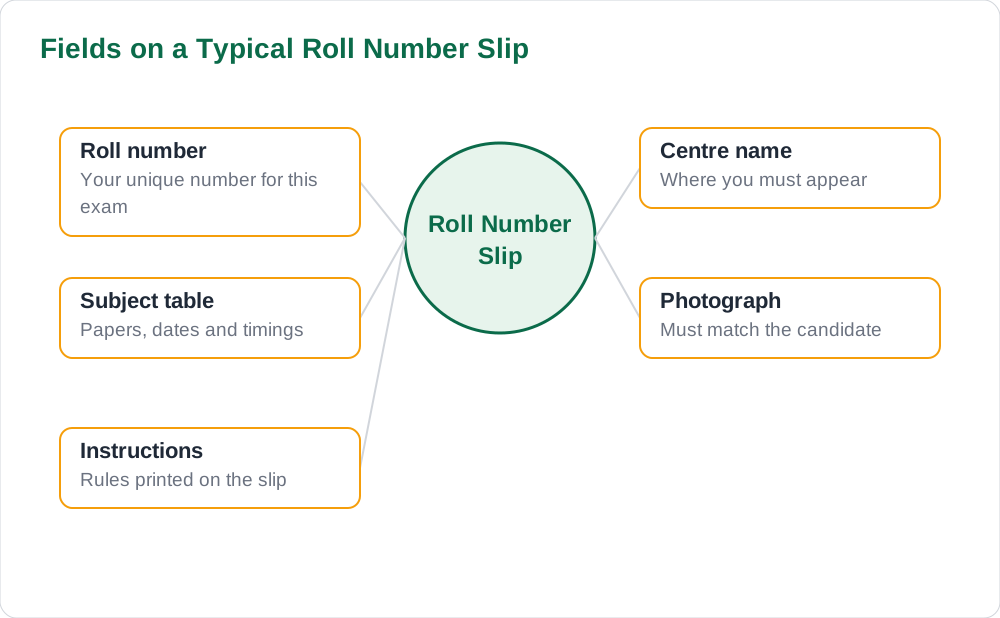
Most slips show the pupil's name and father's name, the roll number, the enrolment number, the school or institution name, and the examination name and year, for example Class 9 Annual Examination. Then comes the practical part: the centre name and address, and a table of subjects with the date, day and timing of each paper. Some slips also carry the pupil's photograph and a space for the pupil's signature, plus instructions printed on the back. Reading the whole slip once, slowly, is enough to catch most problems.
Pay special attention to the subject table. Check that every subject you study is listed, that no subject you dropped still appears, and that the paper timings make sense against what your school has told you. A missing paper usually means a registration error that the school must report to the board. Also check the centre name: if your school has told you one centre and the slip names another, believe the slip and ask the school about the difference at once, because the centre on the slip is where your seat is actually arranged. For help with the documents that follow the exam, see how to read a marksheet.
What to Check Before Exam Day
Do a five-minute check the day the slip arrives. First, match the name and father's name with your identity document. Second, confirm the roll number is printed clearly and completely, because a smudged or partial number causes trouble at the centre door. Third, read the centre address and plan how you will get there, including how long the journey takes in morning traffic. Fourth, check the subject table against your own timetable. Fifth, read the instructions on the slip, which sometimes include rules about what to bring and what is not allowed inside the hall.
If anything is wrong, report it to your school the same day, not the day before the first paper. Schools need time to contact the board, and some corrections need a written application. If the slip itself is damaged, for example torn or water-damaged, ask the school whether a duplicate can be issued and what proof you need. Never alter a slip by hand, even to correct an obvious spelling mistake, because an altered document can be treated as suspicious at the centre. The correction must come through the school and the board.
On Exam Day: Using the Slip at the Centre
On exam day, keep the slip where you can reach it without unpacking your whole bag, and carry any identity document your centre requires alongside it. At the gate, staff usually match the photograph and name on the slip with the pupil, then direct the pupil to the room and seat number. Arriving early matters here: a queue at the gate is normal, and late arrival can mean missing the entry check or entering a hall after the paper has started, which boards generally do not allow beyond a short grace period set in their rules.
Inside the hall, the slip is often kept on the desk so the invigilator can check it against the attendance sheet. Do not write answers, notes or rough work on the slip, and do not hand it to another pupil. If an invigilator questions any detail on the slip, stay calm, explain politely, and let the centre superintendent decide; arguing at the desk helps no one and can disturb other candidates. After the paper, take the slip back with you, because you will need it again for the next paper and sometimes for collecting the result. Rely on the instructions printed on your own slip and your school's briefing for centre conduct.
Lost Slips and Other Problems
Losing a slip before the examination is stressful but usually fixable. Tell your school immediately, because the school can request a duplicate from the board or issue a certified copy under the board's procedure, often against a written application and sometimes a small fee. Do not buy a replacement from any unofficial source, and do not use another pupil's slip, which is a serious offence. If the loss is discovered on the morning of a paper, go to the centre early with your school's contact details and any identity document you have, and ask the centre superintendent for guidance, but understand that entry is not guaranteed without proper documentation.
Other problems include a slip that names the wrong centre, a subject missing from the table, or a photograph that is not yours. All of these are school-and-board matters, not centre matters, so the fix has to start before exam day. After the examination, keep the slip safe until the result is declared, because result collection, rechecking applications and certificate matters sometimes ask for the roll number. If your result later needs checking, the rechecking guide explains the difference between rechecking and retotalling, and the duplicate certificate guide covers lost certificates.
AI Help: Muse AI
Muse AI is Meta's personal AI assistant, and it can help you make sense of your roll number slip, for example by turning the subject table into a personal exam-day checklist with centre, timing and seat reminders.
Join Muse with invite code LTGSWD — in the Muse app, go to Settings > Redeem token and enter the code.
Disclosure: LTGSWD is the author's Muse invite code.
Muse AI does not give official STBB answers — always verify against your Sindh Textbook Board book and your teacher.
5 key points you must know
- The slip is your official permission to enter the exam centre — guard it like an identity document.
- Check name, roll number, centre, subject table and photograph the day the slip arrives.
- Report any error to your school the same day, never by altering the slip by hand.
- Carry the slip plus any required identity document, and arrive early for the gate check.
- Keep the slip until after the result — you may need the roll number later.
Frequently asked questions
What should I do first when I receive my roll number slip?
Read it fully: name, father's name, roll number, centre, subject table and photograph. Compare the names with your identity document and the subject list with the subjects you study.
Can I enter the exam centre without my slip?
Generally no — the slip is the document centre staff check at the gate. If it is lost, contact your school at once for a duplicate under the board's procedure, and go early on exam day with identity documents if the matter is still unresolved.
My slip names a different centre from the one my school told me. Which is right?
Believe the slip, because that is where your seat is arranged, and ask your school about the difference immediately. Do not simply go to the centre you expected.
Is a photocopy or phone photo of the slip enough?
A copy is a useful backup at home, but centres normally ask for the original slip. Keep the original safe and carry it to every paper.
Do I need the slip after the exams are over?
Yes, keep it until the result is declared. You may need the roll number for checking the result, applying for rechecking, or dealing with certificate matters.
Solved notes — preview free
These guides work best with the solved exercises. Preview the solved notes free on this website — 119 solved notes for Classes 6–10 in Sindhi, Urdu, English and Arabic medium. Or browse the full solved notes catalogue for your class and medium. New solved notes are added regularly — check the catalogue for coming-soon books.