Didn't Clear All Six Papers? Your BIEK Pre-Engineering Recovery Plan

If your BIEK Pre-Engineering Part-I result, announced on 2 October 2026, shows fewer than six papers passed, you are far from alone, and you are far from finished. Out of 14,683 students who appeared, 6,310 passed all six papers, which means 8,373 students did not clear all six, spread across every possible count: 79 passed five papers, 747 passed four, 1,827 passed three, 1,864 passed two, and 1,783 passed one. Each of those groups faces a different recovery task, and the biggest mistake is treating them all as the same failure. This article builds your recovery plan from your own papers-passed count, explains the ungraded rule that may sit behind your result, and shows how scrutiny fits, or does not fit, into your next steps. Recovery is not a single road; it is a set of roads, and your count tells you which one is yours.
First, Read Your Result for What It Actually Says
Recovery starts with an honest reading of your result, and the gazette is the best place to do it, because it groups candidates by papers passed and lists marks paper by paper. Find your entry, note your papers-passed group, and write down, for each paper, whether you passed it and what mark you received. That simple list is your recovery map: the papers on it that you passed are finished business, and the papers on it that you did not pass are the whole of your remaining task. Students who skip this step often carry a vague sense of failure into their recovery, studying everything a little and nothing properly, while students who make the list study only what remains, with full energy.
Separate two different kinds of remaining papers as you list them, because they need different responses. A paper you narrowly missed, where your mark sits close to the pass line, usually needs revision and practice rather than relearning, and it is the quickest win in your recovery. A paper where your mark is far below the line, or where you scored under 40 percent and therefore fall under the ungraded rule, needs rebuilding from the foundations, and it deserves the largest share of your study time. Be honest about which kind each paper is, and ask a teacher to check your sorting if you are unsure, because a recovery plan built on a misdiagnosis wastes the very weeks it is meant to save. Use your college's help and the board's own record to confirm your entry, and the solved notes can support your rebuilding work. The earlier guide on reading a gazette explains the gazette's layout in general.
Planning by Papers Passed: From Five Down to One
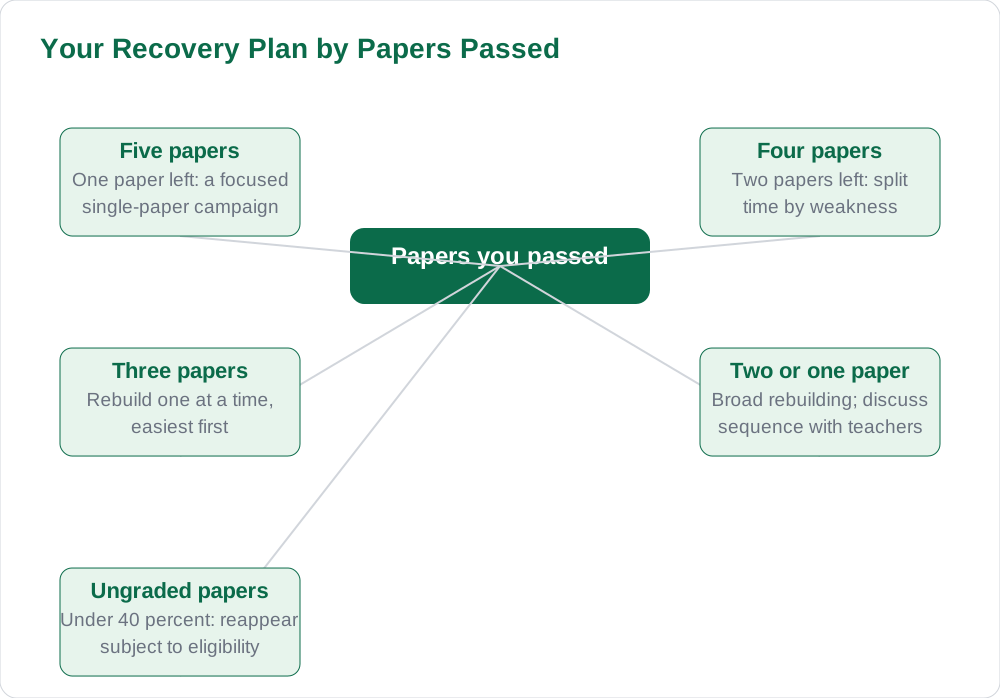
Your papers-passed count sets the scale of your recovery, and each count deserves its own plan. If you passed five papers, your task is narrow and focused: one paper stands between you and a complete result, so give that paper daily attention, practise its past papers intensively, and treat its examination as a single-paper campaign rather than a whole-year repeat. If you passed four papers, two papers remain, and your plan should split your time between them by weakness, giving the weaker paper more hours while keeping the stronger one warm with regular practice. In both cases, protect your passed papers by not neglecting them entirely in conversation, but do not waste study hours relearning what you have already passed.
If you passed three papers or fewer, your recovery is larger, and it needs a longer view and a steadier rhythm. With three papers passed, three remain, and the sensible approach is to rebuild them one at a time in order of difficulty, starting with the paper you came closest to passing, so that early progress builds confidence for the harder rebuilds. With two or one papers passed, the honest assessment is that your foundations need broad rebuilding, and you should discuss with your teachers whether your recovery runs alongside Part-II preparation, or whether a different sequence suits your situation better, since that decision depends on your college and your board's eligibility rules. Whatever your count, the principle is the same: the fewer papers you passed, the more your plan should emphasise foundations over shortcuts, and the more it should lean on teachers rather than on solitary struggle.
The Ungraded Rule: Under 40 Percent Means Reappear
Behind many recovery plans sits the new grading rule that BIEK applies under the IBCC and Sindh Universities and Boards Department decision: a candidate who scores under 40 percent in any paper is graded as ungraded in that paper, which means the paper is not passed, and the candidate reappears in that paper subject to eligibility. This rule changes how you should read a low mark, because a mark in the thirties is not a narrow miss to be nudged over the line by rechecking, but a paper to be genuinely relearned and reappeared in. Students who misunderstand the rule sometimes spend their recovery window chasing a checking error in a paper that actually needs rebuilding, and they lose the time that rebuilding required.
If one or more of your papers falls under the ungraded rule, make those papers the centre of your plan, and be realistic about what rebuilding them takes. Return to the textbook chapters behind the paper, work through them with a teacher's guidance, and practise until you can solve typical questions without help, because a reappearance that repeats the same preparation usually repeats the same result. Check your eligibility for reappearing with your college, since reappearance is subject to eligibility and the conditions are the board's, not yours to assume. The guide to the new grading system and the ungraded rule explains the rule's background, and your teachers can confirm how it applies to your specific papers.
Scrutiny: What Rs 1,000 Per Paper Buys — and What It Does Not
Scrutiny is the option students reach for first and understand least, so it deserves a plain explanation. BIEK's scrutiny fee is Rs 1,000 per paper, and no scrutiny deadline was published on BIEK's pages at the time of checking, which means you must confirm the current position with your college or the board rather than assuming a date. Scrutiny, like rechecking elsewhere, is a checking process: it verifies that your paper was handled correctly, and it does not re-mark your answers or rescue a paper whose answers were weak. It fits the student who has a specific reason to suspect a handling error in a particular paper, and it fits that student only.
Before paying Rs 1,000 for any paper, ask yourself whether you have such a reason. Did your mark in that paper fall far below your performance in class tests and your own sense of the examination? Did a teacher who knows your work find the mark surprising? Is there a specific anomaly, such as a paper whose total looks inconsistent with its parts? If you can answer yes with specifics, scrutiny may be worth the fee for that paper. If your honest answer is that the paper simply went badly, the fee is better spent on nothing at all, and the time is better spent rebuilding the paper for reappearance. Scrutiny and recovery are not alternatives; scrutiny checks the past result, while recovery builds the next one, and most students with papers to clear need the second far more than the first. For the Sindh process in detail, see scrutiny and rechecking in Sindh.
Your Recovery Timetable Without Invented Dates
A recovery plan needs a timetable, but this article will not invent one for you, because reappearance dates and second sittings depend on board eligibility and board announcements that this article does not presume. What you can timetable today is the preparation, and preparation timetabled well is what makes any future date workable. Divide your remaining papers into weekly blocks, giving each paper a set number of study days per week in proportion to its weakness, and end each week with a self-test on the papers you studied. Keep a simple log of what you covered and what you still cannot do, because that log becomes the evidence you show a teacher when you ask for help, and it keeps your recovery honest when motivation dips.
Alongside preparation, keep two administrative tasks on your list: confirming your eligibility for reappearance with your college, and confirming the current scrutiny position, including its fee and any deadline the board has since published, before you spend money on it. Both confirmations cost a single visit or message each, and both prevent the two costliest recovery mistakes, which are preparing for a sitting you are not eligible for, and paying for a process whose window has closed. Recovery is not glamorous work, and it rarely feels as good as a fresh start, but students who do it properly, paper by paper and week by week, routinely turn a partial result into a complete one. Your count tells you where you stand; your plan decides where you finish, and the plan starts with the next study session, not with the next announcement.
AI Help: Muse AI
Muse AI is Meta's personal AI assistant, and it can help you build a recovery plan by breaking a large task into weekly blocks and daily study targets.
For this article's topic, you can ask Muse AI to help you organise your remaining papers by weakness, or to quiz you on the chapters you need to rebuild.
Join Muse with invite code LTGSWD — in the Muse app, go to Settings > Redeem token and enter the code.
Disclosure: LTGSWD is the author's Muse invite code.
Muse AI does not give official STBB answers — always verify against your Sindh Textbook Board book and your teacher.
5 key points you must know
- 8,373 of 14,683 candidates did not clear all six papers: 79 passed five, 747 four, 1,827 three, 1,864 two, 1,783 one.
- Your papers-passed count sets your recovery scale, from a single-paper campaign to broad rebuilding.
- Under 40 percent in any paper means ungraded, and the candidate reappears subject to eligibility.
- BIEK scrutiny costs Rs 1,000 per paper, and no scrutiny deadline was published at check time.
- Scrutiny checks handling errors; it does not re-mark weak answers, so rebuilding remains the core of recovery.
Frequently asked questions
How many BIEK Pre-Engineering students did not clear all six papers?
8,373 of the 14,683 who appeared: 79 passed five papers, 747 passed four, 1,827 passed three, 1,864 passed two, and 1,783 passed one paper.
What does ungraded mean under the new grading rule?
Scoring under 40 percent in any paper means the paper is graded as ungraded, not passed, and the candidate reappears in that paper subject to eligibility.
What does BIEK scrutiny cost, and is there a deadline?
The scrutiny fee is Rs 1,000 per paper. No scrutiny deadline was published on BIEK's pages at the time of checking, so confirm the current position with your college or the board.
Should I apply for scrutiny or focus on rebuilding my papers?
Scrutiny only fits a paper where you have a specific reason to suspect a handling error. For most papers that simply went badly, rebuilding for reappearance is the useful path.
Can I reappear in my remaining papers?
Reappearance is subject to eligibility under the board's rules. Confirm your eligibility and the available sittings with your college before planning around a particular date.
Solved notes — preview free
These guides work best with the solved exercises. Preview the solved notes free on this website — 119 solved notes for Classes 6–10 in Sindhi, Urdu, English and Arabic medium. Or browse the full solved notes catalogue for your class and medium. New solved notes are added regularly — check the catalogue for coming-soon books.