How to Read the BIEK Pre-Engineering Gazette by Roll Number
The Board of Intermediate Education Karachi announced the HSC Part-I Science Pre-Engineering Group Annual Examination 2026 result on 2 October 2026, and for thousands of students the gazette is the document that actually settles the question of what they passed. Unlike the online result lookup, which shows one student at a time, the gazette is a college-wise record that lists roll numbers and marks and groups candidates by the number of papers they passed, under headings such as 6 Papers, 5 Papers and so on. Learning to read it properly matters, because a misread group heading can make a student believe they passed everything when they did not, or panic over a paper they actually cleared. This guide walks you through the gazette step by step, explains what each part of your entry means, and warns you about the unofficial topper lists that circulate every result season even though the gazette itself names no position holders at all.
What the Gazette Is — and What It Is Not
A gazette is the board's official published record of an examination result, organised college by college rather than student by student. In the BIEK Pre-Engineering Part-I gazette, each college's candidates appear together, with roll numbers and marks shown alongside the group heading that records how many papers each candidate passed. That structure is deliberate: colleges, teachers and students can all check a whole class at once, and any dispute about a result can be settled against the same published record. The gazette is not a merit list, not a ranking and not a celebration of toppers, and treating it as one is the first mistake students make when they open it.
The gazette also differs from the online result in an important way. The online lookup answers one question, which is what happened to your roll number, while the gazette answers the wider question of how your whole college performed and where your entry sits among your classmates. Both come from the same result, and if they ever seem to disagree, the board's own record is the one to trust and to query through proper channels. Keep in mind the scale of this result: 15,044 students registered, 14,683 appeared, and 6,310 passed all six papers, so the gazette is a long document and finding your entry takes a calm, methodical search rather than a quick scroll. For a general comparison of gazettes and online results, see gazette versus online result.
Step by Step: Finding Your Roll Number
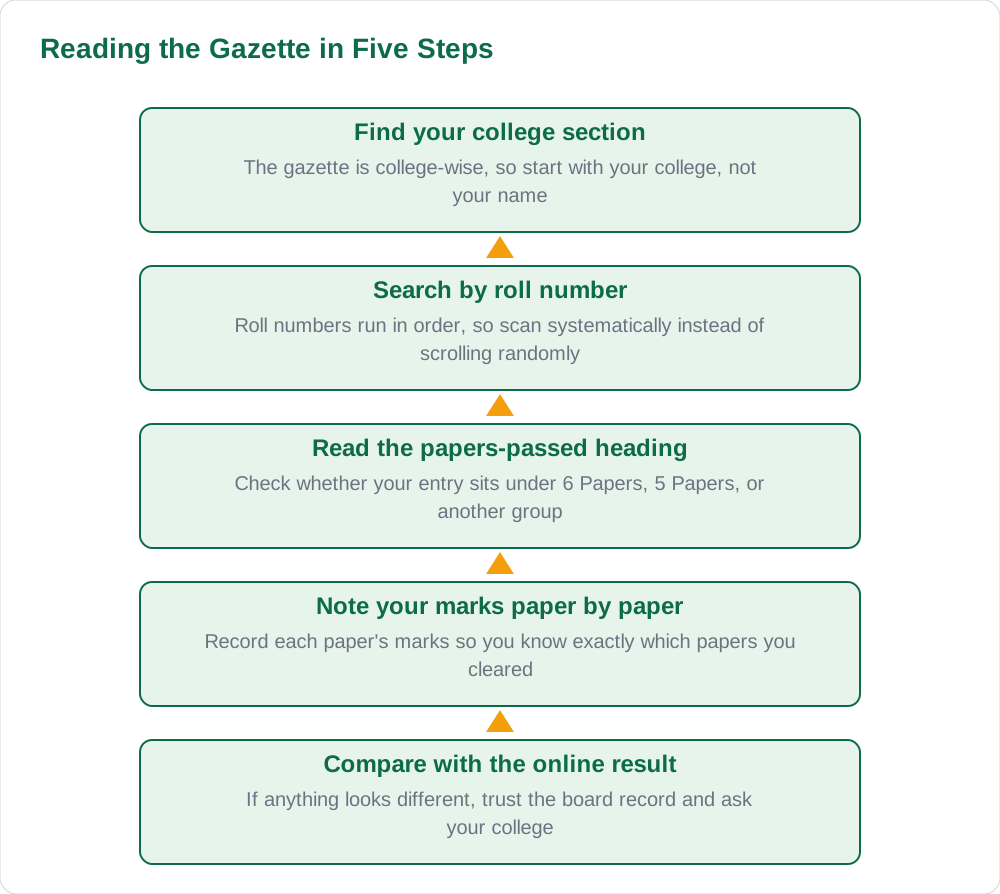
Start by confirming which college name the board has recorded for you, because the gazette is organised by college and a student who searches under the wrong college name will never find their entry. Open the gazette section for your college and work through the roll numbers in order, since they are listed systematically and a hurried scan easily skips a line. It helps to have your admit card or result slip beside you so you can match the full roll number digit by digit rather than relying on memory, and to mark your entry once you find it so you can return to it without searching again. If you are checking on a phone, use the document's search function for your roll number instead of scrolling through hundreds of entries.
Once you find your roll number, read the whole line before reacting to any single figure. Your entry sits under a group heading that states how many papers you passed, and your marks appear paper by paper, so the heading and the marks must be read together. A student under the 6 Papers heading has cleared all six papers, while a student under a lower heading still has papers to clear even if some individual marks look strong. Take a screenshot or a careful note of the full entry, including the college name and the group heading, because you may need it when you discuss your result with a teacher or apply for scrutiny. If you cannot find your roll number at all, do not assume the worst; check the spelling of your college name, check whether you are looking at the right group gazette, and then ask your college office to help.
Reading the Papers-Passed Groups
The papers-passed headings are the heart of the gazette, and they deserve more attention than any single mark. Under the 6 Papers heading sit the 6,310 candidates who passed all six papers, and below that heading the gazette groups the remaining candidates by five papers, four papers, three papers, two papers and one paper passed. These headings tell you, at a glance, how much of the examination you have completed and how much remains, which is exactly the information you need to plan your next step. A student who passed five papers has a very different recovery task from a student who passed two, and the gazette makes that difference visible without any guesswork.
Read your group heading together with your individual marks, because the two together explain your position completely. If your heading says you passed four papers, your marks will show which two papers you did not clear, and those two papers become the whole focus of your recovery plan. Do not let a strong mark in one paper distract you from a weak paper that still needs work, and do not let one weak paper overshadow five passes you have genuinely earned. Students who read the gazette this way walk away with a clear, honest picture: this is what I passed, this is what remains, and this is what I do next. That clarity is worth more than any rumour about how the class performed overall, and it is the reason the gazette remains the board's most useful result document.
Why There Are No Position Holders in This Gazette
One fact about this gazette surprises many students and parents: BIEK's gazette names no position holders and no toppers for the Pre-Engineering Part-I result. There is no first, second or third position list inside the document, and any list of toppers you see on social media, coaching advertisements or unofficial websites does not come from the gazette. Some of those lists are guesses dressed up as announcements, some are copied from other years or other groups, and some are simply invented to attract attention. Treating them as official can mislead students about their own standing and can cause real distress to students wrongly named or wrongly left out.
The safe rule is simple: if a topper claim does not come from BIEK itself, treat it as unverified and ignore it. The board's own portal, biek.edu.pk, is the only place to confirm what the board has actually announced, and your college notice board is the next best source because colleges receive the board's record directly. When friends forward a topper list, ask where it came from before you share it further, because forwarding an invented list spreads the same confusion to other students. Your result is defined by your own entry in the gazette, not by anyone else's claim about who stood first, and students who focus on their own papers-passed group plan their next steps far better than students who chase rankings that do not exist. The companion guide on reading the earlier gazette explains the same caution in more detail.
What to Do After You Read Your Entry
Once you know your papers-passed group, your next step depends on where you stand. If you passed all six papers, your focus shifts to Part-II preparation, and your Part-I marks become the foundation for choosing how hard to push in each subject. If you passed some papers but not all, list the remaining papers and treat each one as a separate, manageable task rather than as a single failure, because the gazette has already shown you exactly which papers need work. Students who are unsure about a total or who believe an answer went unmarked can consider scrutiny, and the board's scrutiny process is explained in the guide on scrutiny and rechecking in Sindh.
Whatever your group, discuss your entry with a teacher before you make any big decision, because teachers read gazettes every year and can spot misunderstandings quickly. Bring your noted entry, your marks paper by paper, and your questions, and ask plainly what your options are for the papers you did not clear. Keep your gazette note safe, because you may need it again when you apply for anything related to this result, and avoid sharing screenshots of other students' entries, since their results are their own business. Read carefully, plan honestly, and let the gazette do the job it was published to do: give every student a true, checkable record of their own result. The solved notes on this site can support your preparation for the papers that remain.
AI Help: Muse AI
Muse AI is Meta's personal AI assistant, and it can help you make sense of a gazette entry by walking through the papers-passed groups in plain language.
For this article's topic, you can ask Muse AI to explain what your papers-passed group means for your next study steps, or to help you draft the questions you want to ask your teacher about your remaining papers.
Join Muse with invite code LTGSWD — in the Muse app, go to Settings > Redeem token and enter the code.
Disclosure: LTGSWD is the author's Muse invite code.
Muse AI does not give official STBB answers — always verify against your Sindh Textbook Board book and your teacher.
5 key points you must know
- The BIEK Pre-Engineering gazette is college-wise and lists roll numbers with marks.
- Candidates are grouped by papers passed, under headings such as 6 Papers and 5 Papers.
- 6,310 candidates passed all six papers out of 14,683 who appeared.
- The gazette names no position holders, so unofficial topper lists are unverified.
- Read your group heading together with your paper-by-paper marks before planning next steps.
Frequently asked questions
How is the BIEK Pre-Engineering gazette organised?
It is organised college by college. Each college's candidates appear together with their roll numbers and marks, grouped under headings showing how many papers each candidate passed, such as 6 Papers or 5 Papers.
What does it mean if my entry is under the 6 Papers heading?
It means you passed all six papers of the Part-I Pre-Engineering examination. Students under lower headings passed fewer papers and still have papers to clear.
Why can't I find a topper list in the gazette?
Because BIEK's gazette names no position holders for this result. Any topper list you see elsewhere is unofficial and should not be treated as a board announcement.
What should I do if my gazette entry differs from my online result?
Trust the board's record, note both versions carefully, and ask your college office to help you clarify the difference through the board's proper channels.
When was the BIEK Pre-Engineering Part-I result announced?
The result was announced on 2 October 2026, with 15,044 students registered, 14,683 appeared and 6,310 passing all six papers.
Solved notes — preview free
These guides work best with the solved exercises. Preview the solved notes free on this website — 119 solved notes for Classes 6–10 in Sindhi, Urdu, English and Arabic medium. Or browse the full solved notes catalogue for your class and medium. New solved notes are added regularly — check the catalogue for coming-soon books.